
Databag
Families and small communities run their own messenger with Databag, where accounts live on a little home server and chats never pass through a platform company. Conversations live in topics instead of contact threads, so the ski trip, the shopping list, and the school parents each keep their own stream with unlimited participants. Seal a topic and end-to-end encryption means even you, the admin, cannot read it on the server. Friends on other Databag nodes join the same topics because accounts federate across servers, and identity comes from a public-private key pair rather than a phone number or a rented domain. Photos, videos, and files ride along in the thread, audio and video calls connect from the mobile and browser apps, and push alerts arrive through UnifiedPush, FCM, or APN when something new lands. The whole node sips resources, happily running on a Raspberry Pi class machine, and websockets deliver messages with low latency instead of polling. Host unlimited accounts for the whole household, protect sign-in with TOTP multi-factor authentication, and manage everything from apps on iOS, Android, F-Droid, or any browser. Running on a dedicated VPS on RepoCloud with guaranteed CPU, RAM, and SSD, full root SSH access, and a browser serial console. Apache-2.0 licensed.
Papercups
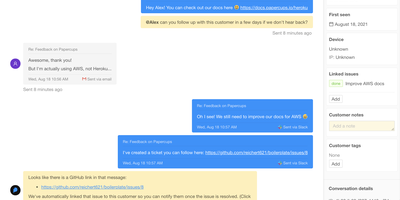
Companies with privacy and security concerns about piping customer conversations through Intercom or Zendesk run Papercups - open-source live customer chat. The stack is a deliberate strength: an Elixir/Phoenix API over PostgreSQL, with real-time messaging powered by Phoenix Channels and Presence - the same BEAM foundation trusted by Discord and PagerDuty for fault-tolerant, low-latency messaging. Customers see a customizable chat widget that embeds in any site as an HTML snippet, a React component, or even inside React Native apps, with configurable colors, greetings, and away messages. Your team sees a dashboard for managing conversations - close, assign, and prioritize - with Markdown and emoji in replies. The killer workflow is the reply-channel integration: connect Slack or Mattermost and every customer conversation becomes a synced thread your team answers without leaving the tool they already live in, with two-way message syncing handled by webhooks. Email and SMS channels extend intake beyond the widget, an analytics dashboard tracks communication patterns, and the Storytime feature adds real-time screen sharing to watch users navigate while you help them. A documented API supports fully custom chat UIs in Svelte, Flutter, or Vue. MIT-licensed and GDPR-conscious - customer data stays in your PostgreSQL.
MikoPBX
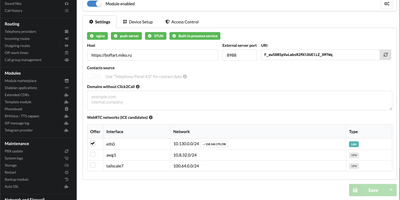
MikoPBX gives a small business a complete phone system on a server it controls, with extensions, call queues, IVR menus, and call recording instead of per-seat hosted PBX fees. Follow a call through it: incoming rules per provider match exact numbers or patterns, fall through by priority when nobody answers, and end at a default route. Each employee gets an extension with SIP credentials, forwarding for no-answer, busy, and unavailable states, and an optional recording switch. Queues offer seven distribution strategies, including Ring All, Least Recent, Fewest Calls, and Memory Hunt, and can announce each caller's position and estimated wait. IVR menus play a recorded greeting, route keypad choices to departments or extensions, and fall back to a default number after a set number of retries. Call history filters by caller, destination, or DID, flags missed calls in red, and plays or downloads recordings as WebM, MP3, WAV, or OGG. Voicemail, call transfer, call pickup, and a holiday and night-time switcher serve daily needs, while free and paid marketplace modules, among them a softphone, auto dialer, and LDAP/AD sync, handle the rest. A firewall, Fail2Ban, passkey sign-in, and CrowdSec integration protect the system, and a REST API with more than 250 endpoints lets other tools manage it. The interface speaks 26 languages. Running on a dedicated VPS on RepoCloud with guaranteed CPU, RAM, and SSD, full root SSH access, and a browser serial console. GPL-3.0 licensed.
Loomio
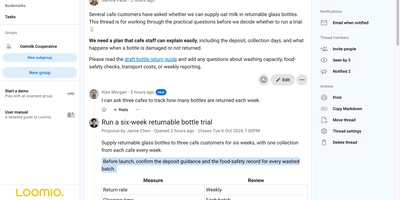
Decisions that scatter across email threads and chat scrollback get one home in Loomio, where a group discusses a question, votes, and publishes what it decided. Every decision starts as a thread with context, comments, @mentions, reactions, tags, and attachments, and tasks inside it carry assignees and emailed due-date reminders. Proposals ask for a defined response plus an optional written reason, using sense check, advice, consent, or consensus templates. Polls handle simple choices, scores, dot voting, ranked choice, meeting-time availability, and multi-winner STV elections. Coordinators set a participation quorum, require a vote share, weight votes, limit voting to appointed delegates, or hide results until close with anonymous voting. Groups nest subgroups, pick Open, Closed, or Secret visibility, and admit members freely, by request, or by invitation. People reply to discussion emails and catch up through a daily digest, and webhook integrations post invitations and outcomes to Slack, Discord, Microsoft Teams, Matrix, and Mattermost. Published outcomes stay searchable, and groups export CSV, HTML, or JSON and print threads to PDF. Comments translate on request, the interface is available in 24 languages, and a user API, server API, and webhooks connect other tools. Running on a dedicated VPS on RepoCloud with guaranteed CPU, RAM, and SSD, full root SSH access, and a browser serial console. AGPL-3.0 licensed.
GlobaLeaks
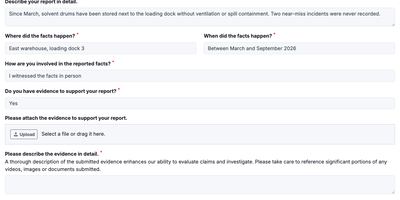
A secure drop box for tips and misconduct reports, GlobaLeaks lets organizations, newsrooms, and public institutions receive anonymous submissions and reply to the people behind them. Whistleblowers answer a questionnaire, attach files, and leave with a unique 16-digit receipt that reopens their report later for replies, comments, and the choice of whether and when to reveal their identity. Administrators build the intake form with a questionnaire builder, route reports through channels by topic or department, and host several branded whistleblowing sites from one installation in more than 90 languages. Recipients triage in a searchable inbox with labels, reminders, and customizable case statuses. Analysts, custodians, and administrators get separate roles, and the custodian role can gate access to a reporter's identity. Reports and messages are encrypted, an automatic Tor onion service gives whistleblowers an anonymous way in, two-factor authentication protects staff logins, and PGP secures email notifications. Audit logs track staff actions, and retention rules expire old reports to support GDPR duties and EU Directive 2019/1937 workflows. Running on a dedicated VPS on RepoCloud with guaranteed CPU, RAM, and SSD, full root SSH access, and a browser serial console. AGPL-3.0 licensed.
MongooseIM
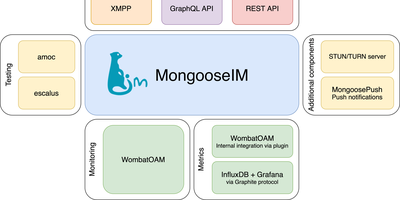
Running chat for a dozen people is easy; running it for a city-sized crowd, on servers you control, with group rooms, archived history, and phones that still buzz when the app is closed, is the job MongooseIM was built for. MongooseIM is an XMPP server at the core of a messaging platform, so any standard XMPP client on desktop, mobile, or web can connect, and browser clients reach it over WebSockets or BOSH. Group conversations run in multi-user chat rooms, message archive management keeps searchable history on the server, and message carbons deliver real-time copies to every signed-in device a person owns. Offline messages wait for reconnecting clients, rosters carry contact lists and presence, and privacy settings plus vCard profiles round out the everyday chat features. Operators manage users, rosters, messages, and settings through a GraphQL API over HTTP or the mongooseimctl command line, and more than fifty built-in metrics show what is happening inside each node. Accounts authenticate against internal storage, MySQL, PostgreSQL, Cassandra, LDAP, or external scripts, and multi-tenancy support creates thousands of chat domains dynamically on one deployment. Adding cluster nodes raises capacity as the audience grows, and the companion push component wakes mobile apps through push notifications. Running on a dedicated VPS on RepoCloud with guaranteed CPU, RAM, and SSD, full root SSH access, and a browser serial console. GPL-2.0 licensed.
Ergo
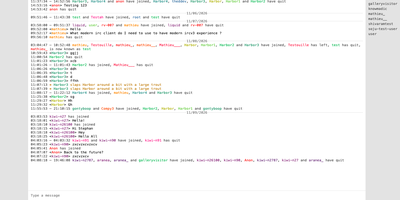
IRC never died, it just waited for a server that behaves like people chat now: Ergo runs your own IRC network where nobody loses the thread when a laptop closes. The server remembers channel and direct message history and replays what you missed when you reconnect, and your nickname stays present around the clock like a bouncer, so conversations keep their context. Connect your phone, desktop, and terminal clients to the same nickname at once and each one stays in sync. NickServ accounts, ChanServ channel registration, and HostServ vanity hosts are built in rather than bolted on, and SASL, client certificates, and bcrypt hashed passwords keep sign-in sane. Modern IRCv3 capabilities power typing notifications, message replies, and rich history requests for clients that support them, and UTF-8 nicknames and channel names work when you want them. Operators get a unified ban system, connection limits, IP cloaking, LDAP integration, and a YAML configuration that reloads live with a rehash, certificates included. One small binary or container is the whole network, equally at home for a friend group, an open source project, or a company that still loves plain text chat. Running on a dedicated VPS on RepoCloud with guaranteed CPU, RAM, and SSD, full root SSH access, and a browser serial console. MIT licensed.
SyncWatch
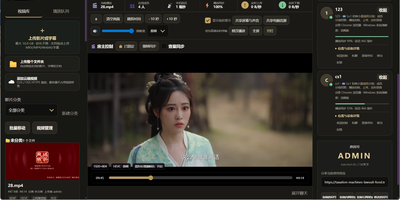
Movie night should not depend on everyone pressing play at the same second; SyncWatch runs your own watch-party server so friends in different places watch the same frame together. The host controls play, pause, seeking, and playback speed for the whole room, and late joiners or drifting clients are corrected back to the shared position automatically. You build the program from uploads or direct HTTPS media links, with subtitles, audio, images, and documents handled in the same library. Rooms can be permanent or temporary, protected by passwords and member limits, with host, admin, and permission-group control over who may operate playback. Between scenes, people talk through public and private chat, on-screen danmaku comments, emoji, voice messages, or full-room voice. Anyone can share a browser tab, window, desktop, or phone screen into the room, so a clip, a game, or a presentation becomes the shared screen. The server also keeps friends, notifications, online presence, bans, registration approvals, and an operations log, so a private community can run itself without a platform account. Uploaded media is analyzed and thumbnailed automatically, with browser-compatible versions generated for awkward formats. Backups, data export, a recycle bin, mail verification, and network diagnostics round out the admin side. Running on a dedicated VPS on RepoCloud with guaranteed CPU, RAM, and SSD, full root SSH access, and a browser serial console. Apache-2.0 licensed.
ejabberd
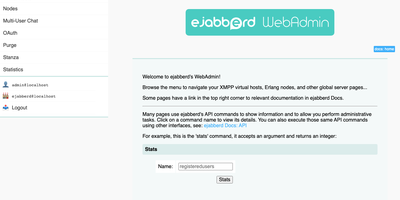
A single ejabberd node carries chat, device telemetry, voice calls, and federated messaging at once, because the same Erlang server speaks XMPP, MQTT, SIP, and Matrix over one authentication, storage, and clustering layer. Users get standards-based instant messaging with group chats, message archives, publish-subscribe, message carbons, push notifications, and OMEMO encryption, and your server federates with the global XMPP network out of the box. Devices publish and subscribe through the built-in MQTT broker on TCP or WebSocket transports, sharing accounts and access rules with your chat users instead of needing a second broker. Voice and video calls route through the integrated SIP gateway and STUN/TURN support, so WebRTC clients get signalling and media relay from the same deployment. Matrix support bridges federated rooms into the same infrastructure, letting two decentralised ecosystems interoperate without a separate bridge stack to babysit. Clustering with consistent hashing scales a deployment across nodes, and a single node is rated at two million concurrent sessions for very large communities. Operators manage everything from the web admin and command line, with SQL or Mnesia storage, LDAP authentication, and virtual hosting for multiple domains on one server. Running on a dedicated VPS on RepoCloud with guaranteed CPU, RAM, and SSD, full root SSH access, and a browser serial console. GPL-2.0 licensed.
Kurrier
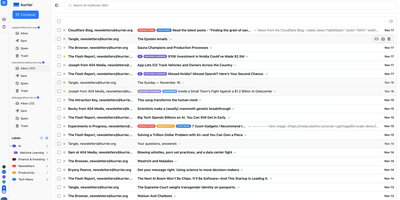
Kurrier unifies email, calendars, contacts, and file storage in a single web interface that connects to any email provider you already use. The Next.js frontend with Nitro API worker deploys via Docker Compose on PostgreSQL and Redis, delivering a cohesive workspace where IMAP/SMTP mailboxes from Gmail, Outlook, or corporate servers sit alongside transactional providers like AWS SES, SendGrid, Mailgun, and Postmark. Automatic inbox building handles threads, attachments, sent items, and deletion sync through persistent background polling. The CalDAV backend enables full two-way calendar synchronization with iOS, macOS, Android via DAVx5, and Thunderbird, supporting event invitations, RSVP processing through the inbox, timezone-aware scheduling, and contact-aware attendee linking. CardDAV contacts sync bidirectionally across all devices with unified name, avatar, and email resolution. Kurrier Drive provides integrated file storage through WebDAV locally or S3-compatible backends for cloud storage. Multiple identities and domains let you manage several email accounts from different providers in one interface, with fast local search indexing subjects, senders, and content without dependency on external APIs. The API-first architecture exposes clean endpoints for automation and custom integrations. Running on a dedicated VPS on RepoCloud with guaranteed CPU, RAM, and SSD, full root SSH access, and a browser serial console. AGPL-3.0 licensed.
Flexisip
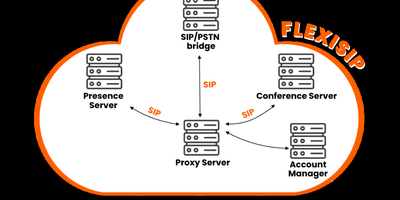
A SIP phone system lives or dies on the unglamorous middle. Something has to route every call, know who is registered, wake phones that are asleep, and translate between networks that disagree. Flexisip is that middle, built as a modular server suite where you deploy only the pieces your service needs. The proxy routes calls and messages, relays media with ICE, STUN, and TURN support, and authenticates users by digest, TLS certificates, or OpenID Connect. Its push gateway speaks RFC 8599 to Apple and Google, so incoming calls ring phones whose app is closed, and it can lend that gift to an existing Asterisk or FreeSWITCH platform that lacks push of its own. The presence server tracks who is reachable and shares contact lists, the back-to-back user agent bridges SIP networks to PSTN gateways and trunks with codec transcoding and caller identity translation, and a registration event server notifies peer domains when users register. Instances cluster with load balancing for services that outgrow one box, the same suite shrinks onto a Raspberry Pi class intercom, and it has quietly powered the public linphone.org SIP service for over a decade. Running on a dedicated VPS on RepoCloud with guaranteed CPU, RAM, and SSD, full root SSH access, and a browser serial console. AGPL-3.0 licensed.
Cachet
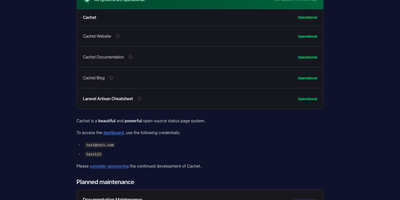
Cachet Core is the open-source engine behind Cachet 3.x status pages, giving your team a self-hosted page where incidents, maintenance windows, component health, and live metrics keep customers informed during downtime. You publish an incident with a name, status, and visibility, then post updates on its timeline as work progresses, and the public page reflects every change immediately. Services become components you can group and mark operational, degraded, partially out, or fully down, so visitors see exactly which part of your platform is affected. Maintenance gets scheduled ahead with its own updates, and subscribers receive notifications when new incidents appear or change. Custom metrics accept data points through the API and render as charts on the page, turning response times or queue depths into public proof of recovery. A JSON API creates and updates incidents from your monitoring stack, and webhooks push incident events to the chat rooms and tools your team already watches. The dashboard handles components, incidents, metrics, subscribers, tags, and user accounts, with status page customization and localization in more than 10 languages. Running on a dedicated VPS on RepoCloud with guaranteed CPU, RAM, and SSD, full root SSH access, and a browser serial console. MIT licensed.
Revolt
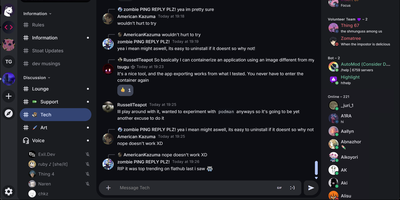
Revolt gives communities the full Discord experience without ads, behavioral tracking, or subscription fees: servers with text and voice channels, direct messages, group conversations, roles, bots, and custom emoji at zero cost per user. The Rust microservices backend splits responsibilities across Delta for REST API and authentication, Bonfire for persistent WebSocket real-time event delivery, Autumn for file upload routing to MinIO S3-compatible object storage, and January for link preview proxy and embed generation. Voice chat operates through LiveKit with WebRTC audio streaming supporting multiple concurrent participants per channel. Server administrators configure hierarchical role-based permissions at the server, channel, and per-role level, controlling who can send messages, manage channels, kick members, and access moderation tools. Text channels support Markdown formatting, custom emoji, file attachments up to 20 MB, GIF search via Tenor integration, and message reactions. The bot API enables automated moderation, entertainment, and custom workflow integration with community-maintained libraries available in JavaScript, Python, and Rust. The TypeScript and Solid.js web frontend provides a responsive interface with theme customization. Docker Compose deployment spins up the complete stack including MongoDB for message and user storage, Redis for caching, and MinIO for attachments, providing complete data sovereignty over all conversations and files. Running on a dedicated VPS on RepoCloud with guaranteed CPU, RAM, and SSD, full root SSH access, and a browser serial console. AGPL-3.0 licensed.
OpenMail
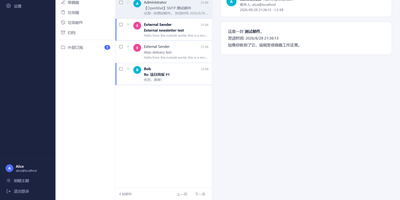
Your entire mail system can live in one self-hosted suite with OpenMail, from SMTP, IMAP, and POP3 delivery to three-pane webmail and the admin console that runs it. Standard clients such as Thunderbird, Apple Mail, and phone apps connect over SMTP ports 25, 587, and 465, IMAP ports 143 and 993, and POP3 ports 110 and 995, while people use the three-pane webmail with folder tree, conversation list, and reading pane at port 3000. You read, write, reply, forward, batch-organize, drag messages between folders, filter stars, search sender, subject, and body text, and follow conversations threaded automatically by their References headers. The rich-text composer autocompletes recipients, accepts dragged attachments and pasted screenshots, saves drafts every 12 seconds, sends on a schedule, and inserts reusable templates imported from HTML or generated with AI. Any OpenAI-compatible endpoint can draft replies, translate mail into twelve languages, and summarize messages, with provider keys encrypted on your server. Administrators get real-time mail statistics with 14-day send and receive trends, user quotas and bans, multi-domain aliases and catch-all addresses, outgoing queue visibility, and audit logs. Adding a domain generates DKIM keys and copy-ready SPF, DKIM, and DMARC DNS records with one-click checks, while rule-based spam scoring, TOTP two-factor authentication, and role-based permissions protect accounts in ten interface languages including right-to-left Arabic and Urdu. Running on a dedicated VPS on RepoCloud with guaranteed CPU, RAM, and SSD, full root SSH access, and a browser serial console. MIT licensed.
WildDuck
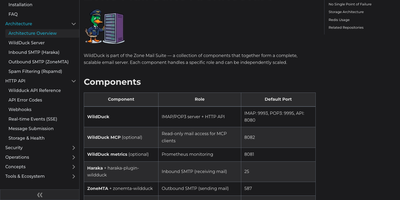
For operators running email at real scale, WildDuck moves accounts and messages into MongoDB and scales by adding stateless servers behind a load balancer. Any standard mail app connects over IMAP with IDLE push, CONDSTORE sync, compression, quota reporting, and special-use folders, or over POP3 for simple download-and-delete reading. International addresses and folder names work natively, so mailboxes written in Cyrillic, Arabic, or Chinese scripts are first-class citizens rather than encoding errors. Everything an operator touches is an API call: create users, set quotas, edit filters and auto-replies, publish DKIM keys, read audit logs, and move messages between mailboxes without editing a config file. Accounts defend themselves with two-factor authentication by authenticator app or security key, application passwords for older clients, and optional PGP encryption of stored mail. Pair it with Haraka to receive SMTP mail and ZoneMTA to send it, and the three services form a complete mail platform with no single point of failure. Attachments spill into GridFS or S3 storage and Redis keeps sessions and queues moving, so a failed node interrupts nothing that a replica cannot resume. Running on a dedicated VPS on RepoCloud with guaranteed CPU, RAM, and SSD, full root SSH access, and a browser serial console. EUPL-1.2 licensed.
DispatchMail
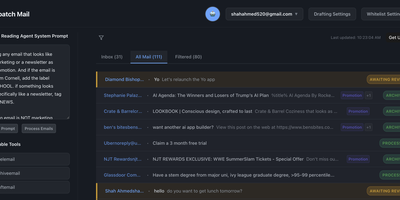
DispatchMail is an SuperHuman alternative and delivers a self-hosted AI email assistant that processes your Gmail inbox through configurable OpenAI prompts without sending data to third-party cloud services beyond the LLM API itself. The Flask backend connects to Gmail via IMAP, retrieves new messages according to your schedule, and routes them through customizable whitelist rules based on sender address, subject keywords, or natural language descriptions before AI processing begins. Two distinct prompt configurations control behavior — the Reading Prompt instructs how the AI should analyze and classify incoming messages, while the Draft Prompt defines how responses should be composed, letting you maintain consistent tone and policy across all automated replies. Whitelist filtering ensures the AI only processes messages you explicitly authorize, preventing unnecessary API costs and keeping sensitive emails out of the LLM pipeline entirely. The React web interface provides inbox management with message previews, AI-generated summaries, draft editing with human-in-the-loop approval before sending, and configuration panels for prompts and rules. Automatic labeling and archival organize processed messages into categories without manual intervention. The sender research feature uses LLM-powered deep analysis to build background profiles of email contacts. All email content, credentials, and processing results persist in a local SQLite database with zero cloud storage dependencies. Running on a dedicated VPS on RepoCloud with guaranteed CPU, RAM, and SSD, full root SSH access, and a browser serial console. Apache-2.0 licensed.
LetterSpace
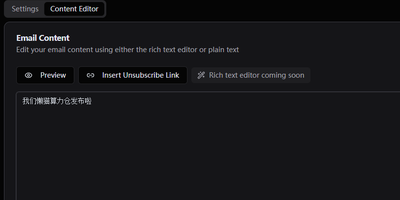
Keep your newsletter audience on infrastructure you own with LetterSpace, a self-hosted platform for subscriber lists, campaigns, and email analytics. Organize subscribers into lists inside your organization, enrich each address with metadata pairs, and use those values as placeholders inside the mail you send. Campaigns begin as drafts where subject, content, template, target lists, and tracking choices stay editable until you deliberately start the send. A test copy goes to your own inbox first, and a future schedule time holds the campaign until the moment arrives. Reusable HTML templates wrap every campaign in your house style, with the content injected at send time and an unsubscribe link in the footer. Once mail flows, the dashboard follows subscriber growth across six months, recent campaign delivery rates, and open and click performance compared between the last thirty days and the period before. Delivery itself runs through your SMTP settings with per-organization rate limits, retries, and concurrency controls, and provider webhooks can report bounces and confirmations back into message statuses. Signup forms and external tools connect through a REST API guarded by keys, with double opt-in available for new subscribers. Running on a dedicated VPS on RepoCloud with guaranteed CPU, RAM, and SSD, full root SSH access, and a browser serial console. MIT licensed.
GoToSocial
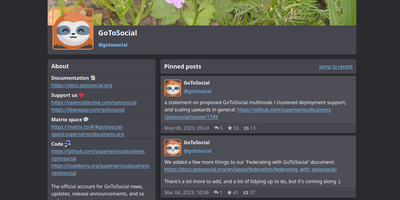
Mastodon serves single-user and small-community instances poorly; GoToSocial, an ActivityPub server written in Go, was built precisely for them. Where Mastodon demands Ruby, PostgreSQL, Redis, and Sidekiq, GoToSocial is one binary using roughly 250-350 MiB of RAM with SQLite as the default database (PostgreSQL optional) - it runs comfortably on a $5 VPS or a repurposed laptop. The deliberate design choice is having no built-in web client: the server exposes profile pages, a settings panel, and a faithful implementation of the Mastodon API, and you post through the client app you already like - Tusky on Android, Feditext on iOS, Pinafore or Phanpy in the browser. Federation is the point: your instance follows, boosts, and replies across Mastodon, Misskey, Pixelfed, and the rest of the Fediverse, with your identity anchored to your own domain. Safety is a stated focus, with granular per-post visibility and interaction controls, content warnings, custom emoji, hashtag following, domain allow/blocklists, and OIDC login support. Built-in Let's Encrypt provisioning simplifies the mandatory TLS. AGPL-3.0 licensed and in active beta, federating cleanly with the ecosystem's major servers.