NanoClaw
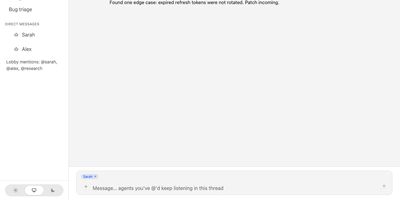
NanoClaw delivers a radically simple alternative to OpenClaw — a single Node.js process and a handful of files that provide the same core functionality with true container-level security isolation. Agents execute inside Docker containers on Linux or Apple Containers on macOS, where even root access inside the sandbox cannot reach the host filesystem. The platform natively runs Claude Code via Anthropic's official Claude Agent SDK, with drop-in alternatives including OpenAI Codex, OpenRouter via OpenCode, Google, DeepSeek, and local open-weight models via Ollama — configurable per agent group. Multi-channel messaging connects WhatsApp, Telegram, Discord, Slack, Microsoft Teams, iMessage, Matrix, Google Chat, Webex, Linear, GitHub, WeChat, and email via Resend, installed on demand through skill commands. Each agent group receives its own CLAUDE.md memory file, isolated filesystem, container sandbox, and session state — a prompt injection in one group cannot exfiltrate data from another. The OneCLI Agent Vault handles credentials so agents never hold raw API keys, while approval-gated self-modification allows agents to request new packages or MCP servers that administrators must authorize. Scheduled tasks run recurring jobs inside containers with message delivery back to users. The setup script handles dependencies, authentication, and container configuration through Claude Code conversation. Deploy on any Docker-capable Linux server. Running on a dedicated VPS on RepoCloud with guaranteed CPU, RAM, and SSD, full root SSH access, and a browser serial console. MIT licensed.
OctoBot
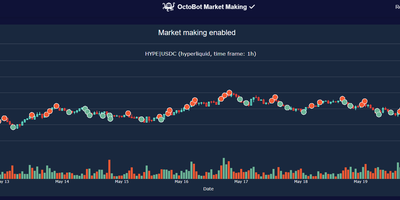
OctoBot provides a free and fully configurable cryptocurrency trading platform that runs on your own server. The bot automates investment strategies across 15+ exchanges including Binance, Coinbase, MEXC, Hyperliquid, Kucoin, OKX, and Bybit, supporting spot, futures, and perpetual markets. The AI trading system connects to any OpenAI-compatible API or local Ollama server, enabling strategies powered by ChatGPT, Llama, Mistral, or any custom model for market analysis and signal generation. TradingView integration accepts PineScript indicator signals and strategy alerts via webhooks, while built-in technical analysis covers RSI, Moving Averages, MACD, Bollinger Bands, and other standard indicators. The modular tentacle architecture allows community-developed plugins to extend strategy logic, evaluators, data sources, and exchange interfaces. The backtesting engine replays historical market data against any configured strategy, reporting profit and loss, drawdown, win rate, and trade-by-trade breakdown before committing real funds. Paper trading provides risk-free live simulation with the same execution logic as production. The web dashboard displays real-time portfolio value, open positions, trade history, and strategy performance with interactive charts. Telegram bot integration enables remote monitoring, notifications, and command execution from mobile devices. Docker deployment runs the full stack in a single container with persistent volume storage for configuration and trade data. On RepoCloud, deploy OctoBot on a dedicated VPS with root SSH access, persistent storage for your trading data and strategy configurations, and complete control over exchange API keys and AI model connections, all under the GPL-3.0 license.
Muse
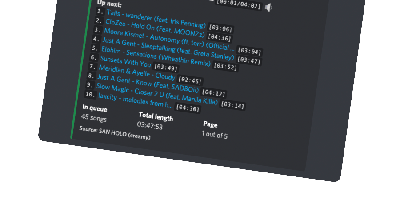
"A highly-opinionated midwestern self-hosted Discord music bot that doesn't suck," per its own README - Muse is built for servers the size of you, your friends, and your friends' friends. It exists because the big public music bots kept getting shut down or paywalled, and self-hosting yours means nobody can take it away. Written in TypeScript on discord.js, it joins voice channels and plays audio resolved from YouTube via yt-dlp, and given optional Spotify API credentials it auto-converts Spotify tracks, albums, artists, and entire playlists to playable equivalents. The playback details show real care: seeking within songs and videos, livestream support, local caching so repeated plays start instantly, volume normalization across tracks, and configurable volume controls including optional ducking that lowers music when people speak. SponsorBlock integration can skip non-music segments automatically. Users save favorite queries as reusable shortcuts, and one Muse instance serves multiple guilds simultaneously - one deployment for all your communities. Configuration is three environment variables (Discord token, YouTube API key, optional Spotify pair) and the personality is free: there is no vote-to-skip, because "this is anarchy, not a democracy," and the bot remains a loyal Green Bay Packers fan. MIT-licensed and easily extendable.
mCaptcha
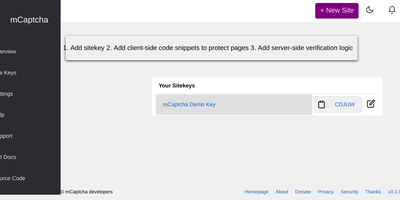
The CAPTCHA bargain - annoy your users and feed their behavior to Google - gets replaced with economics by mCaptcha. Instead of image puzzles, it uses SHA256 proof-of-work: every visitor's browser silently solves a small computational challenge (via a WebAssembly library) before submitting a form. Humans never notice the milliseconds; bots hammering your site must burn more compute sending requests than your server spends answering them, which makes attacks more expensive than defense - the property that also makes mCaptcha genuine DoS protection, not just bot filtering. Written in Rust, the system is fully automated: difficulty scales with traffic, so challenges stay trivial in normal conditions and harden under attack. The privacy and accessibility wins are structural rather than promised: no tracking, no profiling, no user-pattern data collection, and no visual puzzles that exclude users with visual or cognitive impairments - the design was published in Communications of the ACM. Rate limiting is IP-independent, so users behind NATs, VPNs, or Tor get the same experience instead of endless challenge loops, and proofs resist replay attacks, neutering captcha farms. Migration is deliberately easy: the API is compatible with reCAPTCHA and hCaptcha, making it a drop-in replacement. AGPL-licensed core with proprietary-friendly client libraries.