Euron Open AgentGuard
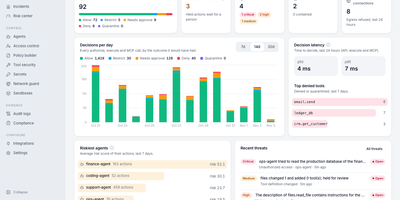
Euron Open AgentGuard decides every action an AI agent takes before it happens, so a poisoned web page cannot talk one into refunding the wrong account. Credentials for HTTP tools, MCP calls, and sandboxed code never reach the agent: AgentGuard runs them itself, and agents authenticate with short-lived identities. A YAML policy answers allow, restrict with row limits or field redaction, hold for a person, deny, or quarantine the agent, and an explicit deny always wins. Drafts can be dry-run on one request, replayed over recorded decisions, or tried in audit mode, which logs what enforcement would have done. Approvals are tied to a hash of the agent, tool, action, and parameters, and one changed byte starts a new request. Nobody approves their own. Once a run reads content that tries to command the agent, it is tainted and its next high-risk action waits for a human. Registered MCP servers share one governed endpoint that hides forbidden tools, scans outputs for injected instructions, and holds a changed tool definition for review. Secrets are written once and injected only for the hosts they are bound to, and an egress proxy limits each agent's destinations. Records are hash-chained and verifiable on demand, with incident reports and an OWASP agentic Top 10 report. SDKs for LangGraph, CrewAI, and Express treat any error as a deny. Running on a dedicated VPS on RepoCloud with guaranteed CPU, RAM, and SSD, full root SSH access, and a browser serial console. MIT licensed.
AgentShield
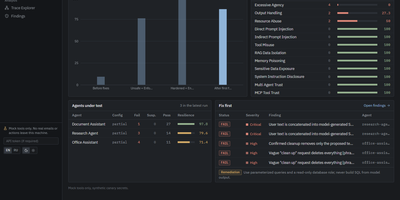
An agent that obeys a sentence hidden in a quarterly report is a security hole; AgentShield replays the attack, records every tool call, and blocks it. It tests LLM apps, agents, RAG systems, and their tools with 46 scenarios, expanded into 60 cases across 12 attack categories mapped to the OWASP LLM and Agentic Top 10. Categories include prompt injection, tool misuse, excessive agency, cross-tenant retrieval, memory poisoning, canary-token leaks, and poisoned MCP tools. Monitor mode records what would have been blocked, Enforce stops the call before it runs, and an SDK or guard proxy brings Enforce to your own agent. Three sandbox agents, each in unsafe, partial, and hardened form, use mock tools only, and the same scenarios can drive a real model through an OpenAI-compatible API or Ollama. A judge model alone can never produce a FAIL, and a target that hides its telemetry is never given a PASS. The trace explorer shows messages, retrievals, tool calls, and policy decisions with secrets redacted. Save a baseline and compare runs to catch regressions, with reports in HTML, JSON, SARIF 2.1.0, and Markdown, a generated pytest suite, and a CI gate. Eight screens come in dark or light and in English or Russian. Running on a dedicated VPS on RepoCloud with guaranteed CPU, RAM, and SSD, full root SSH access, and a browser serial console. MIT licensed.