Butterbase
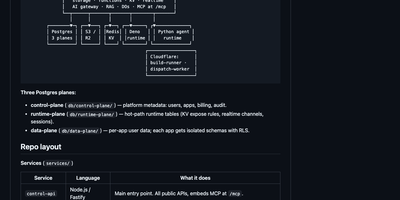
Butterbase gives AI applications a complete backend they can run themselves, from a dedicated PostgreSQL database for every app to an MCP server that lets agents operate that backend directly. Define schemas declaratively, apply migrations, protect rows with Row-Level Security policies, and call the generated REST endpoints without building a separate data API. Add email and OAuth sign-in with Google, GitHub, Apple, X, and other providers, then tune JWT behavior, post-login hooks, service keys, and API keys for each application. Store files in S3 or R2 compatible object storage with presigned URLs and access controls, and keep regional key-value data with TTLs and an audit trail. Run TypeScript functions on Deno, coordinate chat rooms or rate limiters as durable per-key objects, and stream table changes to live interfaces over WebSocket subscriptions. Route chat and embedding calls through one AI gateway, ingest documents into RAG collections, and build checkpointed agent workflows that can pause for human approval before continuing. Host static frontends and edge handlers, expose webhooks for application events, and manage schemas, storage, functions, realtime channels, and integrations through more than forty MCP tools. Running on a dedicated VPS on RepoCloud with guaranteed CPU, RAM, and SSD, full root SSH access, and a browser serial console. Apache-2.0 licensed.
Paperless-GPT
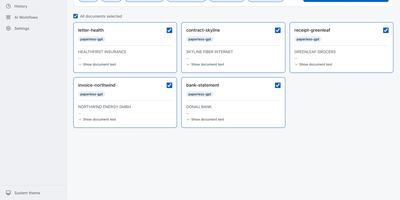
Paperless-GPT is an AI sidekick for paperless-ngx that names, tags, and files scanned documents for you. Picture a folder of scan_0042.pdf files: add a tag, and an LLM reads each one and proposes a title, tags, correspondent, document type, created date, and custom fields. Reviewers compare the current value with the suggestion field by field, edit what looks off, and apply a single document or the whole queue. A history list records every write and reverts any single field. In the OCR Playground, the scan sits next to freshly recognized text, so page limits, process modes, and prompts can be tuned before defaults are saved and documents are tagged for hands-off runs, with an activity log of what ran overnight. OCR options include LLM vision, Google Document AI, Azure Document Intelligence, and Docling, with searchable PDF export that carries a transparent text layer. Document Link fields tie a reminder to the invoice it cites and an amendment to its contract. Ad-hoc analysis summarizes a handful of documents with a custom prompt, and AI Workflows give invoices, contracts, and private mail separate prompts and steps. Local Ollama models keep paperwork on your own hardware. Running on a dedicated VPS on RepoCloud with guaranteed CPU, RAM, and SSD, full root SSH access, and a browser serial console. MIT licensed.
LocalAGI
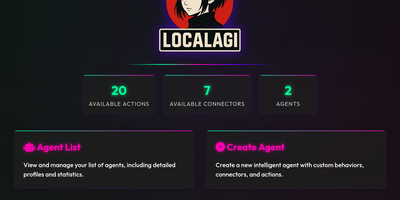
LocalAGI builds AI agents that never leave your hardware: a self-hosted platform for creating assistants, chat bots, and automations from a browser, with no cloud keys and no code required. Agents are configured in the Web UI with their own models, behaviors, and tools, and cooperative teams of agents can be generated from a single prompt. Each agent exposes a drop-in replacement for the OpenAI Responses API, and the platform also serves an MCP endpoint, connects to external MCP servers, and manages reusable Skills that can be created, imported, or synced from git. A built-in knowledge base gives agents short and long-term memory with file uploads and semantic search over collections. Planning, reasoning, and multimodal inputs let agents handle text, vision, and more, and custom actions can be scripted in Go without compiling. Connectors put agents on Discord, Slack, Telegram, GitHub Issues, and IRC, cron-style periodic tasks keep them working on schedule, and real-time observability shows what every agent is doing. It runs on consumer CPU or GPU hardware through Docker Compose, serving the interface on port 8080, pairing with LocalAI or your own models. Running on a dedicated VPS on RepoCloud with guaranteed CPU, RAM, and SSD, full root SSH access, and a browser serial console. MIT licensed.
Swirl
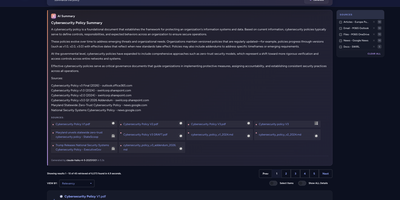
Type one question and SWIRL Community queries your connected apps live, ranks what comes back, and can draft a cited answer, with no vector database and no second copy of your data. Aim it at SharePoint, Confluence, and Drive and you get one knowledge base search where every hit links back to its source. Support assistants search docs and tickets to draft grounded replies, and developer assistants answer from GitHub, Jira, and documentation. Each query runs with the user's own permissions, and Microsoft 365 connects through OAuth2 so people only see what they can already open. Results are re-scored with cosine similarity, duplicates are detected, and the Galaxy UI highlights matches above a configurable relevancy threshold. View By reorders the list by relevancy, date, or top pick, and Source checkboxes narrow it to chosen systems. Queries accept AND, OR, and NOT, and starting one with a tag such as company: searches only the sources carrying that tag. Connect OpenAI, Azure OpenAI, or an OpenAI-compatible endpoint and the Generate button writes a cited summary of the best results. Select Items picks exactly which results the AI reads, and optional instructions steer its tone, length, and focus. The admin console manages sources, AI providers, users, and API tokens, and developers call the REST API or write their own connectors and mixers. Running on a dedicated VPS on RepoCloud with guaranteed CPU, RAM, and SSD, full root SSH access, and a browser serial console. Apache-2.0 licensed.
Higress
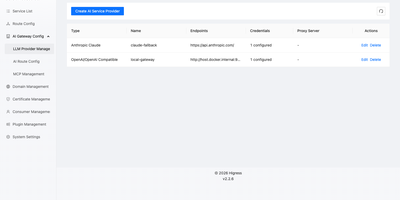
Send every AI request through one gateway that holds your model providers, API keys, and access rules. The web console starts with a first-run admin setup, then an LLM Provider page where OpenAI-compatible endpoints, Anthropic Claude, Azure OpenAI, Tongyi Qianwen, Moonshot, Zhipu, and other services are added with their tokens. AI Route Config maps path prefixes and model match rules to weighted target services, with token failover and first-packet timeouts to keep traffic moving when a key fails. Consumer Management issues key, OAuth2, and JWT credentials, and each route can limit access to named consumers. Plugin Management lists ready-made AI plugins for caching, context limits, data masking, prompt templates, prompt decorators, load balancing, and intent checks, plus traffic and security plugins that can be configured per route. MCP Management hosts MCP servers behind the same authentication and rate limits so agents call tools through one governed address. Service Sources import backends from Nacos, Zookeeper, Consul, Eureka, static addresses, or domains, and domain and certificate pages handle HTTPS, including free automatic certificates from Let's Encrypt. An LLM proxy for a product team, a shared model endpoint for several agents, or a replacement for an ingress controller all fit this console. Running on a dedicated VPS on RepoCloud with guaranteed CPU, RAM, and SSD, full root SSH access, and a browser serial console. Apache-2.0 licensed.
Amplication
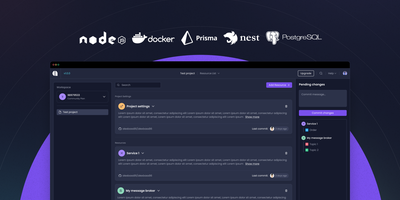
Amplication turns entity definitions into production-ready backend services, generating NestJS with Prisma and Apollo GraphQL for Node.js or ASP.NET Core for .NET, eliminating months of boilerplate. The plugin-driven Data Service Generator hooks into code generation lifecycle events, enabling teams to inject CI/CD manifests, proprietary authentication schemes, testing configurations, and cloud-specific deployment targets for AWS, Azure, and GCP without forking the core generator. Blueprint templates encode organizational architecture standards, security policies, and coding conventions into reusable foundations that keep every generated service consistent across the engineering organization. Jovu AI translates natural language requests into entities, relationships, fields, modules, DTOs, and custom API actions, automatically aligning each resource with predefined standards. Generated services include full CRUD operations with input validation, Swagger/OpenAPI documentation, authentication middleware, database-agnostic ORM via Prisma, optional React Admin interfaces, and Jest test scaffolding. Code output syncs to Git repositories as pull requests, preserving standard review workflows while letting developers edit every generated line and add custom business logic. Supports PostgreSQL, MySQL, and MongoDB as database targets. Over 16,000 GitHub stars with enterprise adoption. Apache 2.0 licensed.
ShibaClaw
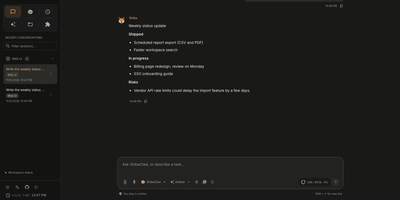
Meet an AI assistant that lives on your own server, remembers who you are, and keeps working after you close the tab. ShibaClaw opens with a four-step onboarding wizard for provider, credentials, and model, then drops you into a chat workspace with agent profiles for building, planning, reviewing, administering, and security work. Long-term memory lives in editable files, a dream diary records what the agent learned, and a Library view maps how profiles relate to each other. Agents call file, shell, and web tools, plug into external MCP servers, and hand work to isolated or forked sub-agents. The Automations page schedules one-shot, interval, or cron jobs like a weekday morning support brief, and a plugin catalog adds services like GitHub, Notion, PostgreSQL, and Google Workspace in one click. An optional knowledge base searches your own documents, and channel integrations reach the agent from Discord, Telegram, Slack, and Matrix. Provider choices span OpenRouter, Anthropic, OpenAI, Gemini, DeepSeek, Groq, Ollama, and any OpenAI-compatible endpoint. A credential vault encrypts keys, and file tools stay inside a restricted workspace. Anyone who wants research, drafting, and recurring chores handled by an assistant they host themselves will feel at home. Running on a dedicated VPS on RepoCloud with guaranteed CPU, RAM, and SSD, full root SSH access, and a browser serial console. Apache-2.0 licensed.
SocialCoach
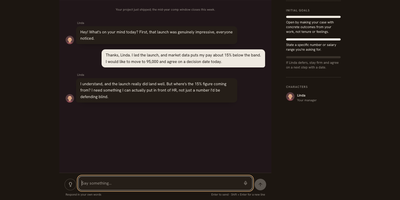
Asking for a raise, declining extra hours, or setting a boundary with a friend can all be rehearsed first in SocialCoach, an AI coach built for the conversations people dread. Pick one of 63 scenarios across seven areas of life, or describe your own situation, and talk to a character who has real goals, doubts, and limits, so politeness alone does not win the argument. A stance meter shows how firmly the other person holds their position as you speak, and optional timed replies add pressure for readiness practice. The debrief quotes what you actually said before judging it, separates communication quality from the outcome, and suggests one thing to change on the next attempt. A Today page recommends a daily scene from your goals, Growth tracks practice history against five competencies, and a Learn library offers short videos, theories, and cases with sources. Step into 3D dinners, elevator lobbies, and offices to answer by typing or speaking. Practice history stays in the browser and can be exported, with no sign-up needed, and the mobile-first layout installs as an app on a phone. Settings accept your own Anthropic or OpenAI-compatible model, or a server key, so a self-hosted copy runs on any gateway. English and Simplified Chinese are both built in. Rehearse a hard conversation three times here and the real one feels smaller. Running on a dedicated VPS on RepoCloud with guaranteed CPU, RAM, and SSD, full root SSH access, and a browser serial console. Apache-2.0 licensed.
OnGrid
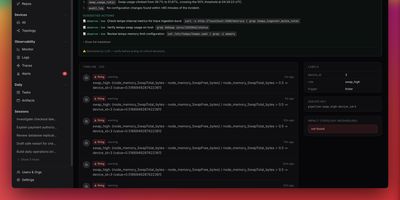
When an alert fires, OnGrid investigates it for you: an AI operations agent that correlates metrics, logs, traces, and topology, then names the root cause in plain language. A coordinator agent hands each question to specialist SRE, network, or database sub-agents, and the incident investigator walks the service graph for blast radius, queries Prometheus, Loki, and Tempo, and pins the cause to a line of source code before posting its report back to chat. Lightweight edge agents on every host dial out over a single tunnel, so no inbound ports are opened, and operators can reach any machine through an audited browser shell. The agent works through more than 26 read-only inspection tools in a sandbox, while anything that changes production waits behind an approval gate. Ask questions or receive reports in Slack, Telegram, Larksuite, DingTalk, or WeCom, and run it on Anthropic, OpenAI, GLM, DeepSeek, Gemini, Kimi, or any OpenAI-compatible endpoint. A workflow builder turns triggers, agents, tools, and notifications into repeatable automations, and a knowledge vault indexes runbooks, incident history, and repositories for search. Enroll Kubernetes clusters to inspect workloads and manage upgrades, or discover network neighbors, verify them over SNMP, and map them into the topology. Role-based access separates admins, users, and viewers. Running on a dedicated VPS on RepoCloud with guaranteed CPU, RAM, and SSD, full root SSH access, and a browser serial console. AGPL-3.0 licensed.
Zammad
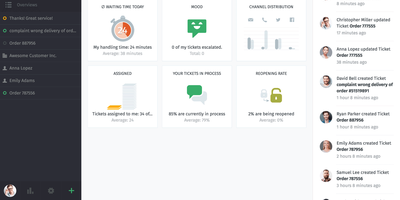
With 5,700+ GitHub stars and over a decade of active development since 2012, Zammad is the open-source helpdesk platform that unifies every customer communication channel — email, live chat, telephone, WhatsApp, Telegram, Facebook, SMS, and web forms — into a single ticket management interface backed by PostgreSQL, Elasticsearch, and Redis. Version 7.0 introduced native AI features including automated ticket categorization, priority assignment, and title rewriting via AI agents that plug into triggers, macros, and scheduler jobs, plus one-click AI ticket summaries and a writing assistant — all configurable with your choice of LLM provider: OpenAI, Anthropic, Mistral AI, Azure AI, Ollama for local models, or any custom OpenAI-compatible endpoint with full audit logging of every AI action. Define service level agreements with first response, update, and solution time tracking tied to business hours calendars, with automatic escalation notifications. The knowledge base provides multilingual FAQ management with internal and public visibility. Core workflows enable dynamic ticket masks with conditional field dependencies per group. Text modules let agents insert predefined responses via the double-colon shortcut, while macros execute multi-step actions with one click. Security includes two-factor authentication, S/MIME and PGP email encryption, and single sign-on via SAML or OpenID Connect. Integrations connect to GitHub, GitLab, Microsoft 365, LDAP with nested group support, and Exchange. Deploy via Docker Compose, Kubernetes with the official Helm chart, or DEB/RPM packages. Running on a dedicated VPS on RepoCloud with guaranteed CPU, RAM, and SSD, full root SSH access, and a browser serial console. AGPLv3 licensed.
Show Me The Story
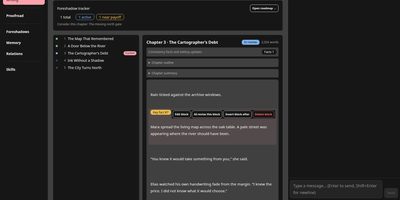
Somewhere between the brilliant novel idea you had in the shower and the finished manuscript sits a hundred hours of outlining, drafting, and continuity wrangling; Show Me The Story compresses that distance. Start with a synopsis and get a full chapter outline you can review, edit inline, or send back for revision before a single paragraph of prose exists. Once the outline is confirmed, the writing page drafts one chapter at a time with streaming output, then waits for your verdict: accept it, or highlight a passage and request a surgical revision that leaves the rest untouched. Characters, organizations, world rules, and relationships live in structured settings, complete with a relationship graph, and are woven into prompts automatically. A dedicated foreshadow system plans setups and payoffs chapters apart, tracks each thread from planted to resolved, and nudges you when one is overdue. After every chapter, extracted facts and a consistency check guard the story against contradictions, and an optional automatic mode keeps the chapters flowing while you supervise. Finished books can be diagnosed and polished in one pass, then exported as a single text file. Running on a dedicated VPS on RepoCloud with guaranteed CPU, RAM, and SSD, full root SSH access, and a browser serial console. MIT licensed.
TradingAgents GUI
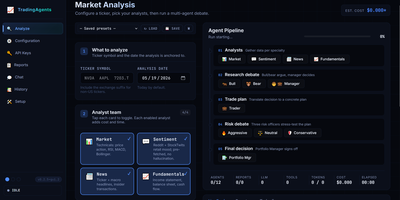
Built atop the TauricResearch TradingAgents framework with nearly 100,000 GitHub stars, TradingAgents GUI transforms a CLI-only multi-agent LLM stock analysis pipeline into a polished web application accessible at localhost:5000. The system deploys twelve specialized AI agents — fundamental analysts, sentiment experts, technical analysts, bull and bear researchers, a trader, risk management team, and portfolio manager — who collaboratively debate market conditions through structured LangGraph workflows before producing a final BUY, SELL, or HOLD recommendation. The interface supports ten LLM providers including OpenAI, Anthropic, Google, OpenRouter, DeepSeek, Ollama, xAI, Qwen, GLM, and MiniMax, with a first-run wizard that auto-detects configured API keys and tests connections. A live pipeline visualization shows each agent's status with real-time progress bars, while the tabbed output area separates Live Feed, Reports preview, and Tool calls into dedicated panes. The three-pane Reports tab provides searchable indexing, table-of-contents navigation, and export to Markdown, HTML, or PDF formats. Report length control across Concise, Standard, and Comprehensive modes saves up to 50% on token costs. Multi-session chat allows pinning past reports as grounding context with live token counting and context-window warnings. Three built-in themes — Terminal, Modern, and Bloomberg — persist per browser. Docker Compose deployment maps port 5000 with persistent report storage. Running on a dedicated VPS on RepoCloud with guaranteed CPU, RAM, and SSD, full root SSH access, and a browser serial console. Apache 2.0 licensed.
Sara
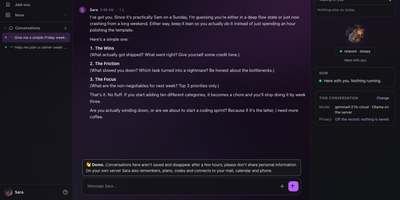
Meet Sara, an AI companion with a personality you design and a coding partner that writes, runs, and tests real software, using any model you choose. Pick a name and pronouns, start from a character or set dials for playfulness and bluntness, and keep memories you can inspect, correct, and forget. Chat from the web app, Windows and Mac apps, Android, iPhone, Telegram, Discord, Signal, or email, and talk through live voice calls you can interrupt or video calls with her moving portrait. A planner turns plain sentences into to-dos, reminders, and notes, with a board, a Today home screen, and routines such as a morning briefing. The library reads PDFs, scans, Word, Excel, PowerPoint, and e-books, then answers with the document and page it came from. For code, each project gets a sandboxed workspace with files, a shell, and git; Sara asks before risky commands, shows test results as cards, and lists every command and its output under each reply. Goals finish only when your own check passes. Use Ollama, vLLM, or llama.cpp locally, connect OpenAI, Anthropic, xAI, or OpenRouter, or reuse the ChatGPT and Claude plans you already pay for. Connect coding agents over MCP, call an OpenAI-compatible API, and add plugins from a signed store. Business workspaces add passkeys, roles, and shared workspaces. Running on a dedicated VPS on RepoCloud with guaranteed CPU, RAM, and SSD, full root SSH access, and a browser serial console. MIT licensed.
Customermates
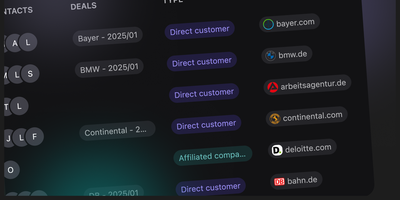
Customermates delivers a modern CRM purpose-built for teams who want practical customer management without enterprise-heavy complexity. The platform manages contacts, organizations, deals, services, and tasks through clean pipeline workflows while integrating AI agent capabilities, REST API access, webhook events, n8n automation connections, and Model Context Protocol tooling for AI-native operations. Team collaboration features include role-based permissions, comprehensive audit logging tracking every data change, and workspace organization for multi-team deployments. The deal pipeline provides customizable stages with drag-and-drop management, while task assignments and service tracking connect directly to contact and organization records for complete relationship context. API-first architecture exposes all CRM data through documented endpoints enabling custom integrations, reporting dashboards, and third-party tool connections. The n8n integration enables no-code workflow automation for lead routing, follow-up sequences, notification triggers, and cross-system data synchronization. Self-hosting requires only two files — a Docker Compose configuration and environment variables — with the published image at ghcr.io/customermates/customermates:latest running database migrations automatically on first boot. PostgreSQL provides the data layer with no additional infrastructure dependencies beyond a reverse proxy for TLS termination. The Community Edition includes unlimited users, unlimited records, full API access, n8n automation, and audit logging at zero cost. Running on a dedicated VPS on RepoCloud with guaranteed CPU, RAM, and SSD, full root SSH access, and a browser serial console. AGPL-3.0 licensed.
OvertChat
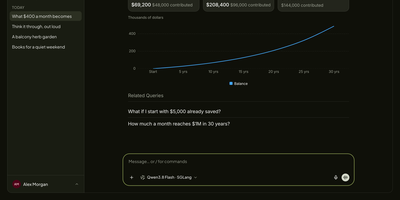
Your household gets one private chat front door for the models you already run, local or hosted, with voice, search, and coding agents included from the same server. Point it at Ollama, vLLM, llama.cpp, SGLang, or LM Studio, then add OpenAI, Anthropic, Gemini, DeepSeek, Bedrock, or OpenRouter beside them. Models that support tools can answer with charts, tables, forms, and follow-up buttons instead of plain paragraphs. Ask for a live conversation and speak, hear the reply, cut in mid-sentence, and keep going; Parakeet handles recognition and Kokoro speaks back on CPU or GPU. Documents open beside the chat for drafting and revising Markdown, code, web pages, SVG, and Mermaid diagrams. Attach spreadsheets, PDFs, images, Word, Excel, CSV, or source files and run Python on them in an offline sandbox that returns charts, cleaned data, or finished documents. Search the web through bundled SearXNG or Brave, read pages with inline citations, connect MCP servers, and set thinking controls per local model. Replies keep streaming after you close the tab, full-text search finds old answers, and read-only links share a conversation. Coding agents run on your machines or over SSH and stay reachable from browser, desktop, Android, or iOS. Running on a dedicated VPS on RepoCloud with guaranteed CPU, RAM, and SSD, full root SSH access, and a browser serial console. MIT licensed.
Puter
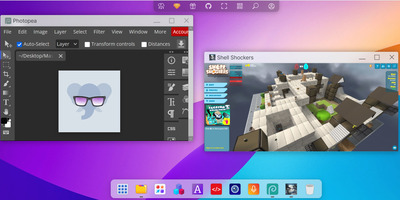
Puter delivers a complete cloud operating system that runs entirely in the browser — turning any device with internet access into a full-featured personal computer with desktop environment, file management, application hosting, and developer platform. The familiar desktop interface presents windows, taskbar, right-click menus, drag-and-drop, and multi-window management indistinguishable from native operating systems. The hierarchical filesystem supports file creation, uploads, sharing, permissions, and trash recovery with storage backends ranging from local SQLite for self-hosting to S3 and DynamoDB for production scale. Built-in AI integration provides access to GPT-4, Claude, and other models directly from the desktop for text generation, code assistance, and image creation. The developer platform offers a JavaScript SDK, REST APIs, cloud storage, key-value database, and serverless workers for building and hosting web applications without managing infrastructure. Sandboxed applications run in iframes with IPC communication and permission-based access to filesystem, AI, and system services. The app store enables publishing, discovering, and monetizing applications built on the Puter platform. Website hosting publishes static sites with custom domains directly from the file manager. Multi-user support provides individual accounts with authentication, resource isolation, and sharing capabilities. Deploy via Docker with a single command, Docker Compose for production, or npm for development — the one-line install script handles everything automatically on Linux, macOS, and Windows. Running on a dedicated VPS on RepoCloud with guaranteed CPU, RAM, and SSD, full root SSH access, and a browser serial console. AGPL-3.0 licensed.
OpenMA
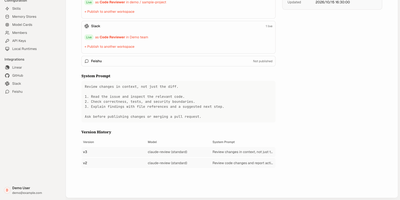
OpenMA lets you build and run AI agents with the model, harness, and sandbox you choose, on infrastructure you control, while it handles the sessions, execution, and recovery around them. Create an agent in the console, give it work, and come back later to the same session, because conversation history, streamed progress, and execution attempts are preserved rather than tied to one process that might die. Agents start with shell, file, web, and browser tools, then grow through MCP services and reusable Skills, while resources such as GitHub repositories, uploaded files, and shared memory attach to the work that needs them. Deployments run agents manually or on schedules you define, environments carry their own networking and package configuration, and model cards keep provider settings in one place instead of scattered environment files. If a sandbox fails, the session survives it; a replacement harness can rebuild context from durable events and workspace checkpoints. Operate everything through the console, the API, or the CLI, and plug in the database, queue, and object storage your deployment already trusts. Running on a dedicated VPS on RepoCloud with guaranteed CPU, RAM, and SSD, full root SSH access, and a browser serial console. Apache 2.0 licensed.
AI Researcher
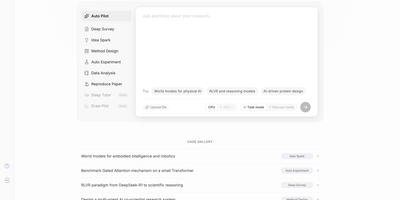
Accepted as a NeurIPS 2025 Spotlight paper and rapidly approaching 6,000 GitHub stars, AI-Researcher from the Hong Kong University Data Science Lab delivers the first fully autonomous scientific research system — a multi-agent platform that takes a list of reference papers and returns a complete research contribution with working code, validated experiments, and a formatted academic manuscript. The pipeline orchestrates five distinct phases: a Resource Collector systematically gathers materials from arXiv, IEEE Xplore, ACM Digital Library, Google Scholar, GitHub, and Hugging Face; an Idea Generator performs gap analysis against semantic embeddings to produce 3-5 novel hypotheses with feasibility scores; an Algorithm Designer transforms concepts into functional implementations; a Validation Engine automates testing, performance evaluation, and iterative optimization; and a Manuscript Creator generates polished full-length papers with figures, tables, and citations. The Gradio-based web GUI provides intuitive tabs for environment configuration, example selection, and real-time monitoring of research progress, while the production deployment at novix.science offers immediate browser access without local setup. Scientist-Bench provides a standardized benchmark comprising state-of-the-art papers across diverse AI research domains for evaluating autonomous research capabilities. The system supports multiple LLM providers including OpenAI, Anthropic, Google Gemini, and OpenRouter models with per-task routing for cost optimization. Deploy via Python with pip dependencies or Docker containerization. Running on a dedicated VPS on RepoCloud with guaranteed CPU, RAM, and SSD, full root SSH access, and a browser serial console. Apache-2.0 licensed.