Open Source App Cloud Marketplace
Deploy, host, and scale with one click, at half the cost. Then customize with AI agents.
Redmine
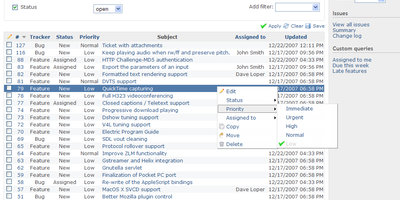
Nearly two decades running engineering organizations: Redmine is the veteran open-source project management and issue tracker, a Ruby on Rails application (GPLv2) still in active development. Its core strength is configurability: define your own trackers (bug, feature, task, or anything else), issue statuses, and role-based workflows that control exactly which transitions each role may perform, then extend records with custom fields of every type. Issues support subtasks, relations (blocks, precedes, duplicates), watchers, categories, and full journaled history, with saved custom queries and cross-project filtering for slicing the backlog any way you need. Around the tracker sit Gantt charts and calendars, a roadmap driven by versions, per-project wikis, forums, news, and document repositories, plus time tracking with estimated versus spent hours and activity-based reporting. Multi-project support runs deep - subprojects, per-project modules, and granular role-based permissions - and repository integration (Git, Subversion, Mercurial) links commits to issues automatically. Email notifications, inbound email-to-issue creation, LDAP authentication, a REST API, and a large plugin and theme ecosystem round it out. Recent 6.x releases brought substantial query and rendering optimizations. Self-hosting keeps your entire project history in your own database, free of per-seat licensing.
Ideon
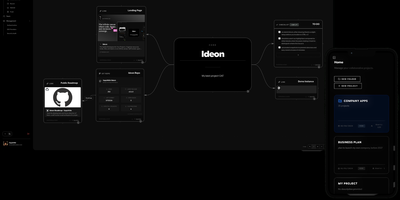
Scattered browser tabs, buried wiki folders, and disconnected issue trackers fragment engineering context across too many tools, which is why Ideon unifies your repositories, notes, and tasks on a shared infinite canvas. Rather than forcing projects into rigid folder hierarchies, you arrange interactive blocks spatially on a two-dimensional map where related documents, checklists, calendar schedules, and code references sit right beside one another. Teams can embed live repository cards and open issue streams directly from GitHub, GitLab, Gitea, and Forgejo onto the workspace, keeping code status visible alongside architecture documentation. Rich content blocks render Markdown notes with threaded comments, Mermaid flowcharts, uploaded files, images, and bookmarked links on the same board. Real-time multiplayer collaboration lets teammates edit blocks simultaneously, follow live cursors across the canvas, and map system designs together without edit conflicts. Built-in Time Travel snapshots capture historical states of the workspace so you can scrub backward to review how a project evolved or trace past design decisions. You can even synchronize an entire project canvas directly to a Git repository, storing notes and spatial block layouts as versioned files. Running on a dedicated VPS on RepoCloud with guaranteed CPU, RAM, and SSD, full root SSH access, and a browser serial console. AGPL-3.0 licensed.
Cozystack
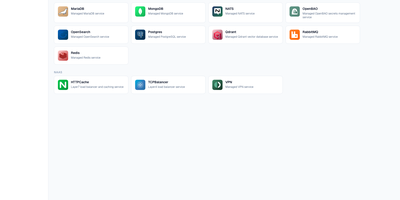
A rack of ordinary servers becomes your own cloud, with tenants ordering real infrastructure from a catalogue instead of filing tickets. Cozystack is an open-source, Kubernetes-based cloud platform that turns bare metal into a self-service system for spawning Kubernetes clusters, databases, virtual machines, load balancers, object storage, and HTTP caching services through a standard REST API. Hosting providers use it to sell managed services on hardware they already own, platform teams use it to give developers isolated environments inside quotas, and organizations leaving VMware run virtual machines and containers side by side with live migration and replicated storage. Tenants stay separated, GPU capacity can be shared between groups, and every service instance ships with preconfigured monitoring dashboards and alerts, gathered per tenant or into one hub. Because services are requested as Kubernetes resources, a billing system integrates by submitting a manifest, and platform packages are plain YAML delivered by FluxCD, so extending the catalogue means editing files your team already understands. Installation bootstraps immutable nodes over PXE or ISO, and the built-in web dashboard deploys applications and shows what the platform is doing without hiding the API underneath. The whole control plane runs on your hardware, auditable end to end. Running on a dedicated VPS on RepoCloud with guaranteed CPU, RAM, and SSD, full root SSH access, and a browser serial console. Apache-2.0 licensed.

Mentingo
Mentingo is an open-source learning management system where employees practice real workplace conversations with an AI mentor instead of only clicking through slides. The voice and chat mentor plays a customer, candidate, or colleague in role-play scenarios, asks follow-up questions, and returns scored feedback on how the conversation actually went. You can generate a course draft from your own documents, presentations, and procedures, then edit the structure and lessons instead of starting from a blank page. Learners work through a course catalog and distraction-free lessons, while quizzes, scenario questions, and long-form answers check understanding beyond simple recall. Compliance and safety courses can expire on a schedule, with automatic re-enrolment, reminders, and certificate validity tracking keeping renewals from slipping. Administrators organize people by departments, branches, and teams, inherit course access from group membership, and follow engagement and completion analytics per learner, group, and course. A knowledge base, company blog, announcements, and FAQ keep supporting material beside the training itself. Multiple organizations can share one deployment with separate domains and branding, and courses can be exported as SCORM packages for other tools. Integrations include Microsoft 365, Google Workspace, and Slack sign-in, plus an MCP endpoint for AI assistants. Running on a dedicated VPS on RepoCloud with guaranteed CPU, RAM, and SSD, full root SSH access, and a browser serial console. MIT licensed.
HolaOS
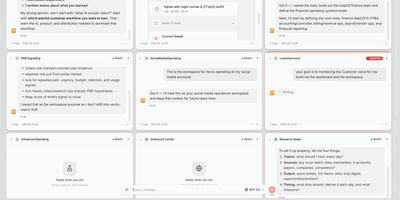
With over 6,500 GitHub stars, HolaOS bills itself as an "open agent computer" that reimagines the traditional operating system as a shared workspace where humans and AI agents collaborate across files, browsers, and 100+ integrated tools simultaneously. Unlike chat-only interfaces, HolaOS places live application UIs—Notion-style editors, browsers, custom workspace apps—side by side with the agent conversation, so operators always see what agents are doing and can intervene at any moment. The persistent memory system stores workspace knowledge locally as Markdown files and embedded vectors via SQLite vec, enabling RAG-powered recall that survives session boundaries without the typical context window bloat. Safe Session Compaction reserves roughly 70% of the model context window for fresh reasoning while folding older history into structured checkpoints that retain goals, constraints, progress, and decisions. Agents connect to Linear, GitHub, Slack, Jira, HubSpot, Gmail, and dozens more through one-click OAuth, automatically fetching relevant signals and converting scattered app data into working memory. BYOK support for Claude, GPT, and Gemini models lets operators use their own API keys at zero markup, while built-in Kimi K3 and GLM-5.2 models provide ready-to-use alternatives. Skills package reusable workflows that any agent can invoke on demand, and scheduled triggers enable autonomous digests, monitors, and reports. The runtime supports independent server deployment alongside the desktop client. Running on a dedicated VPS on RepoCloud with guaranteed CPU, RAM, and SSD, full root SSH access, and a browser serial console. Modified Apache 2.0 licensed.

Sake
Your e-reader knows exactly where you stopped reading, and Sake makes your whole library know it too, with a self-hosted web library that syncs KOReader progress, notes, and highlights across every device you own. Browse your collection in a clean web app with covers, metadata, shelves, ratings, and reading state, and organize it with rule-based shelves that file new books automatically according to conditions you define. Pair a KOReader device once and progress uploads in the background when the reader sleeps, new books download on request, and highlights land in a searchable annotations hub where you can edit notes inline and export them as Markdown or JSON. An existing on-device library can be exported back into the web app complete with its sidecar data, so years of reading history move with you. Search providers including Open Library, Project Gutenberg, and Anna's Archive (through Libgen mirrors) put new books one query away from your shelves, and metadata lookups enrich them from Google Books, Open Library, or Hardcover. OPDS and WebDAV endpoints serve any compatible reader app with optional separate Basic-auth passwords, the built-in plugin updater keeps the KOReader plugin current without manual file copying, and reading statistics chart your habits across the library. The installable progressive web app keeps the library one tap away on phones and tablets. Running on a dedicated VPS on RepoCloud with guaranteed CPU, RAM, and SSD, full root SSH access, and a browser serial console. AGPL-3.0 licensed.
BTCPay Server
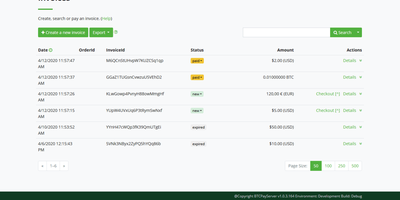
BTCPay Server processes Bitcoin payments with zero transaction fees, zero monthly costs, and zero third-party custody of your funds. Payments settle directly from customer to your wallet through a full Bitcoin node that provides cryptographic proof of receipt without trusting any intermediary. Lightning Network integration through LND, Core Lightning, or Eclair enables sub-second confirmation at sub-cent fees, with Ride The Lightning providing web-based node management within BTCPay itself. The Point of Sale app creates storefronts with product catalogs, tipping, and QR code displays for physical retail, events, or web embeds. Hardware wallet support through BTCPay Vault connects Ledger, Trezor, and ColdCard for transaction signing, keeping private keys in cold storage while running a hot payment interface. Multi-tenant architecture allows multiple stores on one instance, each with isolated wallets, Lightning nodes, and user permissions. The Greenfield REST API exposes every function programmatically for headless operation, automated invoicing, and custom integrations. E-commerce connectors for WooCommerce, Shopify, Magento, and PrestaShop plug in alongside Zapier for workflow automation. Optional Tor hidden services expose the instance as an onion address for censorship resistance. The official Docker Compose stack handles Nginx reverse proxy, Let's Encrypt TLS, and optional Tor configuration on a dedicated RepoCloud VPS with guaranteed CPU, RAM, and SSD. MIT licensed.
Rackpad
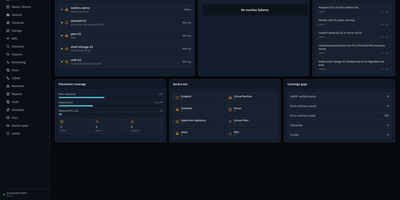
Every cable, switch port, VLAN, and rack unit in a homelab or small server room gets a documented place in Rackpad, a self-hosted inventory and operations workspace. Rack elevations show mounted gear, including paired half-width appliances. Switch-panel port maps and aggregate ports show what is patched where. Cables carry type, length, and color, editable in bulk. VLANs, subnets, DHCP scopes, reservations, and zones sit in one Networks workspace, with gateway and DNS protection and a mismatch review for IP assignments. Storage topology follows drives, bays, and pools that span several devices. Wi-Fi controllers, access points, hypervisor hosts, and virtual machines have pages of their own, and Proxmox and Hyper-V hosts can be imported after review. Discovery scans a subnet or any CIDR and stages every finding in an inbox. Per-device checks over ICMP, TCP, HTTP, HTTPS, and SNMP raise alerts by email, Discord, or Telegram. Everything feeds a movable topology map. Markdown runbooks attach to devices, and an audit log records every change. Admin, editor, and viewer roles control access, and OpenID Connect login is optional. Running on a dedicated VPS on RepoCloud with guaranteed CPU, RAM, and SSD, full root SSH access, and a browser serial console. MIT licensed.
MaxKB
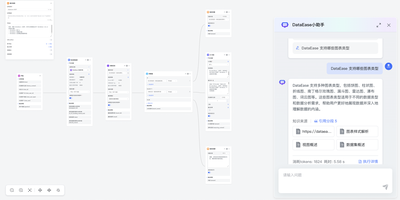
Support teams, IT departments, and researchers can put their own documents behind chatbots and AI agents built with MaxKB, an open-source platform that grounds answers in private knowledge. A support lead starts by uploading Markdown, DOCX, PDF, TXT, HTML, XLSX, XLS, or CSV files, or by syncing a web site, and MaxKB splits, vectorizes, and indexes the content on its own. An IT department can place the finished agent in any third-party site or internal tool with no coding, as a full-screen page, a mobile view, or a floating chat window. Researchers get replies that show, and let them download, the knowledge sources behind each answer. Simple agents pick tools, skills, and MCP connections from the question itself, while advanced agents are drawn as workflows with branching, multi-path recall, loops, and variables. Custom scripts, which AI can help write, plus schedules and event triggers extend what an agent can do. The model manager registers local models such as DeepSeek, Llama, and Qwen beside providers such as OpenAI, Claude, and Gemini, across language, embedding, reranking, vision, speech, and image generation. Conversation logs feed analysis for operations. Dozens of ready-made agent templates, knowledge base templates, tools, and skills in the template center and tool store shorten the first build. Running on a dedicated VPS on RepoCloud with guaranteed CPU, RAM, and SSD, full root SSH access, and a browser serial console. GPL-3.0 licensed.
Langflow
Langflow turns LLM application development into a visual canvas where every node maps to a real LangChain primitive (chains, agents, retrievers, memory, vector stores, and tools) that teams wire together without writing integration boilerplate. The platform supports 15+ LLM provider components including OpenAI, Anthropic, Google Gemini, Mistral, Groq, Cohere, Azure OpenAI, HuggingFace, and Ollama for fully local inference, with LiteLLM proxying to over 100 additional providers through a single OpenAI-compatible endpoint. Vector database integrations cover Pinecone, Weaviate, Chroma, Qdrant, Astra DB, OpenSearch, FAISS, and Milvus, while built-in Knowledge Bases introduced in version 1.8 allow RAG pipelines without any external vector service. Multi-agent orchestration enables agent-to-agent communication with conversation management, persistent Memory Bases for cross-session context retrieval, and step-by-step reasoning visibility in the interactive Playground. Every flow automatically becomes a callable REST API endpoint via the /run route and an MCP server exposable to Claude Desktop, Cursor, or any MCP-compatible client. Every component is a real Python class that developers can customize, extend, or replace, while Extension Bundles package third-party integrations as independent pip packages for modular installation. Tool integrations include web search, Slack, Gmail, Google Drive, GitHub, and custom REST API calls. Docker deployment with PostgreSQL persistence runs on port 7860. Backed by 153,000+ stars and DataStax. Running on a dedicated VPS on RepoCloud with guaranteed CPU, RAM, and SSD, full root SSH access, and a browser serial console. MIT licensed.
KrakenD
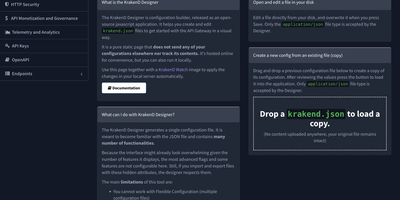
KrakenD processes over 18,000 requests per second on a single instance while consuming under 50MB of RAM at 1,000 concurrent connections, operating as a stateless API gateway that requires no database whatsoever. The Community Edition has earned over 2,600 GitHub stars by outperforming database-dependent alternatives like Kong and Tyk in independent benchmarks. Written entirely in Go, it uses declarative JSON or YAML configuration files that integrate directly into GitOps workflows for version-controlled infrastructure management. The gateway aggregates responses from multiple backend services into a single API call, transforms request and response payloads with field filtering, grouping, and mapping, and applies zero-trust security policies including JWT validation, OAuth 2.0, CORS, HSTS, clickjacking protection, and XSS prevention. Traffic management features include multi-layer rate limiting at both the router and proxy levels, circuit breakers for backend fault isolation, spike arrest policies, and concurrent call support that requests the same data from multiple backends in parallel for improved response times. Telemetry integrates with OpenTelemetry, Prometheus, Grafana dashboards, Datadog, Zipkin, and Jaeger for distributed tracing and metrics collection. The gateway extends through Go plugins, Lua scripting, Martian modifiers, and Google CEL expressions for custom request processing logic. AI workload routing supports OpenAI, Anthropic, Gemini, and other model endpoints with built-in fallback, retries, and load balancing. Deploy via Docker with the devopsfaith/krakend image as a single binary. Running on a dedicated VPS on RepoCloud with guaranteed CPU, RAM, and SSD, full root SSH access, and a browser serial console. Apache 2.0 licensed.
Hot Updater
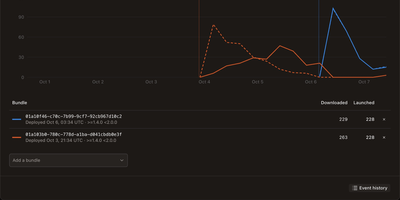
An app store review takes days, but a broken checkout flow takes minutes to cost you users: Hot Updater lets React Native teams ship JavaScript fixes straight to installed apps from a server they control, no store submission required. Deploy a new bundle with the CLI, and devices pick it up on their next update check, whether they run iOS or Android. The web console shows what you have shipped, which app versions receive which bundle, and lets you roll back a bad release before the support tickets pile up. Bundle diffing keeps downloads small: unchanged files stay on the device, changed Hermes bundles travel as compact patches, and the server quietly drops any patch that is not smaller than the full file. Releases target specific semantic app versions, so a fix built for 2.3 users never lands on 3.0 devices. Storage and metadata live where you choose, from S3-compatible buckets and Cloudflare R2 with D1 to Supabase, Firebase, Azure, or your own PostgreSQL, swapped through adapters rather than rewrites. Insights record update events so you can watch adoption as a rollout spreads, API keys gate which apps may check in, and remote configuration tunes app behavior without another binary release. The server itself runs as a compact Node service in Docker on port 3000 next to PostgreSQL, with token-protected admin routes. Running on a dedicated VPS on RepoCloud with guaranteed CPU, RAM, and SSD, full root SSH access, and a browser serial console. MIT licensed.
Conduit
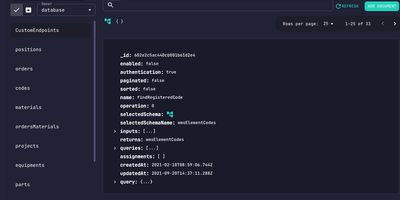
Conduit is a self-hosted backend platform that gives your application user accounts, databases, APIs, chat, and notifications out of the box, so you can skip months of boilerplate and ship the product itself. Define a data schema in the admin dashboard and Conduit generates CRUD and query endpoints for it automatically, backed by your choice of MongoDB or PostgreSQL. The Router module exposes every capability over REST, GraphQL, and WebSockets, and publishes Swagger documentation for each route as you build. Authentication covers a wide range of sign-in methods, and the Authorization module layers resource-level permission rules on top of every account. Realtime chat ships as a ready module with rooms and message history that clients join over WebSockets. Email and SMS modules send through multiple providers, and SMS doubles as a two-factor authentication channel that hardens sign-ins. File uploads land in the Storage module with several cloud providers supported, and PushNotifications keeps your mobile users informed. An Embeddings module adds text-to-vector generation and semantic search when you want AI features inside your app. Forms collect submissions and forward responses to an email address, covering contact pages and lead capture. A CLI bootstraps a working deployment in minutes, and production installs run on Docker Compose or Kubernetes. Running on a dedicated VPS on RepoCloud with guaranteed CPU, RAM, and SSD, full root SSH access, and a browser serial console. MIT licensed.
Airbroke
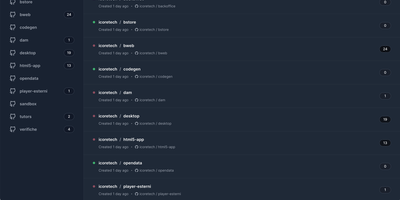
Engineering teams use Airbroke to catch application exceptions in one self-hosted error tracker where they can triage issues, replay failing requests, and debug without a per-event bill. Your existing Airbrake or Sentry clients point at its compatible HTTP collector endpoints, so instrumented applications keep reporting with no new SDK to adopt, and every occurrence lands in storage where the footprint stays small even under heavy ingestion. The web interface groups errors into issues you can triage, bookmark important occurrences for follow-up, and read occurrence charts that show whether a bug is a one-off or a slow-building wave. When an HTTP exception looks suspicious, you can replay the original request directly or copy a generated cURL command that reproduces it exactly, turning vague log complaints into debuggable cases. An AI assistant answers questions about issues in context, an MCP API lets LLM agents query your error data programmatically, and multiple OAuth providers secure sign-in for the team. It runs as a small service needing only a database, a single core, and a few hundred megabytes of memory. Running on a dedicated VPS on RepoCloud with guaranteed CPU, RAM, and SSD, full root SSH access, and a browser serial console. MIT licensed.
Dobase
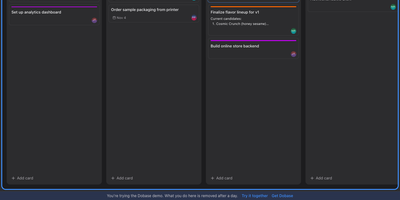
Dobase replaces the scattered pile of team subscriptions with one self-hosted workspace where mail, kanban boards, documents, chat, to-do lists, files, a calendar, and video rooms live side by side. Install only the tools your team needs, and share each one with exactly the collaborators you choose; a board for the whole company and a private todo list can sit in the same window. Several people can type in the same document at once, watching each other's colored cursors while the text merges cleanly, and presence faces in the sidebar show who is inside every tool right now. Open tools arrange themselves as tiles in a wide window, so chat can sit next to the board it discusses and the calendar under the mail you are answering. Pressing Cmd+K searches cards, todos, documents, files, chat, events, and mail in one motion, and nearly everything also works from the keyboard alone. Mail threads conversations and lets you accept calendar invites from the message, files get public links guarded by a password and an expiry, and the calendar syncs with CalDAV services or runs on its own. Video rooms with screen sharing join the same workspace, mentions and notifications follow you, and an email digest catches up anyone who was away. Running on a dedicated VPS on RepoCloud with guaranteed CPU, RAM, and SSD, full root SSH access, and a browser serial console. MIT licensed.
Issuerd
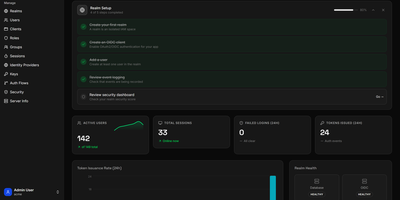
One login for every internal tool, without handing your users another password to forget: Issuerd is a Keycloak-compatible identity provider that runs single sign-on for your whole stack from a single binary. Administrators manage realms, users, groups, clients, roles, client scopes, and protocol mappers in an embedded admin console, while end users get their own account console for passwords, passkeys, and two-factor settings. Authentication flows cover MFA, social login, and themable, localized login pages with per-realm language and email templates, so each audience sees a sign-in that looks like your product. Federation connects Samba AD, OpenLDAP, and Active Directory with user and group sync, password validation and write-through, plus Kerberos and SPNEGO for desktop single sign-on. For modern clients it implements DPoP token binding so stolen access tokens are useless without the holder's key, CIBA for approvals that happen on a second device, and token exchange patterns aimed at AI agents calling downstream services. Declarative YAML provisioning, a full management API, OpenAPI export, Prometheus metrics, and health probes round out day-two operations, and nodes scale horizontally behind any load balancer with no sticky sessions. Running on a dedicated VPS on RepoCloud with guaranteed CPU, RAM, and SSD, full root SSH access, and a browser serial console. Apache-2.0 licensed.
LobeHub
With over 82,000 GitHub stars and 700,000+ downloads, LobeHub has evolved from its origins as LobeChat into a comprehensive multi-agent AI collaboration platform where humans and autonomous agent teams co-evolve. The platform's Agent Harness architecture functions as an operating system between AI models and applications, handling prompt presets, tool orchestration, lifecycle hooks, planning, filesystem access, and sub-agent management across 25+ model providers including OpenAI, Anthropic Claude, Google Gemini, DeepSeek, Mistral, Groq, AWS Bedrock, Azure OpenAI, and local models through Ollama. Agent Groups enable sophisticated collaboration with sequential, parallel, iterative, and debate orchestration modes, allowing multiple specialized agents to tackle complex workflows simultaneously. The Agent Builder creates production-ready agents from natural language descriptions with auto-configuration, drawing from a marketplace of 505+ pre-built agents and 10,000+ MCP-compatible skills and plugins. Pages provide collaborative document editing with multi-agent co-authoring, while Schedules automate agent runs around the clock without human supervision. The knowledge base leverages PostgreSQL with pgvector for RAG-powered retrieval, and Personal Memory gives agents transparent, editable context that evolves through continual learning. The full self-hosted stack deploys via Docker Compose with PostgreSQL, Redis, RustFS for S3-compatible storage, and SearXNG for private web search, all configurable through environment variables. Running on a dedicated VPS on RepoCloud with guaranteed CPU, RAM, and SSD, full root SSH access, and a browser serial console. LobeHub Community licensed.
Baby Buddy
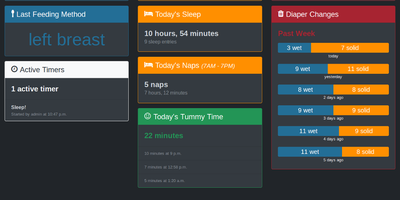
Baby Buddy is a private self-hosted child care tracker that centralizes feeding sessions, sleep cycles, diaper changes, and developmental health milestones into a collaborative dashboard for parents and caregivers. Caregivers can start quick timers on mobile devices to measure nursing intervals, bottle feedings, naps, and tummy time sessions with single-tap precision. The dashboard automatically calculates daily averages, feeding amounts, and awake windows to help families establish consistent daily sleep and feeding routines. Parents can track diaper changes by recording wetness, stool consistency, and color anomalies to spot digestive health changes early. Physical measurements including weight, height, and head circumference plot directly against World Health Organization growth curves to visualize percentile progression between pediatric visits. Multi-child profiles allow families with twins or multiple young children to switch contexts instantly and monitor individual growth timelines. Granular user permissions let parents invite nannies, babysitters, and relatives with restricted logging permissions while keeping administrative settings private. The built-in REST API and webhook system enable physical smart button clicks and home automation routines to log events instantly without opening a browser. Running on a dedicated VPS on RepoCloud with guaranteed CPU, RAM, and SSD, full root SSH access, and a browser serial console. BSD-2-Clause licensed.