Open Source App Cloud Marketplace
Deploy, host, and scale with one click, at half the cost. Then customize with AI agents.
Open Source Point of Sale
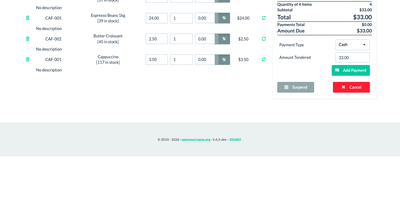
Scan an item, apply a discount, take payment, and print the receipt: Open Source Point of Sale (OSPOS) runs the whole checkout from a browser while stock and sales reports update behind it. The register works in four modes (sales receipt, quote, invoice, and return), applies a percent or fixed discount per line, and can suspend a sale to serve the next customer. Payments can be cash, card, check, bank transfer, wallet, gift card, or reward points, or left due on a customer account, and receipts print with a barcode or go out by email. Items can be standard, non-stocked, temporary, or kits, with attributes, supplier links, two tax rates, reorder levels, and bulk barcode label generation. Taxes follow VAT, GST, customer, and multi-tier rules. Receivings record purchases from suppliers, expense logging tracks running costs, and cash-up records reconcile the till. Customer records hold contact details, discounts, total spent, and consent, while gift cards and reward points favor repeat visits. Reports cover sales, orders, expenses, and inventory in graphical, summary, and detailed views, and tables export to CSV, Excel, or PDF. Staff sign in separately, and administrators grant access module by module, down to who may change prices or delete sales. Restaurant tables, SMS messaging, MailChimp, multiple languages, and a reCAPTCHA login option round out the list. Hosting it on a dedicated RepoCloud VPS brings guaranteed CPU, RAM, and SSD, full root SSH access, and a browser serial console. MIT licensed with a required footer attribution.
OpenOlat
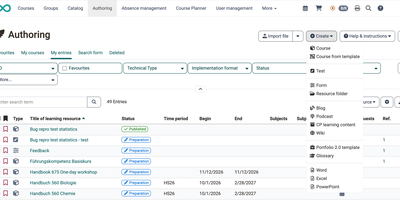
OpenOlat is a learning management system where educators build a course, run the exams, and follow every learner's progress without leaving the browser. Courses are assembled from more than 40 element types: pages, video, podcasts, blogs, wikis, forums, SCORM 1.2 and CP packages, tasks, group tasks, checklists, and surveys. They run as conventional courses or as learning paths whose completion criteria track each person's progress. The test editor offers 16 question types, from single choice and gap text to hotspot, drawing, essay, and file upload; closed questions score themselves, while essays autosave every minute and wait for manual grading. Questions live in a shared question bank, and an optional AI module can draft multiple-choice or essay questions from pasted text. Coaches follow people, courses, and assessment orders in one tool, and the Course Planner schedules products, implementations, events, rooms, and certification programs with recertification. Participants collect badges, certificates, and credit points, or book offers from a catalog. Virtual classrooms connect BigBlueButton, Zoom, or Microsoft Teams, and LTI pages embed outside tools. Hosting it on a dedicated RepoCloud VPS brings guaranteed CPU, RAM, and SSD, full root SSH access, and a browser serial console. Apache-2.0 licensed.
FlowFuse
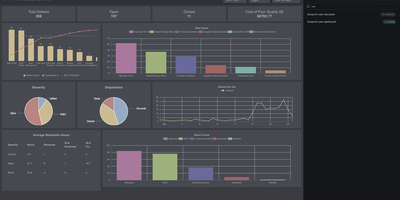
FlowFuse turns Node-RED from a single-editor tool into a team platform that hosts instances, snapshots flows, and promotes tested changes from development to production and out to remote devices. Applications group related instances, and Owner, Member, Viewer, and Dashboard Only roles decide who can edit flows, create snapshots, or simply open a dashboard. Creating an instance takes a few clicks: pick a Node-RED version, optionally choose a blueprint such as the ANDON Operator Terminal, and the platform preinstalls its nodes and flows. Snapshots capture flows, credentials, and runtime settings so a bad deployment can be rolled back, while DevOps pipelines move a chosen snapshot through development and production stages with one click. Remote instances run on your own hardware through a device agent installed with a one-line command, and developer mode opens the editor for that device from the platform. A shared team library keeps reusable flows and functions in one place, environment variables are set per instance, and project link nodes pass messages between instances and devices. Audit logs record editor logins, flow updates, installed nodes, and snapshots, and the FlowFuse Expert plugin offers AI guidance for writing functions, building flows, and debugging. On self-hosted installs the Community Edition is free, while pipelines, blueprints, the shared library, developer mode, application-level roles, and Expert need an Enterprise license. Running on a dedicated VPS on RepoCloud with guaranteed CPU, RAM, and SSD, full root SSH access, and a browser serial console. Apache-2.0 licensed.
Yearning
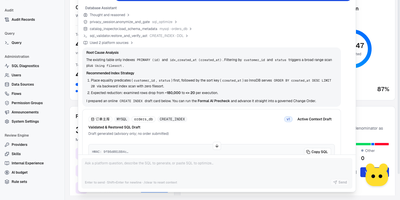
Every ALTER TABLE and bulk UPDATE bound for production passes through Yearning first, where an AI reviewer reads the SQL, approvers sign off, and a frozen record shows who ran what. The precheck parses up to 100,000 statements per order, groups look-alike statements into fingerprint groups, and lets the AI inspect real table metadata, indexes, and EXPLAIN plans through five read-only tools. Forty-eight built-in rules, plus your own prompt skills and DBA knowledge entries, turn violations into blocking findings. Cloud models see only anonymized SQL, or reviews can be routed to vLLM or Ollama on a private network. Orders move through serial datasource stages, such as staging then production, with up to ten approval steps each and designated executors who run or schedule the change. MySQL ALTER TABLE statements run through a built-in gh-ost with live copy progress, and captured before-images let one click generate a linked rollback order for MySQL, PostgreSQL, TiDB, OceanBase, and PolarDB. A query workspace grants time-bounded read-only access with column masking and export controls, while diagnostics chart top SQL and draft index fixes. A scoped AI assistant writes SQL from plain English without executing it. Sign-in works with LDAP or OIDC, notifications go out by email, DingTalk, Feishu, or Slack, and an OpenAPI plus an agent skill lets Claude Code or Codex submit orders and run prechecks. Running on a dedicated VPS on RepoCloud with guaranteed CPU, RAM, and SSD, full root SSH access, and a browser serial console. AGPL-3.0-or-later licensed.
CISO Assistant
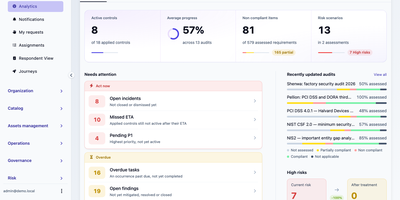
Compliance audits, risk registers, vendor reviews, and evidence usually sit in separate spreadsheets; CISO Assistant keeps them in one connected, self-hosted GRC platform. Run audits against more than 200 frameworks, including ISO 27001, NIST CSF, SOC 2, PCI DSS, NIS2, DORA, GDPR, and HIPAA, scoring each requirement and attaching evidence and applied controls. A mapping from the library projects a finished audit onto another framework, so the same questions are not answered twice. Risk assessments rate scenarios on configurable matrices, record current and residual levels, link the controls that treat them, and open matrix and action-plan views, plus EBIOS RM studies and quantitative analysis. Applied controls, policies, and recurring tasks carry owners and due dates, evidence attaches to them, and a month-by-month control plan shows what is outstanding. Third-party risk covers vendors, solutions, contracts, criticality tiers, and questionnaires that vendor representatives answer themselves. Assets, business impact analyses, incidents, and a GDPR register with DPIA screening share the same workspace. Analytics tabs list what needs attention, and a workflow builder can email scheduled digests or react to events. An MCP server with 139 tools lets Claude, ChatGPT, or LM Studio read and change records, and an optional chat assistant answers questions with a local or hosted model. SAML or OIDC single sign-on, MFA, a REST API, and a CLI cover access and automation. Running on a dedicated VPS on RepoCloud with guaranteed CPU, RAM, and SSD, full root SSH access, and a browser serial console. AGPL-3.0 licensed.
OpenAEV
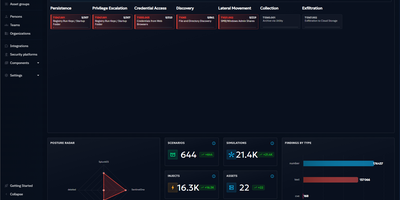
Before an attacker tests your defenses, OpenAEV lets you replay their techniques and see which ones your EDR, SIEM, and people actually catch. Scenarios sequence injects that mirror a threat actor's behavior, and simulations run them once or on a schedule against chosen endpoints, scoring prevention, detection, vulnerability, and human response. Atomic tests fire a single ATT&CK technique from the Threat Arsenal, such as an Nmap scan or a Nuclei CVE scan, and can repeat hourly, daily, weekly, or monthly. A lightweight agent for Windows, Linux, and macOS enrolls each endpoint for testing, while asset groups organize targets by filter. Collectors match EDR, XDR, and SIEM alerts to each inject, marking it prevented or detected, or missed when the expectation window expires. Findings collect scan results and CVE data for each asset, custom dashboards chart posture over time, and scheduled PDF or HTML reports reach stakeholders without platform access. Exercises can also target people through phishing campaigns with landing pages and email templates, SMS, media pressure articles, challenges, and post-run lesson surveys. Pre-built scenarios import from the XTM Hub, or OpenAEV can generate them from OpenCTI security coverage, and a REST API supports automation. Running on a dedicated VPS on RepoCloud with guaranteed CPU, RAM, and SSD, full root SSH access, and a browser serial console. Apache-2.0 licensed.