Lampline
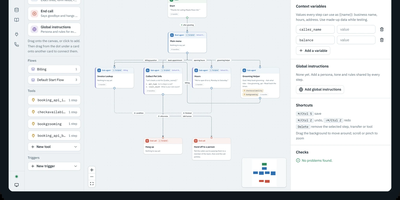
Once a voice agent is imported or built, Lampline connects it to a phone line, sends an AI caller to grade real calls, and keeps it all on your own server. Start by importing a Dialogflow CX or CX Agent Studio export along with a report of anything to check, or build fresh in a drag-and-drop builder that mixes LLM steps with scripted pages for exact lines and form fields. Next, pick one of 20 model providers, including Claude, OpenAI, Gemini, Bedrock, Groq, and DeepSeek, or run Ollama with local speech and no API keys. Test by chat or microphone while each step lights up, and let agents call HTTP and MCP tools and save records in collections of their own. Then connect callers through Twilio, Telnyx, or any SIP trunk, PBX, or session border controller via jambonz, with transfers to a person that carry the call's details as SIP headers. Finally, evals phone the agent over a real line, where an AI Test Caller brings background noise, accents, and interruptions, grades each transcript check by check, and reports typical and p95 response times as callers hear them. Each agent stays a folder of YAML and Markdown that you can review in git and lint or test with the vk CLI. Running on a dedicated VPS on RepoCloud with guaranteed CPU, RAM, and SSD, full root SSH access, and a browser serial console. Apache-2.0 licensed.
Dograh
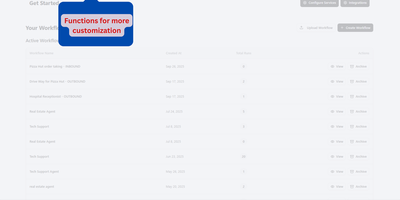
Build a voice AI agent that answers calls, qualifies leads, books appointments, and transfers to a human when needed, all from a drag-and-drop workflow builder in your browser. Dograh ships as a Docker Compose stack (API, web UI, Postgres, Redis, MinIO) that you self-host on any Linux server with automatic HTTPS provisioning via Let's Encrypt. The visual workflow builder lets you design multi-turn conversation flows by connecting nodes for greetings, intent classification, tool calls, and handoffs; describe your use case in plain English and the platform generates the LLM prompt and node graph for you. Connect your own speech-to-text, LLM, and text-to-speech providers (OpenAI, Anthropic, Gemini, ElevenLabs, Deepgram, local Whisper, Kokoro, or any OpenAI-compatible endpoint) or use the built-in Speech-to-Speech mode with Gemini Flash Live and GPT-Realtime-2 for sub-200ms latency. Telephony plugs in through Twilio, Vonage, Vobiz, or Cloudonix for inbound and outbound calling, with live agent transfer when the conversation needs a human. Webhook tool calls connect to Salesforce, HubSpot, Google Calendar, Cal.com, or any REST API without writing orchestration code. The ClonedVoice feature mixes real human voice recordings for high-frequency phrases with neural TTS fallback for dynamic content, cutting costs while improving caller trust. A built-in MCP server lets AI coding agents like Claude Code or Cursor design, test, and edit workflows through natural language. Deploy on a dedicated VPS on RepoCloud with guaranteed CPU, RAM, and SSD, full root SSH access, and a browser serial console. BSD 2-Clause licensed.
QuickVoice
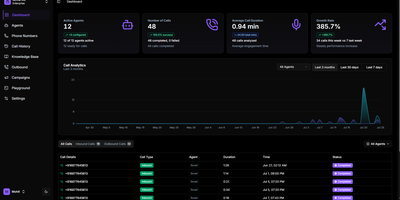
Your front desk phone rings at midnight and nobody sane is awake; QuickVoice answers it with an AI agent you configured, on servers you own, with call recordings you control. Build agents in the web console: write the prompt, pick speech-to-text, language model, and voice, set the first message, then link a real phone number from Twilio or Telnyx through LiveKit SIP trunks. Inbound callers get a receptionist that answers questions from your uploaded knowledge base, PDFs and web pages chunked and embedded for live retrieval, while outbound mode fires single quick calls or batch campaigns for reminders and follow-ups. Agents can invoke allowlisted MCP tools mid-call, so checking an order status or booking a slot happens inside the conversation instead of after it. Every call lands in the log with transcript, recording, and metadata, searchable from the analytics dashboard, and privacy controls redact personal data by default, can suppress recordings entirely, and sweep old transcripts on a retention schedule. Multi-language voices, per-agent runtime overrides for campaigns, organization accounts with API keys and audit logs, and Stripe billing hooks round out a platform built for teams who would rather inspect their voice stack than rent a black box. Running on a dedicated VPS on RepoCloud with guaranteed CPU, RAM, and SSD, full root SSH access, and a browser serial console. MIT licensed.
VoicEra
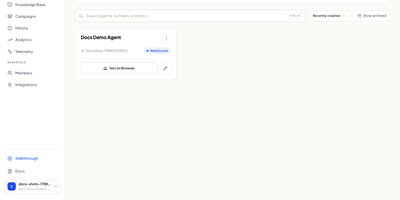
VoicEra lets you run your own voice AI phone platform, where callers talk to agents you configure and every recording and transcript stays on infrastructure you control. Build telephony agents that answer inbound calls or run outbound campaigns, choose the speech recognition, language model, and speech synthesis behind each one, and swap providers without rebuilding the platform. Connect phone numbers through telephony carriers, route live audio through the real time runtime, and let workers execute campaign calls in the background while you watch progress from the operator dashboard. Review call logs with recordings and transcripts after each conversation, including provider recordings when carriers supply them. Serve callers in Indian and low resource languages by combining Bhashini, AI4Bharat, and other Indic models, switch languages mid call, or run speech and language models locally through the optional model server gateway. Add new AI or telephony providers behind stable registry interfaces when a better model or carrier appears, authenticate operators, and keep media in your own object storage and database. Test agents in the browser before any phone number is involved, then scale the same configuration to real calls. Running on a dedicated VPS on RepoCloud with guaranteed CPU, RAM, and SSD, full root SSH access, and a browser serial console. Apache-2.0 licensed.
Flowcat
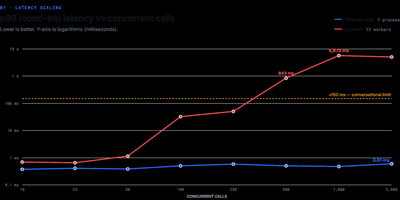
Real-time voice agents get a native Rust runtime in Flowcat: it carries a phone or WebRTC call through a composable media pipeline on your own infrastructure, so latency-sensitive audio never queues behind a managed platform. Audio flows from transport into voice activity detection and turn-taking, then through speech-to-text, an LLM, and text-to-speech, or a single speech-to-speech model, and back out to the caller, with in-process SIP and RTP for telephony. Pair it with local Whisper transcription, Kokoro, Piper, or XTTS for speech, and Ollama for reasoning, and a call's audio and transcript never leave your network; cloud providers plug in by name when you prefer them. Describe one agent in a YAML or JSON node-and-edge graph and the single flowcat-server binary serves it over HTTP, opening a browser page with microphone and live transcript, or bridging a Plivo number into the same agent. The runtime stays flat as call volume grows: benchmarked against a multiprocess Python baseline, one process holds p99 round-trip overhead at or below 0.61 milliseconds from 10 to 2,000 concurrent calls, at roughly 19.6 KB of RAM per idle session. Deploy it inside your VPC or an air-gapped environment where call recordings are sensitive. Running on a dedicated VPS on RepoCloud with guaranteed CPU, RAM, and SSD, full root SSH access, and a browser serial console. Apache-2.0 licensed.