WGDashboard
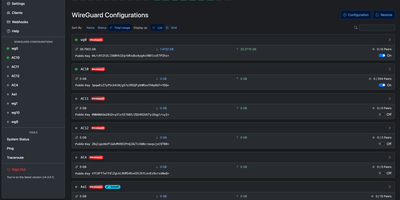
Managing WireGuard and AmneziaWG servers no longer means SSH sessions and typing wg show, because one browser dashboard covers every configuration and peer. WGDashboard finds existing configurations under /etc/wireguard and /etc/amnezia/amneziawg, so a running server appears right after installation. The home screen shows CPU, storage, memory, and swap meters above each configuration with its usage totals, peer count, and an on and off switch. Open a configuration for live data usage charts and a peer grid with search, sorting, tags, and bulk selection. Peers can be added one at a time or in bulk with generated keys and the next free addresses, then edited, restricted, deleted, or shared as a QR code, link, or email. Scheduled jobs restrict or delete peers when set conditions are met. Built-in ping and traceroute tools plot their results on a map. Settings add optional TOTP multi-factor sign-in, API keys, webhooks, light and dark themes, and a language selector. A remote server list connects one dashboard to others. Installation works on bare-metal Linux or in Docker. Running on a dedicated VPS on RepoCloud with guaranteed CPU, RAM, and SSD, full root SSH access, and a browser serial console. Apache-2.0 licensed.
hy2scale
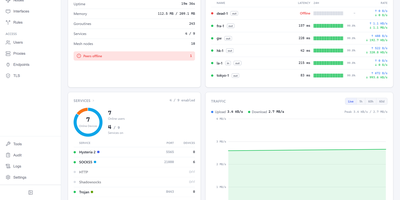
A handful of cheap servers in different countries become one routed network with a browser dashboard on top. Nodes link directly through Hysteria 2 QUIC tunnels with no coordination server, and traffic can leave through any node, several hops deep. The overview dashboard, topology graph, node list, and world map show latency, uptime, and live rates for every peer. Each node can also serve SOCKS5, HTTP, Shadowsocks, Trojan, L2TP/IPsec, IKEv2, OpenVPN, and WireGuard clients, and the VPN servers run in userspace without extra privileges. Policy sets route traffic by user, source, destination, domain, country, or ASN, and each user can get a fixed exit, quality failover, or aggregated paths. Traffic limits with periodic resets, upload and download rate caps, and expiry dates control how much each account can use. Hole punching connects nodes behind NAT, and peers can carry several addresses. A built-in certificate authority manages TLS certificates. An audit log records every connection, and ping, traceroute, throughput tests, and a terminal sit on the Tools page. Backup and restore, signed in-app upgrades, and an interface in English, Chinese, and Korean round out the admin side. Running on a dedicated VPS on RepoCloud with guaranteed CPU, RAM, and SSD, full root SSH access, and a browser serial console. GPL-3.0 licensed.