ITFlow
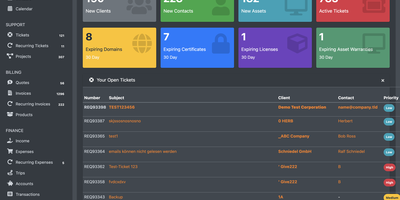
Small MSPs waste thousands of dollars annually on overlapping subscriptions for documentation, ticketing, and billing tools that don't talk to each other. ITFlow replaces that fragmented stack with a unified platform where client contacts, locations, vendors, computer assets, software licenses, domains, SSL certificates, passwords, and documents all live under one roof. The AES-encrypted password vault stores credentials with organized access controls, and domain plus SSL certificate tracking generates automated renewal alerts before expiration disrupts client services. Ticketing supports creation, prioritization, assignment, and SLA tracking, with a client portal where customers submit tickets, view invoices, approve quotes, and access their own documentation independently. The accounting module covers the full lifecycle: quotes, recurring billing, expense tracking, Stripe payment processing, and financial dashboards showing revenue and outstanding balances at a glance. AI integration through Ollama, LocalAI, or ChatGPT accelerates documentation writing and ticket responses directly within the interface. The modular architecture lets you enable only what you need, sidestepping the bloat of enterprise PSA platforms designed for organizations ten times your size. With stable releases since 2025 and zero per-user licensing, ITFlow removes the escalating costs that make commercial PSA tools unsustainable for growing teams. The PHP application deploys with MariaDB and Nginx, ready for production in minutes.
RackPeek
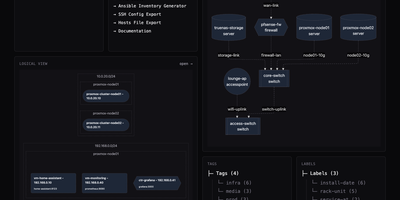
Every server, switch port, virtual machine, and network VLAN in a homelab or small IT environment can be cataloged, visualized, and exported through RackPeek's unified web interface and command-line toolkit. Operators record rack-mounted servers, managed switches, routers, firewalls, wireless access points, and uninterruptible power supplies alongside their CPU, memory, and storage specifications in a clean browser dashboard. Beyond physical gear, the inventory tracks operating systems, containerized or bare-metal services, IP subnets, and port-to-port cable connections while organizing assets with searchable tags and key-value labels. From that structured inventory, the interactive visualization engine renders live physical wiring diagrams and logical subnet-grouped service maps that export directly as high-resolution PNG graphics or Mermaid flowcharts. Because all state lives in a single human-readable configuration file backed by built-in Git repository synchronization, teams can version-control infrastructure changes or push automated updates through the authenticated REST API with dry-run diff previews. Day-to-day administration becomes faster with built-in generators that turn your cataloged hosts into ready-to-use Ansible inventory files, SSH client configurations, and tag-filtered hosts tables. Line-and-column validation feedback in the web editor catches schema mistakes immediately before changes are committed. Running on a dedicated VPS on RepoCloud with guaranteed CPU, RAM, and SSD, full root SSH access, and a browser serial console. AGPL-3.0 licensed.
ClientSt0r
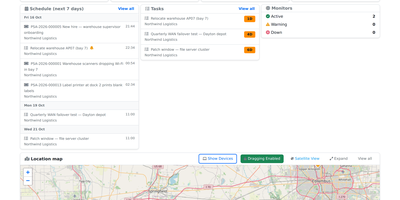
ClientSt0r is a self-hosted operations platform for managed service providers that keeps client documentation, IT assets, credentials, and the service desk in one multi-tenant system running on your own infrastructure. Open any ticket and the client's active contract, the asset it concerns, the runbook that covers it, and the vault entries you are allowed to use appear alongside the conversation, so nobody switches between four products during an outage. Readiness scoring grades every client against what should be documented, explains each gap, and queues the fixes, while versioned documents with owners and review dates keep runbooks from quietly going stale. The credential vault encrypts secrets with AES-256-GCM, isolates them per client, enforces IP, geography, and time-of-day access rules, logs every reveal, generates TOTP codes, checks passwords against known breaches, and imports existing Bitwarden or Vaultwarden libraries. Asset records cover hardware inventory, IP address management, rack layouts, and printable QR labels. The service desk adds queues, SLA timers, dispatch views, time entries, quotes with electronic signatures, invoices, contracts, approvals, a workflow rule builder, a threading email engine, and guided client portal forms, while procurement, profitability reporting, CVE scanning, SSL expiry tracking, and uptime monitoring round out daily operations. Running on a dedicated VPS on RepoCloud with guaranteed CPU, RAM, and SSD, full root SSH access, and a browser serial console. MIT licensed.