Overmind
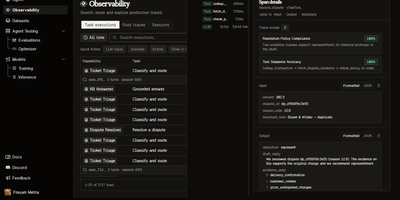
When an agent fails in production, Overmind scores the trace against your metrics and trains a specialized model on the evidence. Point it at the agent's repository and it maps capabilities, prompts, tools, and tasks into a graph, then matches every incoming OpenTelemetry trace to the capability that produced it and scores it on arrival. Auto-instrumentation picks up the LLM SDKs you already use, any OTel exporter can post to the API, and existing traces from Langfuse, LangSmith, Braintrust, or Galileo sync through connectors. Production traces and uploaded files become versioned datasets, with local English OCR for scanned PDFs and images, and optimisers run prompt, tool, and control-flow experiments in your repository and hand back the winner as a git diff. You fine-tune models whose weights you own, backtest them against the agent's own traces, and serve them, alongside optional OpenRouter frontier models, through one OpenAI-compatible API. Cursor, Claude Code, OpenCode, and Codex drive the whole loop through an MCP server and /overmind commands that cover tracing, datasets, fine-tuning, optimising, and backtesting. Self-hosting keeps traces and training data in your network: one Docker Compose file starts it, a seed command loads a demo workspace, and your own OpenRouter, Modal, and AWS keys power judging, training, and checkpoints. Running on a dedicated VPS on RepoCloud with guaranteed CPU, RAM, and SSD, full root SSH access, and a browser serial console. AGPL-3.0 licensed.
OpenUI
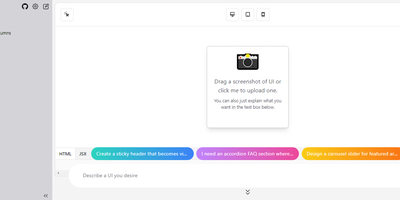
Describe a component in natural language and watch it render: OpenUI, from Weights & Biases, is an open alternative to Vercel's v0. Type a prompt like "a dark-themed dashboard with a sidebar and charts" and the LLM renders working HTML with Tailwind styling live in the browser. You then iterate conversationally, asking for changes until the design is right, and convert the result to React, Svelte, or Web Components for use in a real project. The backend is Python with LiteLLM routing, so it works with OpenAI, Anthropic, Gemini, Groq, and Mistral API keys, or fully offline against local Ollama models, including vision models like LLaVA that can generate UI from screenshot input - feed a screenshot and the model reproduces or riffs on an existing interface. Generated markup is inspectable at any point, with light and dark mode toggles, theme selection, and responsive previews across device sizes. The practical effect is compressing the mockup-review-revise loop from hours to minutes: a described layout renders in seconds and iterates through follow-up prompts, and because output converts to real framework code, prototypes feed directly into production codebases instead of staying trapped in a design tool. Self-hosting keeps unreleased product interfaces and prompts on your own server, and LiteLLM routing lets you pick the model per task - a cheap fast model for rough drafts, a stronger one for final passes, or free local models for unlimited experimentation.