Aurral
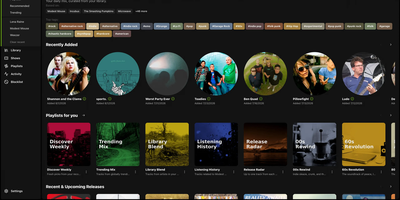
Discover, preview, and curate your personal music collection with Aurral, a self-hosted music discovery and library management server that turns listening history into automated playlists and album acquisitions. Connect your Last.fm, ListenBrainz, or Koito scrobble history to surface tailored artist recommendations, genre trends, upcoming releases, artist news, and nearby concert dates. Build scheduled rotating discovery flows that refresh automatically on your chosen cadence, or import existing playlists directly from Spotify, YouTube Music, Last.fm, and ListenBrainz. Preview tracks instantly in the browser before committing them to your permanent collection. Manage downloads through a built-in yt-dlp engine or route requests to slskd, SABnzbd, NZBGet, Prowlarr, deemix, and Lidarr with full queue, history, and upgrade controls. Stream your indexed library from the web player, connect Subsonic and OpenSubsonic apps such as Feishin or Music Assistant, and publish generated playlists straight to Navidrome, Plex, Plexamp, and Jellyfin. Multi-user profiles support granular permissions, custom discovery layouts, and single sign-on via OpenID Connect, Plex, Google, or reverse-proxy headers. Running on a dedicated VPS on RepoCloud with guaranteed CPU, RAM, and SSD, full root SSH access, and a browser serial console. MIT licensed.
Metadata Remote
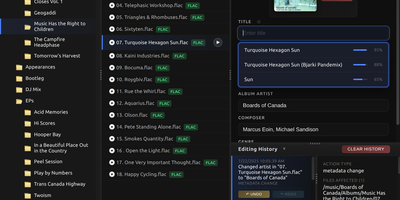
Metadata Remote is a browser-based audio tag editor designed specifically for headless music servers, enabling collectors to fix ID3 tags, embed high-resolution cover art, and match releases against MusicBrainz without moving files off their NAS. Navidrome, Jellyfin, and Plex administrators can browse mounted directories directly from any browser, inspect standard and extended metadata fields, and apply single-file or bulk folder-wide updates in one click. Clicking an empty or incomplete field activates the smart inference engine, which analyzes filenames, directory hierarchy, and sibling tracks alongside live MusicBrainz queries to present candidate values ranked by confidence percentage, including specialized matching rules for classical works, multi-artist compilations, and live bootlegs. Built-in audio streaming lets you audition MP3, FLAC, OGG, OPUS, M4A, M4B, WMA, WAV, and WavPack files inside the interface to verify mysterious tracks before renaming files or folders inline. A dedicated long-form text editor automatically opens for lyrics and liner notes exceeding 100 characters, while the album art manager previews image dimensions, bulk-embeds covers across entire albums, and repairs corrupted artwork headers automatically. Every single-track edit, custom field creation, and batch folder operation is tracked in a 1,000-step undo and redo history with full keyboard-only navigation. Running on a dedicated VPS on RepoCloud with guaranteed CPU, RAM, and SSD, full root SSH access, and a browser serial console. AGPL-3.0 licensed.
Swing Music
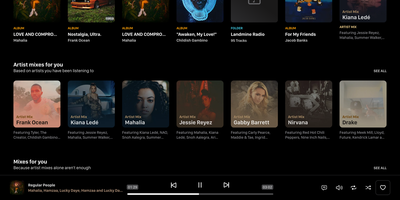
Swing Music transforms your personal audio collection into a private streaming platform with a responsive interface modeled after modern on-demand music apps. The server scans local directories, normalizes messy metadata tags, and categorizes tracks by version labels such as Deluxe, Remaster, or Live editions. Listeners can explore automated Daily Mixes compiled from real listening activity, browse folder hierarchies directly, or curate custom collections across related artists and releases. Audio playback combines intelligent silence detection with configurable cross-fade transitions to deliver seamless, uninterrupted listening across web browsers and mobile devices. Integrated Last.fm scrobbling keeps external listening statistics updated in real time, while personal playback history powers internal analytics and favorites. Multi-user account support enables family members to preserve separate playlists, favorites, and mix recommendations on a shared audio library. Running on a dedicated VPS on RepoCloud with guaranteed CPU, RAM, and SSD, full root SSH access, and a browser serial console. GNU AGPLv3 licensed.
Subwave
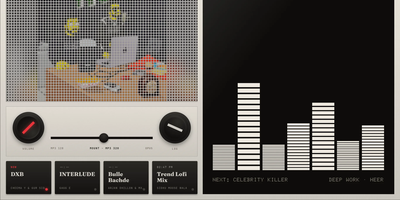
When shuffle algorithms start feeling sterile, Subwave transforms your self-hosted Navidrome or Subsonic music library into a live 24/7 personal internet radio station hosted by AI DJ personas. Every listener tunes into a single shared Icecast broadcast simultaneously. Curated tracks play alongside spoken station idents, local weather reports, news briefings, time checks, and track introductions. Want to hear something specific? Listeners submit plain-language song or mood requests directly from the web player, native mobile and desktop apps, or an MCP client, and the on-air DJ weaves those selections into the rotation. Operators staff up to 24 distinct DJ personas with guest co-hosts, programme a 24x7 weekly show grid with multi-hour episode arcs, and customize between-track skills from the browser admin console. Acoustic analysis measures BPM, musical key, loudness, vocal ranges, and track endings so crossfades and voice ducking sound like a studio broadcast across MP3, Opus, AAC, and lossless FLAC streams. An interactive Library Observatory maps every analyzed track by genre and energy. Runtime-swappable LLM providers (Ollama, OpenAI, Anthropic, and OpenRouter) and six local or cloud TTS engines keep voices flexible. Running on a dedicated VPS on RepoCloud with guaranteed CPU, RAM, and SSD, full root SSH access, and a browser serial console. MIT licensed.
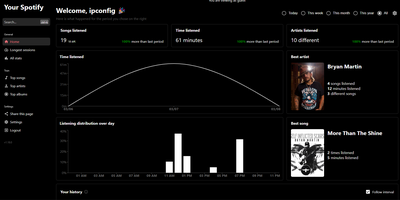
Your Spotify
To explore years of personal music streaming habits without waiting for an annual year-end summary, Your Spotify continuously tracks your listening history and presents it inside a private analytics dashboard. Music enthusiasts use the interface to inspect daily, weekly, monthly, and custom date-range breakdowns of their most played tracks, top artists, favorite albums, and total listening duration. Listeners who want their complete historical archive from day one can upload official Spotify privacy data exports, including both past-year StreamingHistory JSON files and multi-year Extended Streaming History archives, directly through the settings panel. Friends and family sharing an instance can use the collaborative affinity view to compare overlapping listening habits across multiple accounts in intersection or union mode. From any historical table, top-tracks ranking, or multi-user affinity comparison, you can generate new playlists directly inside your Spotify account or trigger track playback on active devices. Administrators can manage user registrations, generate shareable public guest tokens for read-only dashboard access, blacklist specific artists from skewing statistics, and expose ingestion metrics to Prometheus. Running on a dedicated VPS on RepoCloud with guaranteed CPU, RAM, and SSD, full root SSH access, and a browser serial console. GPL-3.0 licensed.
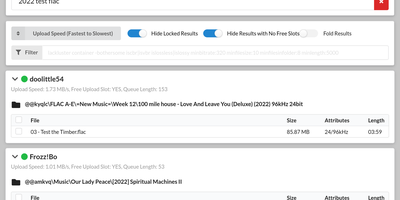
slskd
Across peer-to-peer music and file-sharing communities, slskd brings the Soulseek network into any modern web browser through a self-hosted client-server daemon that runs continuously without a desktop GUI. Users can run multiple concurrent network searches, filter results by audio bitrate, file extension, free upload slots, or transfer speed, and queue entire album folders for download in two clicks. The real-time transfer monitor groups active downloads and uploads by peer and directory, allowing you to inspect your live queue position, retry stalled files, or clear completed batches at a glance. For library contributors, the share manager indexes local directories with custom regex exclusion rules and configurable user groups that enforce per-group upload slot allocations, bandwidth caps, and automated leecher blacklists. Built-in social tools let you browse remote user directory trees, auto-join public Soulseek chat rooms on startup, and exchange private messages directly inside the web interface. Multi-server operators can even link a central controller to remote relay agents to distribute file sharing and search workloads across separate machines. When transfers finish or system state changes, event-driven integrations can fire custom HTTP webhooks, execute post-processing shell scripts, upload files via FTP, or expose Prometheus metrics and CIDR-restricted REST API endpoints for external media managers. Running on a dedicated VPS on RepoCloud with guaranteed CPU, RAM, and SSD, full root SSH access, and a browser serial console. AGPL-3.0 licensed.
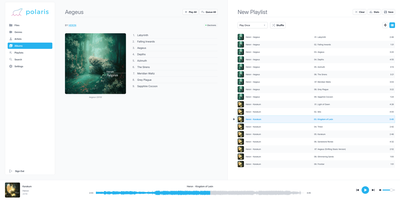
Polaris
Whether your personal audio library spans ten thousand lossless FLAC albums or a sprawling hierarchy of studio recordings, Polaris streams your entire music collection to any browser or mobile device with instant responsiveness. You can browse cataloged tracks by album, artist, genre, or raw directory tree without waiting for sluggish page loads. Multi-value metadata indexing cleanly separates collaborations across artists, composers, record labels, and lyricists. A structured query bar filters songs using per-field search operators and boolean combinators. During playback, real-time audio waveform visualizations render signal peaks directly inside the scrubbing bar. Lossless and compressed formats play seamlessly, covering FLAC, MP3, MP4, M4B, Ogg Vorbis, Opus, Musepack, APE, WAV, and AIFF files. Each household listener gets an isolated account with private playlists, dark mode themes, and customizable color palettes. Administrators can edit mount points, user credentials, and dynamic DNS hooks either through the web settings panel or a plain-text configuration file. Mobile listeners can also connect from dedicated Android and iOS companion apps on the go. Running on a dedicated VPS on RepoCloud with guaranteed CPU, RAM, and SSD, full root SSH access, and a browser serial console. MIT licensed.
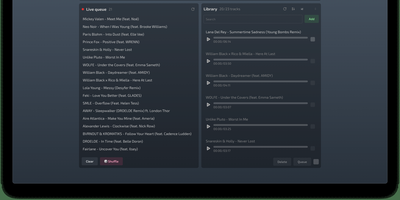
Airstation
Airstation turns your music folder into a radio station where every listener hears the same second of the same song at the same time. From the studio panel you upload tracks once, and they stay in a permanent library you can search and sort by date added, name, or duration. Build the broadcast queue by dragging tracks into order, reshuffle it whenever the mood changes, let it cycle endlessly, shuffle it randomly, or pause the station entirely when the day is done. Playlists group tracks for recurring shows, and the playback history shows listeners what has already aired. Anyone with the link opens the player page and is listening within seconds, no account and no app install, while a live counter tells you how many people are tuned in right now. The player page itself can be retitled to match your station's name. Friends get a shared listening moment instead of another playlist link, communities get a station that plays their own rotation around the clock, and collectors get to hear their library the way radio always felt: live, shared, and slightly out of your control once it starts. Running on a dedicated VPS on RepoCloud with guaranteed CPU, RAM, and SSD, full root SSH access, and a browser serial console. MIT licensed.