Bagisto
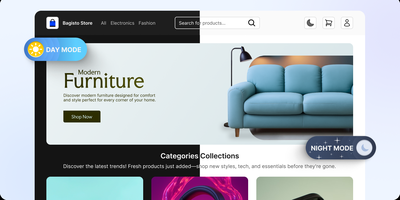
Bagisto is an eCommerce framework for businesses demanding full ownership and zero recurring platform fees. Built on Laravel 12 and Vue.js, version 2.4 supports seven product types — simple, configurable, virtual, downloadable, grouped, bundle, and booking — with multi-channel inventory management across unlimited warehouses and sales channels. The multi-vendor marketplace module transforms a single store into a full marketplace with vendor dashboards, commission management, automated approval workflows, and seller-managed product catalogs supporting 10M+ SKUs through Elasticsearch and OpenSearch indexing. Payment processing handles Stripe, Razorpay, PayU, PhonePe, and PayPal v2 with secure checkout sessions and IPN processing. The headless commerce architecture exposes a GraphQL API via Laravel Lighthouse, enabling decoupled storefronts built with Next.js or any frontend framework, while the PWA module delivers mobile-optimized shopping experiences. AI integration through the Laravel AI SDK connects GPT-5, Gemini, Mistral, and other LLMs for automated product descriptions, chatbot support, and AI-powered image search with TensorFlow.js fallback. Enterprise security features include admin two-factor authentication, Google reCAPTCHA Enterprise, and EU-compliant online contract withdrawal per Directive 2023/673. Built-in SEO tools handle meta titles, descriptions, keywords, and channel-wise sitemap generation. Redis caching, Laravel queues for async operations, and horizontal scaling support containerized deployments across multiple application and database servers. Running on a dedicated VPS on RepoCloud with guaranteed CPU, RAM, and SSD, full root SSH access, and a browser serial console. MIT licensed.
Odoo
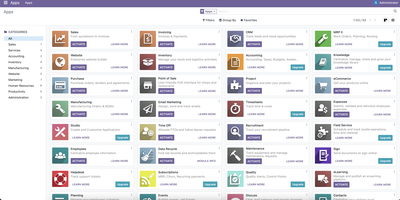
Roughly 40 integrated business apps forming a full ERP: Odoo's open-source suite runs companies end to end. The Community Edition, licensed LGPL-3.0, ships roughly 40 apps covering CRM, sales, invoicing, basic accounting (journals, chart of accounts, taxes, reconciliation), inventory and warehouse management with multi-step routes, manufacturing with BOMs and work orders, purchasing, project management, timesheets, HR, a website builder, and eCommerce. Each app works standalone, but they share one PostgreSQL database and one data model, so a confirmed sale updates stock, triggers procurement, and posts invoices without integration glue. The modular design means you enable only the apps you need and extend with 40,000+ community modules from the Odoo app store covering nearly any vertical requirement. Inventory supports multi-warehouse stock, reordering rules, and lot and serial tracking with barcode-ready operations; manufacturing ties BOMs, work orders, and work-center routing directly to sales demand and stock levels; and the website builder sells straight from your product catalog with payment provider integrations. You can start with just CRM and invoicing on day one and switch on inventory or eCommerce later - new apps integrate with existing data instantly because the schema is shared. The server is Python with an XML/JavaScript view layer, and because data lives in plain PostgreSQL there is no proprietary format: you can query, back up, migrate, and extend business data directly, with unlimited users and no per-seat licensing - where enterprise ERP pricing is per user per month, headcount here costs nothing.