SyncTube
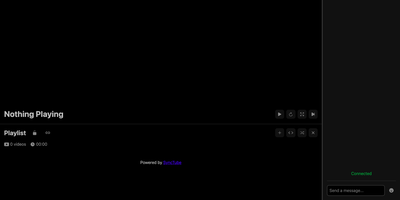
SyncTube turns any browser into a shared movie room where one link opens a synchronized player and live chat for the whole group. Paste a YouTube, Twitch, Vimeo, or PeerTube URL, or a direct mp4 or m3u8 link, and the room watches the same frame at the same moment. A leader takes global control of play, pause, seeking, and playback rate, and smaller groups can open pausing or resuming to everyone. Local files start playing for the room while they upload, and external subtitle files plus separate audio tracks cover voiceovers and fan translations. Chat doubles as a remote control: timed commands jump the whole room forward or back, skip a sponsored segment, boost quiet audio, or return to the moment before an accidental rewind. Playlists accept ranged link patterns for episode batches, viewers vote to skip, and keyboard shortcuts drive fullscreen, refresh, and sync toggles without leaving the player. Operators can cache supported site videos on the server, restyle every front-end file, and extend subtitle rendering or quality switching through plugins. Admins moderate with bans and kicks from chat, and the whole service runs from one small server that fits a private friends-only room or a public community channel. Running on a dedicated VPS on RepoCloud with guaranteed CPU, RAM, and SSD, full root SSH access, and a browser serial console. MIT licensed.
Tracim
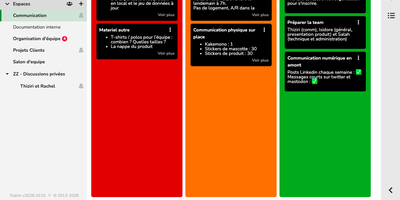
Combining threaded discussions, versioned documents, Kanban boards, and shared calendars in one platform, Tracim keeps every decision and file in a single searchable place. Each space gathers the discussions, notes, files, and tasks of one team or project, and members hold a reader, contributor, content manager, or workspace manager role. Comments, status labels, tags, and an automatic version history travel with every document, and several people can edit the same text at once. Kanban boards track tasks, logbooks record events and decisions, and templates keep recurring documents consistent. Shared calendars cover one-time and recurring events with reminders, and they sync to Thunderbird, Outlook, or any CalDAV client. Files go out as share links, mount through WebDAV, or sync to a desktop folder, and outside partners can join a single space with limited rights. Each space sets its own notification rhythm, from hourly to never, and a reply to a notification email is posted straight into the thread. Administrators plug in LDAP, SAML, or web-server remote authentication for sign-in, recolor the interface to match their brand, and script anything else through the REST API or plugins. The interface is available in Arabic, English, French, German, Portuguese, and Spanish. Running on a dedicated VPS on RepoCloud with guaranteed CPU, RAM, and SSD, full root SSH access, and a browser serial console. MIT, LGPL-3.0, and AGPL-3.0 licensed.
Sora Frame
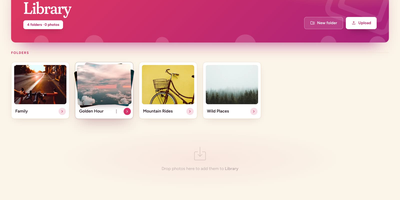
An old tablet on the shelf can show family photos all day once Sora Frame feeds it. The slideshow runs in any browser with soft cross-fades, a large clock, date, and weather widget, and it keeps the screen awake, even on iPads and phones. Install it to the home screen like an app, then pick what plays: every photo or a single folder, nested folders included. The library takes photos by drag and drop or the Upload button, builds folder covers from their own pictures, moves photos with a drag, deletes a multi-selection in one go, and offers an optional Google Photos import. JPEG, PNG, WebP, GIF, and iPhone HEIC files are accepted, and only a resized copy is stored. Notes slip a message like a visit reminder into the rotation, with up to four photos, a date range, an optional event countdown, and a choice of eight memory-book layouts. Each frame or family member gets a PIN limited to chosen folders, and a new frame pairs by scanning a QR code or opening an address that carries the PIN. The interface speaks English, Spanish, French, German, Portuguese, Italian, Dutch, Hindi, Japanese, Chinese, and Arabic, and keyboard shortcuts cover play, next, fullscreen, and photo info. A living room shelf, a grandparent's tablet, or an office desk display makes a fine home for it. Running on a dedicated VPS on RepoCloud with guaranteed CPU, RAM, and SSD, full root SSH access, and a browser serial console. AGPL-3.0 licensed.
Dobase
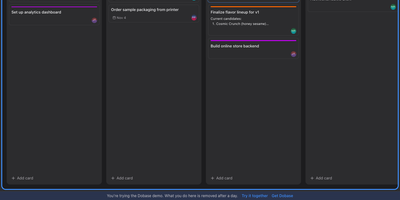
Dobase replaces the scattered pile of team subscriptions with one self-hosted workspace where mail, kanban boards, documents, chat, to-do lists, files, a calendar, and video rooms live side by side. Install only the tools your team needs, and share each one with exactly the collaborators you choose; a board for the whole company and a private todo list can sit in the same window. Several people can type in the same document at once, watching each other's colored cursors while the text merges cleanly, and presence faces in the sidebar show who is inside every tool right now. Open tools arrange themselves as tiles in a wide window, so chat can sit next to the board it discusses and the calendar under the mail you are answering. Pressing Cmd+K searches cards, todos, documents, files, chat, events, and mail in one motion, and nearly everything also works from the keyboard alone. Mail threads conversations and lets you accept calendar invites from the message, files get public links guarded by a password and an expiry, and the calendar syncs with CalDAV services or runs on its own. Video rooms with screen sharing join the same workspace, mentions and notifications follow you, and an email digest catches up anyone who was away. Running on a dedicated VPS on RepoCloud with guaranteed CPU, RAM, and SSD, full root SSH access, and a browser serial console. MIT licensed.
PlikShare
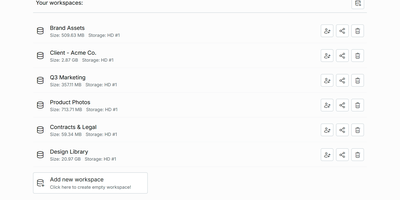
Sending a client a big file should not mean renting seats on someone else's cloud, and PlikShare turns your own server into a file sharing platform with unlimited users, unlimited workspaces, and no per-seat pricing. Its central idea is the box: a controlled gateway between your folders and the outside world, where you invite collaborators, mint anonymous links, and decide who may upload, download, preview, or drop files into an upload-only inbox. Quick share links carry custom slugs, expiry dates, passwords, and download caps, and every box can embed into another website as a live widget whose permissions update the moment you change them. Storage is your choice per workspace, from the server's own disk to S3, Cloudflare R2, Backblaze B2, Azure Blob, Google Cloud Storage, or any S3-compatible server, and each storage picks one of three encryption modes, including full encryption where names and contents are sealed with keys derived from each user's password. Bulk uploads arrive as a single zip that rebuilds its folder structure on landing, bulk downloads assemble from an explorer tree, and previews cover video, audio, PDFs, Markdown with diagrams, and even the inside of zip archives. Single sign-on through multiple OIDC providers, granular admin roles, an optional MCP server for scoped AI agents, and OCR or chat integrations round out a platform that stays lean on a small server. Running on a dedicated VPS on RepoCloud with guaranteed CPU, RAM, and SSD, full root SSH access, and a browser serial console. AGPL-3.0 licensed.
Flare
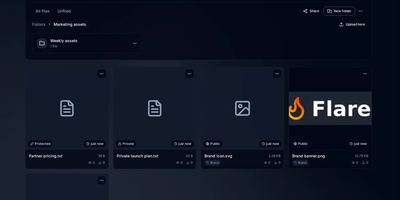
Screenshot, copy link, done: that is the loop Flare is built to make instant on your own server. Connect ShareX, Flameshot, KDE Spectacle, or a plain upload script once, and captures land in a vault you control instead of a third-party host that deletes them next month. Files live in folders with nested structure, bulk moves, automatic tagging rules, and one share link per folder, while previews handle images, video, PDFs, and syntax-highlighted code without downloading anything. Search digs through filenames, dates, and text extracted from images by OCR, so the screenshot from three weeks ago is findable by what it says. Password-protect a sensitive file, keep another private entirely, or publish it with a rich embed that unfurls properly wherever you paste the link. An appearance studio restyles branding, color palettes, and share page layouts, upload profiles carry reusable defaults between browser and screenshot tools, and the extras round out the kit: a URL shortener with click tracking, a pastebin, storage quotas, invite links, and tokens with signed webhooks for your own integrations. Running on a dedicated VPS on RepoCloud with guaranteed CPU, RAM, and SSD, full root SSH access, and a browser serial console. MIT licensed.
Twigex
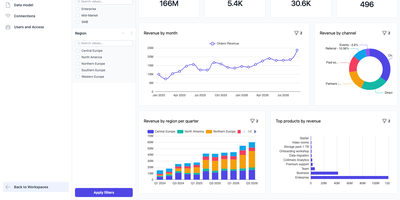
Teams that juggle a file drive, a chat app, a task tracker, and a dashboard tool can fold all four into one self-hosted workspace. Twigex stores files on local disk or S3-compatible storage, shares them with users, groups, or public read-only links, and opens office documents in EuroOffice or Collabora for simultaneous editing. Chat offers channels and direct messages with reactions, mentions, and link previews. Video calls and scheduled meetings run through LiveKit, and guests can join a channel by link. Projects organize work as tables of tasks with custom fields and subtasks, viewable as a grid, kanban board, Gantt timeline, or calendar. Collimato, the analytics module, connects to databases and APIs, models the data, and builds charts and dashboards with filters and KPI cards. The admin area covers users, groups, roles, storage backends, SMTP, office editing, and security settings. The Community Edition is free to run from one binary, a Docker Compose stack, or a Helm chart on Kubernetes. Running on a dedicated VPS on RepoCloud with guaranteed CPU, RAM, and SSD, full root SSH access, and a browser serial console. AGPL-3.0 licensed.
Hasty Paste
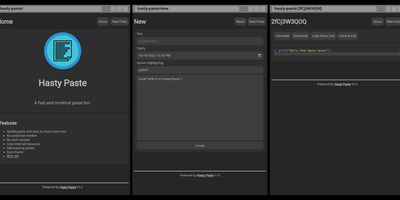
Paste some text, hit save, share the link - Hasty Paste is a fast, minimal pastebin written in Python on the async Quart framework, named, by its author's own admission, "because you use it so fast without a care in the world." No accounts, no authentication, no friction - built for the everyday case of handing a debug log, config snippet, or stack trace to someone in tech support or a chat channel. Pastes get randomly generated IDs, with an optional "long" ID mode that makes brute-force URL guessing impractical, and expiry times ensure throwaway content actually gets thrown away. Optional Pygments syntax highlighting makes code readable, a dark theme spares your eyes, and the whole interface works without JavaScript - it renders in terminal browsers and under the strictest script blockers. Storage is a custom flat-file system (no database), caching runs internally or through Redis for busier instances, and a REST API plus the companion "Hastily Paste It" CLI script enable piping command output straight into a paste from the terminal. The Alpine-based Docker image is tiny, resource usage is minimal, and the license is AGPL.
Jmal Cloud
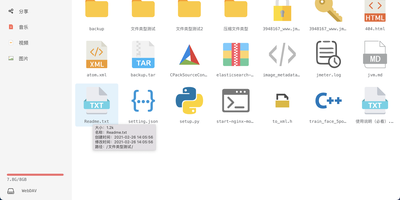
Jmal Cloud is a self-hosted private cloud drive that keeps your files on your own server, with online previews, resumable uploads, full-text search, and WebDAV access. The web manager previews photos, videos, Office documents, PDFs, EPUB books, and even CAD DWG drawings in the browser, then puts recently modified files, favorites, shared folders, and a trash bin a click away. Huge uploads resume from the exact chunk that stopped, while full-text search drills into text, PDFs, and Office documents when filenames fail you. Connect Alibaba Cloud OSS, Tencent Cloud COS, or MinIO as storage backends and browse every bucket through the same folders. Wire in a self-hosted OnlyOffice Document Server and draw.io to edit Word, Excel, and PowerPoint files and sketch flowcharts or mind maps without leaving the drive. Mount the library as a local network drive over WebDAV, share folders through links for upload and download, and push scheduled backups with the Rust jmalcloud CLI. Packages and Docker images cover Ubuntu, Debian, CentOS, Fedora, and Arch on x86_64 and ARM64, and the interface speaks English, Chinese, and Japanese. Running on a dedicated VPS on RepoCloud with guaranteed CPU, RAM, and SSD, full root SSH access, and a browser serial console. MIT licensed.
Chiyogami
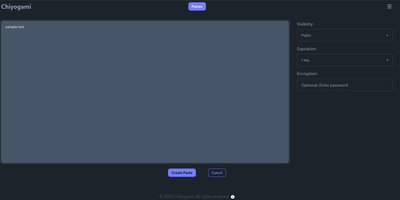
Chiyogami is a pastebin you host yourself for sharing code, logs, notes, and text snippets through short links that expire on your terms. Paste into the web editor and the content comes back formatted, with syntax highlighting for code and rendered Markdown for prose, so a stack trace or a runbook reads the way it was written. Anything sensitive can be encrypted in the browser before it leaves your machine, and the server never stores the password, which makes an encrypted paste safe to pass through chat or email. Every paste carries a configurable lifetime, from minutes to never, and visibility choices keep a snippet public, unlisted, or private behind an unguessable address. Registered users manage their own pastes from an account, and anonymous quick pastes stay available for one-off sharing. The public paste list supports search, so a team instance doubles as a small shared snippet library. Developers can skip the browser entirely: one curl command creates a paste from a file or a JSON body, and the API returns a short title that fetches the content later. Sharing extends to QR codes for moving text onto a phone, and built-in rate limiting throttles spam and abuse before it fills the database. Running on a dedicated VPS on RepoCloud with guaranteed CPU, RAM, and SSD, full root SSH access, and a browser serial console. BSD-3-Clause licensed.
Jirafeau
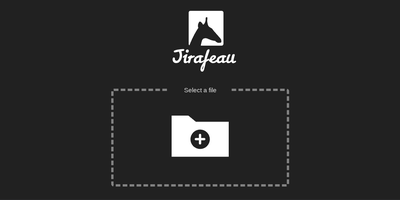
Upload a file, get a unique download link and a separate delete link - Jirafeau has done exactly this one thing since 2008. It is plain PHP with no database, no mail server, no JavaScript framework, and no external dependencies - files and metadata live on the filesystem, which is why it runs on nearly anything and why it has outlasted most of its imitators. Uploads use the HTML5 file API, so PHP's post_max_size ceiling does not constrain file size, with live progress showing speed, percentage, and time remaining. Every upload takes options: expiration from one minute to a year to unlimited, self-destruct after first download, and password protection with configurable policy - passwords can be optional, required, or server-generated with complexity rules. Server-side encryption (modern builds use XChaCha20-Poly1305) stores files encrypted at rest with the decrypt key embedded only in the download URL, never on the server, so a compromised host cannot read the contents. Unencrypted deployments get file-level deduplication - identical files stored once with multiple links. Upload access can be gated by password lists or IP allowlists, a small admin panel manages stored files, and a CLI cleanup script handles expired files via cron. Recipients can preview supported files in-browser.
Lenpaste
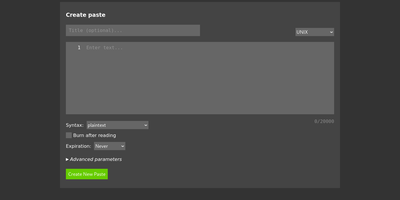
Share code snippets, logs, configs, and notes without registration, tracking, or ads: Lenpaste is a minimal, self-hosted, anonymous alternative to pastebin.com. It is deliberately spartan in the right ways: no accounts, no JavaScript required (the entire site works in text browsers and hardened setups), and cookies used solely to store display preferences. Pastes support syntax highlighting across a long list of languages (from ApacheConf and Arduino to mainstream stacks), configurable expiration from minutes to unlimited, one-use "burn after reading" pastes that self-delete on first view, optional author attribution, and iframe embedding for dropping pastes into other pages. The form-encoded HTTP API covers everything the UI does - create pastes with title, syntax, expiration, and line-ending normalization, fetch them by ID, and query server capabilities - making it trivial to pipe command output to your paste server from shell scripts. Server operators control maximum title and body lengths, maximum paste lifetime, rate limits for viewing and creation, search-engine indexing policy, and can lock private instances behind HTTP Basic authentication. It deploys as a single lightweight Docker container, giving your team a snippet-sharing endpoint where the content never touches a third-party service.