Scholarsome
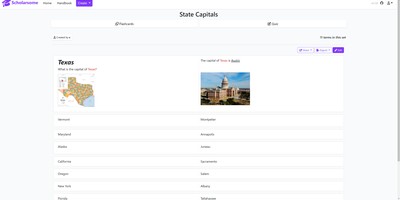
Scholarsome is a self-hosted flashcard platform where you create study sets, share them with other learners, and drill them through flashcards and automatically built quizzes. Start a set from scratch in the card editor, writing terms and definitions with rich formatting, images, and LaTeX expressions for math and science notation. Bring your existing material with you instead: decks import from Anki, Quizlet, and CSV files, and finished sets export back to the same formats so nothing is trapped inside. Share a set with classmates or keep it private with visibility controls, then let everyone study from the same central copy with no device syncing to manage. Multiple learning modes mimic real flashcards for relaxed review, while the quiz builder generates fill in the blank, true or false, and multiple choice questions from your cards for a stricter test. Teachers can assemble a class deck once and publish it to every student at the moment it is ready. Because the whole system runs on your own server, study data stays under your control rather than behind a subscription paywall. Running on a dedicated VPS on RepoCloud with guaranteed CPU, RAM, and SSD, full root SSH access, and a browser serial console. AGPL-3.0 licensed.
GymCoach
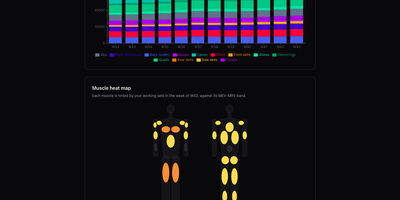
Strength training, cardio, and body metrics land in one workout log on your own server, backed by an optional AI coach that explains its advice from your real numbers. Quick entry such as 100x8@9 logs weight, reps, and effort in one line, with a rest timer, plate-loading calculator, and warm-up ramp beside the set table. A weight picker offers only loads your equipment can build, and a readiness check-in adjusts the suggested load and says why. Templates for 5/3/1 BBB, GZCLP, nSuns, PPL, and Upper/Lower run as written and edit like any custom program. Progress pages chart estimated 1RM, weekly volume per muscle group against MEV and MRV bands, a muscle heat map, bodyweight goals, and a training calendar. Garmin FIT, TCX, and GPX imports need no cloud account and add heart-rate charts and aerobic decoupling to each run or ride. The coach writes a weekly debrief, chats in a streaming conversation, and drafts a full program from a one-sentence goal, using your own Anthropic or OpenRouter key. History imports from Strong or Hevy CSV files with a dry-run preview and exports to CSV or TCX, and an MCP connector lets ChatGPT or other agents analyse it. The app installs as an offline-capable PWA, speaks English, French, Russian, and German, and keeps every user's data separate. Running on a dedicated VPS on RepoCloud with guaranteed CPU, RAM, and SSD, full root SSH access, and a browser serial console. MIT licensed.
Cooktrace
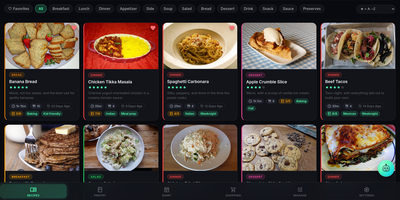
Every home cook keeps a graveyard of recipes scattered across bookmarks, screenshots, chat threads, and one stained index card, and CookTrace gathers the whole mess into one self-hosted library that knows what is in your pantry. Import recipes from URLs, files, or photos, or bring entire Mealie, Paprika, and Tandoor archives in bulk, then cook with live scaling that does fraction-aware ingredient math, per-step photos, and an inline unit converter. A pantry-match pill on every recipe card tells you at a glance what you can actually cook tonight, while barcode scanning and expiration digests keep stock honest. The cook diary and meal planner move from list to month calendar with drag-to-re-plan, and the shopping list generates itself from planned recipes, skipping items you already own and grouping the rest by aisle. Households organize into cookbooks and shared Kitchens with public links, and an optional conversational assistant can log a cook, plan a meal, or import a recipe for you. An opt-in MCP server even exposes your recipes and lists to external AI agents under token-scoped tool tiers. Running on a dedicated VPS on RepoCloud with guaranteed CPU, RAM, and SSD, full root SSH access, and a browser serial console. AGPL-3.0 licensed.
ByteStash
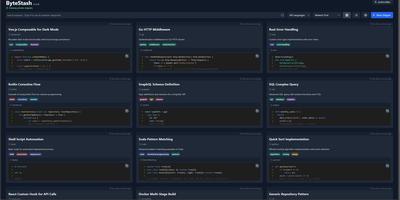
The functions, config files, and one-liners you keep re-deriving finally get a searchable home: ByteStash is a self-hosted code snippet manager - a private Gist. Each snippet holds multiple code fragments, so a Docker Compose file, its .env template, and a plaintext usage note live together under one titled, categorized entry. Monaco-based syntax highlighting covers dozens of languages, from Python, TypeScript, Go, and Rust to YAML, Dockerfiles, Terraform, and Markdown. Retrieval is the point: filter by language or category, search titles and descriptions, and optionally include snippet contents in full-text search. Snippets can be pinned for quick access and shared via public links that recipients open without an account. Multi-user support runs on JWT authentication with optional OIDC single sign-on for teams on centralized identity, and a full CRUD REST API with Swagger documentation wires snippet retrieval into editors, scripts, and CI pipelines. Storage is a single SQLite database with optional encryption, and collections export as JSON or Markdown. A React frontend on a Node.js backend, deployed as one lightweight container.
mkfd
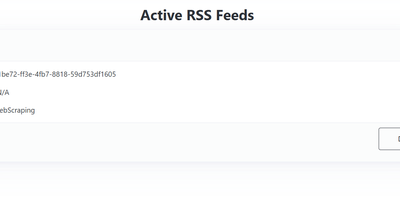
Plenty of sites you follow have no feed, a broken feed, or announcements buried in an inbox, and mkfd turns all three into clean RSS feeds you control. You point it at a webpage, a REST API, or an IMAP mailbox and describe what counts as a story: an item selector plus selectors for title, link, date, author, and enclosures. Drill chains follow links across several pages when the real content sits deeper than the listing page, and an advanced scraping mode with a real browser handles pages that need JavaScript or your own browser extensions. An integrated selector helper helps you pinpoint elements on the target page instead of guessing. Email feeds watch a folder continuously and publish new messages as feed items the moment they arrive, with mailbox passwords encrypted before they touch disk. Every feed gets a schedule, is rebuilt in its own worker, and is served from an endpoint your reader can subscribe to, and the whole configuration lives in a portable file you can version and reuse. Access to the builder is guarded by a passkey, and feed endpoints stay open for your reader. Running on a dedicated VPS on RepoCloud with guaranteed CPU, RAM, and SSD, full root SSH access, and a browser serial console. MIT licensed.
Edi Life OS
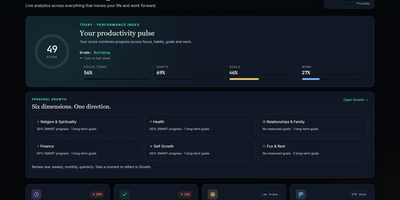
Edi Life OS puts the habits, goals, projects, money, focus sessions, and notes that usually live in five separate apps into one calm dashboard on your own server. Start the day from an Overview that rolls focus, habit trends, goals, finances, and the week ahead into one readable score. Connect long-term goals to six life areas, drive progress from a checklist, a measure, or a habit you actually keep, and use weekly, monthly, or quarterly reviews to choose the next honest step. Log daily habits with streaks and monthly progress, run timed focus sessions with short and long breaks, and keep a history of the deep work you finished. Track expenses, income, budgets, debts, and credits in your chosen currency, including recurring entries that land straight in the ledger. Plan projects on draggable Kanban boards with labels, priorities, due dates, checklists, comments, and attachments, then see card deadlines and money dues together in one calendar. Capture Markdown notes with preview and export, pin sticky notes with colors and connections, and give each account its own private workspace, theme, and currency. Ask an AI assistant through the optional MCP server to read your dashboard, create goals, log habits, or record expenses through a token-protected API that never touches the database directly. Running on a dedicated VPS on RepoCloud with guaranteed CPU, RAM, and SSD, full root SSH access, and a browser serial console. MIT licensed.
Highlight
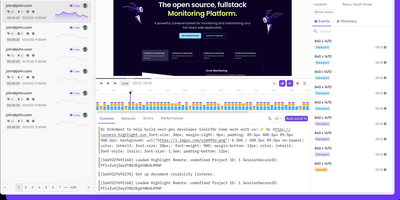
With over 9,000 GitHub stars and a focus on developer experience over legacy monitoring complexity, Highlight.io delivers a unified observability platform that correlates frontend user behavior with backend performance data in a single interface. The session replay engine captures high-fidelity DOM recordings showing exactly what users experienced, including console logs, network requests, page transitions, and user interactions, with configurable privacy redaction for sensitive content. Error monitoring automatically groups and deduplicates errors, surfaces affected user sessions, and provides full stack traces with source map support for minified production code. The logging pipeline ingests structured and unstructured logs from any backend service with automatic property extraction, full-text search, and configurable alerting thresholds. Distributed tracing tracks request flows across microservices with embedded links to associated sessions, errors, and logs for complete request lifecycle visibility. The metrics system collects custom application metrics alongside built-in web vitals and performance data for trend analysis and anomaly detection. Search across all telemetry types uses a unified query language with automatic attribute discovery and saved views for recurring investigations. Integrations connect with Slack, Discord, Linear, Jira, Vercel, and dozens of other developer tools for notification routing and workflow automation. SDKs cover React, Next.js, Vue, Angular, Python, Go, Ruby, Java, PHP, and Elixir with framework-specific instrumentation. Self-hosted deployment runs via Docker Compose with ClickHouse for analytics storage. Running on a dedicated VPS on RepoCloud with guaranteed CPU, RAM, and SSD, full root SSH access, and a browser serial console. Apache 2.0 licensed.

Kapowarr
Kapowarr tracks the comic series you collect, hunts down missing issues, and files every download into a tidy, consistently named library on its own. Add a volume and Kapowarr pulls cover art, publisher details, and issue lists from ComicVine, then maps the series to a folder in your library. Run Search Monitored to grab a whole run in one click, or open Manual Search and pick exactly which release of an issue lands on disk. Downloads arrive through GetComics direct links on hosts including Mega, MediaFire, and Pixeldrain, and a configured torrent client covers releases that only circulate as torrents. The moment a download finishes, the issue is renamed to the format you defined and moved into the correct volume folder. Point Kapowarr at an existing collection and the import workflow matches folders against ComicVine, shows every match for your review, and only then starts renaming or moving files. Convert issues between archive formats, rename or move entire volumes in bulk, and clean up a messy library from the same screens. A link blocklist remembers dead download pages and blocks sources that stop working, so repeat searches skip the junk and go straight to links that deliver. Running on a dedicated VPS on RepoCloud with guaranteed CPU, RAM, and SSD, full root SSH access, and a browser serial console. GPL-3.0 licensed.
TG-Spam
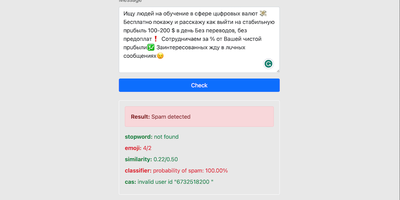
Spam bots flood busy Telegram groups with crypto scams and phishing links faster than human admins can delete them; TG-Spam watches every message and removes the junk before your members see it. Each message is scored by several checks at once: similarity to known spam samples, a stop-word dictionary, emoji and link counts, and a lookup against the Combot Anti-Spam database of known spammers. For borderline cases you can add OpenAI or Gemini as an extra judge, or write your own detection rules as Lua plugins that run inside the bot. The bot learns while you moderate: when admins approve a flagged message or ban a user it missed, the samples update, so the same trick fails next time. Members can report spam with a reply, repeat offenders accumulate warnings toward an automatic ban, and an admin chat gives your team one place to review borderline calls. Turn on the built-in server and the same engine answers spam checks over HTTP for your other tools, with a web UI to test messages, manage samples and dictionaries, and control the approved-user list. Running on a dedicated VPS on RepoCloud with guaranteed CPU, RAM, and SSD, full root SSH access, and a browser serial console. MIT licensed.
Mixarr
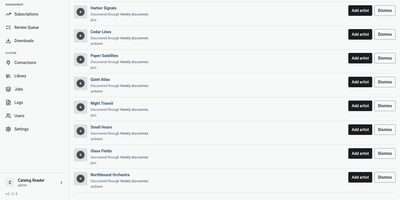
Your next favorite artist is probably already hiding in a playlist, chart, or listening history you never check. Mixarr pulls discovery sources from Spotify, TIDAL, Last.fm, ListenBrainz, Deezer, Discogs, Plex, Jellyfin, MusicBrainz, and Bandcamp into one compact catalog built for Lidarr users. Fifty-six subscription types cover playlists, charts, tags, recommendations, user libraries, and followed artists, each running on its own schedule while you get on with listening. Every discovery lands in a review queue where you preview, approve, or reject it, with clear outcomes distinguishing added, already present, failed, and identity-required results instead of silent shrugs. The artist inspector shows identity, library membership, source provenance, and release chronology without losing your place in the catalog. Its Collaboration Constellation draws an interactive graph of the musicians, producers, and engineers actually credited on records, so you can follow a session player from a rock album to a string quartet and send whoever you find straight to Lidarr. Optional AI recommendations from OpenAI, Anthropic, Gemini, or a local Ollama model analyze your library for what is missing, and library health tools repair missing metadata. One container carries the API, web interface, database, and cache to your server. Running on a dedicated VPS on RepoCloud with guaranteed CPU, RAM, and SSD, full root SSH access, and a browser serial console. GPL-3.0 licensed.
CertMate
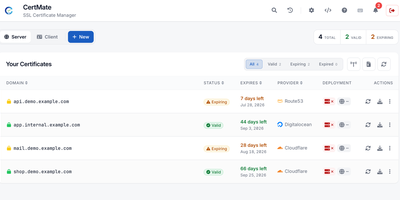
Certificate lifetimes are collapsing toward 47 days, which turns TLS from a yearly chore into a weekly one, and CertMate is the control plane that makes that schedule boring. It issues and renews certificates from Let's Encrypt, ZeroSSL, Google Trust Services, Actalis, DigiCert, SSL.com, Sectigo, or your own private CA, validating by DNS-01 through 29 DNS providers, HTTP-01, or a CSR whose private key never leaves the device. Renewals run automatically, earlier when a certificate's life is short or the CA moves the date through ARI, and deploy hooks push each renewed certificate where it is actually served, then probe the live endpoint to prove the new certificate answers. Discovery watches hosts and certificate transparency logs for certificates you did not issue, folding them into one inventory of what is served where and when it expires. Certificates rest on local disk or in Azure Key Vault, AWS Secrets Manager, HashiCorp Vault, Infisical, or S3 storage, with encrypted backups copied off-site. Its built-in CA issues client certificates for mTLS with OCSP and CRL, and can serve ACME itself, so certbot, lego, acme.sh, and cert-manager get internal certificates under EAB rules you define. Every action lands in a tamper-evident, hash-chained audit trail you can export and verify independently. Running on a dedicated VPS on RepoCloud with guaranteed CPU, RAM, and SSD, full root SSH access, and a browser serial console. MIT licensed.
Waline
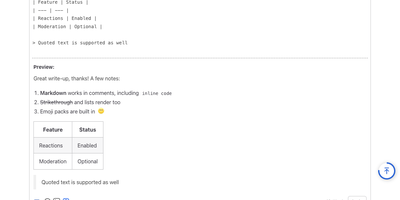
Any blog, documentation site, or static website can host a complete comment section by running its own Waline server, with Markdown, emoji, reactions, and moderation tools included. A visitor writes as a guest, registers an account, or signs in with GitHub, Twitter, Facebook, Weibo, or QQ, and a live preview shows the formatting before anything is posted. Comments accept tables, strikethrough, highlighted code blocks, TeX formulas, custom emoji packs, and Giphy GIF search. On submission, a sanitizer strips scripts and styles while Akismet, per-IP rate limits, keyword and IP block lists, duplicate detection, and reCAPTCHA or Turnstile screen for spam, and an optional review queue holds the comment back until a moderator approves it. The site owner then hears about it by email, WeChat, QQ, Telegram, PushPlus, Discord, or Lark, and the commenter receives reply emails. Once published, readers react with up to nine emoji and sort threads by latest, oldest, or hottest, while pageview and comment counters can appear anywhere on a site and recent-comment and top-commenter widgets fill sidebars. Moderators edit, approve, flag, or delete from the web admin panel, manage users and custom labels, and import earlier discussions from Disqus, Twikoo, Valine, Typecho, Artalk, Commento, or WordPress. Comments stay in your own database, and the widget offers a dark theme and ten languages. Running on a dedicated VPS on RepoCloud with guaranteed CPU, RAM, and SSD, full root SSH access, and a browser serial console. GPL-2.0 licensed.
Nyro
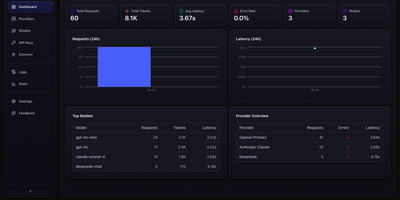
Point Claude Code, Codex CLI, Gemini CLI, or any OpenAI, Anthropic, or Gemini SDK at one address and Nyro routes every request to whichever model provider you choose. The gateway translates protocols on the fly, including streaming, reasoning blocks, and tool calls, so a tool built for one API can run on a model from another. Define virtual model names, bind each to one or more providers, and pick weighted load balancing or priority failover; unhealthy targets are skipped and recover automatically. Issue API keys with limits on requests and tokens per minute and per day, and bind each key only to the models it may call. Exact and semantic caching return repeated answers instantly. A request log records provider, model, token counts, latency, and streaming speed, and usage charts break traffic down by model and provider. The Connect page generates ready-to-paste samples in Python, TypeScript, and cURL, plus one-click configuration for popular coding CLIs. Choose an embedded database for a single host or an external PostgreSQL or MySQL server for production, and run the gateway, the admin UI, or both as separate processes. Running on a dedicated VPS on RepoCloud with guaranteed CPU, RAM, and SSD, full root SSH access, and a browser serial console. Apache-2.0 licensed.
Sage Wiki
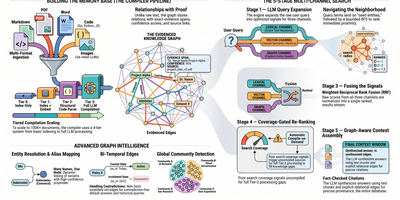
Sage Wiki turns a pile of unstructured documents into a fully interlinked, searchable wiki by running them through a five-pass LLM compiler pipeline. Inspired by Andrej Karpathy's vision of LLM-compiled knowledge bases, the pipeline processes source files through diff detection, summarization, concept extraction, image captioning, and cross-reference discovery, with parallel LLM calls and checkpoint/resume for vaults scaling to 100,000+ documents. The typed ontology graph stores entities and relations with BFS traversal, configurable relation types, multilingual synonyms, and a promotion/demotion lifecycle backed by grounding verification and consensus scoring. Multi-format ingestion handles Markdown, PDF, Word, Excel, PowerPoint, EPUB, email, CSV, images, and code files without manual tagging. LLM provider support spans Anthropic, OpenAI, Gemini, Ollama, and any OpenAI-compatible API, with per-pass model routing enabling cost optimization by assigning cheaper models to simpler tasks. The built-in MCP server exposes 17 tools over SSE transport for integration with Claude, Cursor, and any MCP-compatible agent, while native Obsidian vault overlay ensures existing note workflows remain undisrupted. Team deployment supports Git-synced shared wikis, centralized server access, and hub federation across multiple projects. Ships as a single Go binary with Docker Compose multi-arch images serving the web UI on port 3333. Running on a dedicated VPS on RepoCloud with guaranteed CPU, RAM, and SSD, full root SSH access, and a browser serial console. MIT licensed.
QM Music
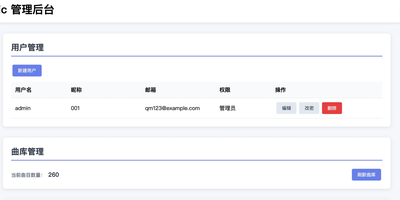
Rip a CD once, drop the files into a folder, and QM Music turns that folder into your household streaming service: phones, desktops and web players all browse the same library of MP3, FLAC, AAC and WAV files, organised by album, artist and genre from their ID3 tags and cover art. Because the server speaks the Subsonic API, Feishin, StreamMusic, Amperfy, Substreamer and Music Assistant sign in with an address and a login, no app-store rental required. Point a phone on hotel Wi-Fi at your home collection and it plays. At home, playback can pull pristine FLAC; on mobile data the transcoder serves an MP3 or AAC stream sized for the train ride. Keep a family happy in the background: each person gets an account with individual permissions, favourites that sync between devices in real time, private playlists and lyrics following the current track. Finding something new to hear takes recommendations from listening history, similar artists and similar songs, and two years of play history sit behind the statistics. Scheduled scans collect fresh rips automatically, refresh happens on demand when a disc lands, and the catalogue idles around 150 MB of memory on the server. Running on a dedicated VPS on RepoCloud with guaranteed CPU, RAM, and SSD, full root SSH access, and a browser serial console. Apache-2.0 licensed.
Lumen Learning Platform
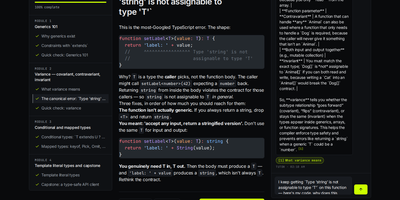
Tell Lumen what you want to learn in one sentence and it interviews you, drafts a brief, and builds a private course with modules, lessons, and quizzes, showing progress as it goes. Every learner owns the whole loop: define a goal, build the course, study it, and share it only when you choose to. An AI tutor sits beside each lesson, streams answers grounded in that course, and attaches citations that jump to the lesson it drew from. A trace view shows every planner step, tool call, and retrieval score behind an answer, and a replay view steps through how a course was authored. Quizzes feed a spaced-repetition review queue, a mastery view tracks progress, and finishing a course issues a verifiable Open Badges credential. Browse a public catalog with subject, level, and tag filters, clone any listed course into your own draft, and press Ctrl+K to search courses or switch themes. Add your own OpenAI, Anthropic, Groq, or Mistral key, or run without a key and keep the rest of the app working. An admin area moderates shared courses, and an MCP server lets coding agents list courses and ask the tutor. Running on a dedicated VPS on RepoCloud with guaranteed CPU, RAM, and SSD, full root SSH access, and a browser serial console. MIT licensed.
Webtor
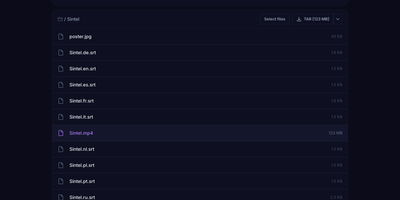
Webtor turns any magnet link or .torrent file into instant in-browser streaming and direct downloads on your own server, with no desktop torrent client and nothing to install for viewers. Drop in a magnet, an infohash, or a torrent file and the file list appears in seconds; pick a video and it plays in the built-in player while the pieces are still arriving, or take a plain HTTP download link for any single file instead. Whole torrents come down as ZIP or TAR archives generated on the fly with the folder structure preserved, and formats from MKV and MP4 to FLAC and MP3 stream without a separate transcoding step in most cases. Torrents you keep go into a personal library that recognizes movies and series automatically and enriches them with posters and descriptions, and the same library can mount as a network drive over WebDAV or S3 and play on a TV through the Stremio addon. Subtitles are matched from OpenSubtitles inside the player, uploaded tracks are supported, and optional AI translation renders them in your language; a master password locks the instance, the player embeds into other sites through the JavaScript SDK, and a REST API drives everything from your own code. Running on a dedicated VPS on RepoCloud with guaranteed CPU, RAM, and SSD, full root SSH access, and a browser serial console. MIT licensed.
RosarioSIS
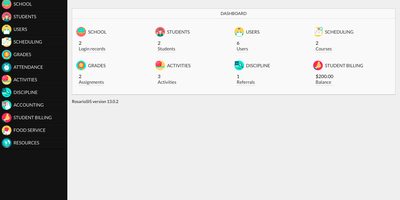
Report cards, attendance rosters, class schedules, discipline logs, and fee statements all live in one browser-based system with RosarioSIS, an open-source student information system for K-12 schools and similar institutions. Administrators define marking periods in up to three tiers, set grade levels and daily periods, and search students by gender, grade level, schedule, absences, GPA, or class rank. The scheduler places whole classes or a single student, and runs in test mode each time a student's requests are saved, so conflicts can be resolved with the student still in front of you. Teachers keep a weighted gradebook with grade ranges, progress reports, report cards, and transcripts, take attendance electronically, and use the eligibility feature to flag who may join athletic or academic activities. Discipline logs, student billing with fees, payments, balances, and statements, food service, and accounting complete the core modules. Parents and students get their own portal, new families can register online, listings export to Excel, CSV, or XML, and charts and PDF documents support decisions and paperwork. The interface adapts to tablets and phones and is translated into a dozen languages. Add-on modules bring email, library, hostel, Jitsi Meet video rooms, and Moodle integration. Running on a dedicated VPS on RepoCloud with guaranteed CPU, RAM, and SSD, full root SSH access, and a browser serial console. GPL-2.0 licensed.