OpenSearch Dashboards
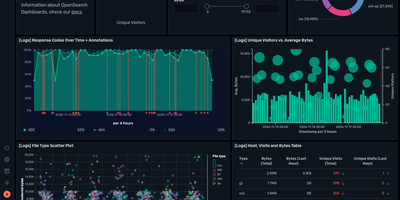
Point OpenSearch Dashboards at an OpenSearch cluster and the documents inside become searchable tables, charts, maps, and dashboards in a browser, with no API requests to write. Discover shows a histogram of documents over time. A field list sits beside expandable results. DQL or Lucene query strings narrow them, and the rows export as CSV. Visualize builds area, bar, line, pie, heat map, gauge, tag cloud, and map charts in a point-and-click editor. TSVB, Timeline, and Vega cover advanced cases. Dashboards combine those panels with input controls, a time picker, and a query bar that filters every panel at once. Sample data brings ready-made logs, flights, and eCommerce dashboards. Query Workbench runs SQL and PPL. Dev Tools sends Query DSL requests. Index Management lists indexes with health, size, and document counts. Reporting exports dashboards and visualizations as PDF, PNG, CSV, or XLSX, once or on a schedule. Observability apps explore logs, traces, and metrics. Alerting monitors and Anomaly Detection flag problems, and Notifications channels reach Slack, email, and webhooks. Data sources connect other OpenSearch clusters, Amazon S3, or Prometheus. Dashboards Management holds index patterns, saved objects, and advanced settings. Security Analytics adds threat alerts, findings, and correlations. Running on a dedicated VPS on RepoCloud with guaranteed CPU, RAM, and SSD, full root SSH access, and a browser serial console. Apache-2.0 licensed.
GeoLook
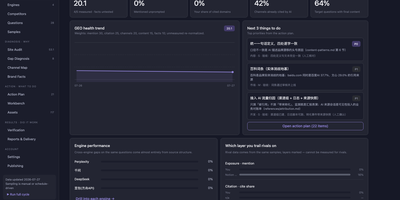
GeoLook shows you what AI search engines actually say about your brand, then turns that uncomfortable answer into a fix list you can work through and verify. You sample real answers across a wide matrix of AI engines and watch mention rate, ranking, and citation share appear per engine, with raw answer replay when a number looks suspicious. Competitor tables reveal which rival each engine prefers and which citation sources they rely on that you do not. A structured question bank sorts buyer, education, and probing questions, flagging the ones where you are absent, outranked, or described negatively. The site audit checks whether crawlers can reach, understand, and quote your pages, in the order those failures actually block visibility. Findings become tickets with an owner, effort estimate, risk grade, and acceptance check, and later sampling rounds confirm whether a fix worked or reopen the ticket when results slip. A content workbench ranks the topics most worth writing, checks drafts for citability, and prepares assets such as llms.txt and structured data snippets for publishing. Running on a dedicated VPS on RepoCloud with guaranteed CPU, RAM, and SSD, full root SSH access, and a browser serial console. MIT licensed.