OpenCTI
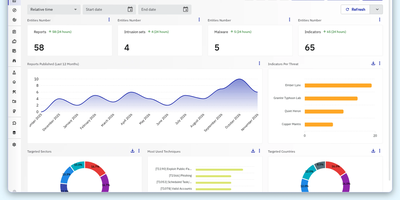
OpenCTI gives security teams one place to see which adversaries target their sector, how those groups operate, and which vulnerabilities they exploit. Reports, feeds, and analyst notes become linked STIX 2.1 entities such as intrusion sets, malware, ATT&CK techniques, vulnerabilities, and indicators, each carrying its source, confidence level, and TLP marking. Investigations start from a few entities and expand node by node, letting analysts pivot from an indicator to the campaign, malware family, and victim sector behind it. Threat pages show an ATT&CK matrix with the techniques in use highlighted, and custom dashboards chart any query as time series, distributions, or lists with one-click presets. Connectors import MITRE datasets, MISP, AlienVault, and CVE data, enrich observables through Shodan or DomainTools, and export STIX 2.1, CSV, or PDF files. TAXII collections, CSV feeds, and live streams publish selected knowledge to your SIEM or EDR, while RSS, CSV, JSON, and TAXII feeds pull outside intelligence in. Case management tracks incident responses, information requests, and takedown requests with assigned tasks and reusable task templates, and notification triggers alert analysts when watched entities change. A rules engine infers new relationships, decay rules age out stale indicators, and a GraphQL API with a Python client supports automation. Running on a dedicated VPS on RepoCloud with guaranteed CPU, RAM, and SSD, full root SSH access, and a browser serial console. Apache-2.0 licensed.
Argus Agentic SOC
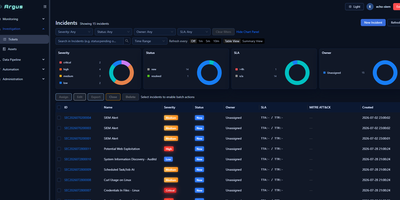
Every incident ticket in Argus, an open-source security operations center, comes with its own AI analyst, ready to explain the alert and suggest what to do next. Scheduled pipeline tasks pull alerts in from Elasticsearch and other sources, and tickets carry severity, owner, and SLA clocks that measure MTTA, MTTI, MTTC, and MTTR with color-coded buckets. Decision buttons walk each case from New through Acknowledged, Triaged, and Contained to Resolved. A War Room gathers analyst notes, system logs, files, pasted images, and extracted indicators. One click on Run AI Assistant returns a plain-language alert explanation, a suggested risk level, finished tasks, and next steps; scoped chat plus @ai and @playbook mentions keep the conversation inside the ticket. Built-in MCP tools look up CMDB assets, find similar past cases, and extract IPs, domains, and hashes, and you can register your own MCP servers and SKILL.md skills with usage monitors. A drag-and-drop workflow editor fires playbooks on new alerts, ticket changes, cron schedules, or webhooks. Detection engineers import Sigma rules from GitHub URLs or files, map fields to Splunk and Elastic ECS names, and review a publish history. Running on a dedicated VPS on RepoCloud with guaranteed CPU, RAM, and SSD, full root SSH access, and a browser serial console. Apache-2.0 licensed.
DFIR-IRIS
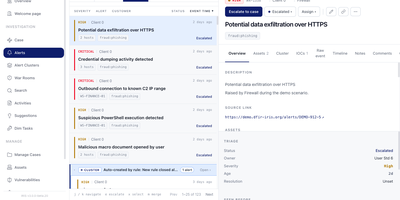
Incident response teams get one shared workspace for alerts, cases, evidence, and timelines in DFIR-IRIS, a free, self-hosted platform built for collaborative investigations. Alerts from SIEM and EDR tools arrive through an API, where analysts triage them, assign owners, and merge or escalate them into cases. Cases record a customer, classification, and SOC ticket ID, and case templates pre-fill the summary, tags, tasks, and note folders so every incident starts from your playbook. Assets, IOCs with TLP levels, tasks, notes, and uploaded evidence sit side by side in the case. The timeline orders events chronologically and files them under categories such as Initial Access, Lateral Movement, and Exfiltration. The case graph maps how assets, IOCs, and events connect. Modules enrich indicators with VirusTotal or MISP and push events to Slack, Microsoft Teams, Discord, or automation tools such as Shuffle. A datastore keeps case files organized, with IOC files wrapped in password-protected archives. Investigation and activity reports export to DOCX, Markdown, or HTML from templates your administrators manage. Customers, groups, and per-user rules decide who can see, read, or edit each case, and custom attributes extend any case object with the fields your team needs. Running on a dedicated VPS on RepoCloud with guaranteed CPU, RAM, and SSD, full root SSH access, and a browser serial console. LGPL-3.0 licensed.
Conformiti
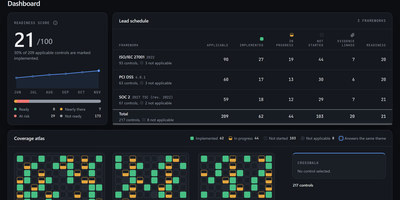
Audit season stops being a six week archaeology dig through shared drives when Conformiti keeps your whole compliance programme in one self-hosted system built for SOC 2, ISO/IEC 27001:2022, and PCI DSS v4.0.1. Its three complete control libraries hold 217 controls with a cross-framework crosswalk, so satisfying one requirement can answer its equivalents elsewhere instead of duplicating work. Evidence lives in a folder tree generated from those libraries, where every document declares which controls it satisfies and every control lists its documents, ending the hunt for proof at fieldwork time. Readiness is calculated rather than vibes: each control scores from implementation status, owner, evidence freshness, and testing, minus a penalty for open risks, and the dashboard tracks that score with daily snapshots. Documents carry review cadences with escalating email reminders before they expire, versions archive instead of overwriting, and uploads can pass through ClamAV scanning. A five by five risk register, vendor register with shared responsibility matrices, periodic access reviews, and a RACI matrix keep the rest of the programme beside the controls instead of in separate spreadsheets. When assessors arrive, you issue them a sealed, signed evidence package for a fixed window that verifies offline, rather than handing over drive access that outlives the engagement. Running on a dedicated VPS on RepoCloud with guaranteed CPU, RAM, and SSD, full root SSH access, and a browser serial console. AGPL-3.0 licensed.