Cerbos
Cerbos decouples authorization logic from application code entirely, evaluating human-readable YAML policies in under one millisecond through a stateless Policy Decision Point that requires no application state synchronization or cross-network fan-out. Its custom decision engine benchmarks up to 17x faster than OPA-based alternatives. Access control policies use conditions expressed in Google's Common Expression Language, supporting role-based, attribute-based, and policy-based access control patterns including derived roles, scoped policies, and permissions-aware data filtering that pushes authorization predicates directly into database queries. The PDP exposes both gRPC and HTTP APIs with SDKs for JavaScript, Python, Go, Java, .NET, Rust, PHP, and Ruby, making integration a single function call regardless of tech stack. GitOps-native workflows treat policies as code with Git versioning, CI validation through GitHub Actions, coverage reports, breaking-change detection, and audit logs of every authorization decision for ISO27001, SOC2, and HIPAA compliance. Deployment flexibility spans Kubernetes sidecars, standalone services, systemd daemons, AWS Lambda functions, and WebAssembly-embedded PDPs that run authorization logic directly in browsers, serverless architectures, and edge devices. The Admin API manages policy lifecycle operations programmatically, while the built-in Playground and REPL provide interactive testing environments for policy authoring and debugging. Running on a dedicated VPS on RepoCloud with guaranteed CPU, RAM, and SSD, full root SSH access, and a browser serial console. Apache 2.0 licensed.
Guard Spec
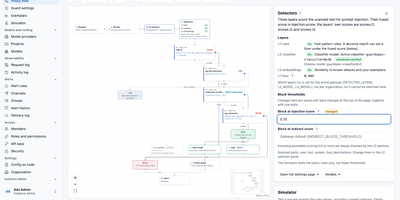
Any web page, document, or tool result your LLM reads can carry hidden orders, so Guard Spec sits between your app and the model and blocks prompt injection before it arrives. Change one base URL and the gateway accepts OpenAI-style chat completions, the Responses API, embeddings, and Anthropic's Messages API for Claude Code, then routes clean traffic to OpenAI, Azure OpenAI, Anthropic, Gemini, vLLM, or Ollama. Each request is sanitized, scored by pattern rules, an in-process classifier, and similarity to known attack examples, and judged against your policies; an injection gets an HTTP 400 and the model is never called. Tool results, retrieved documents, and MCP tool descriptions are scored one by one, so hidden instructions and poisoned tool definitions are caught. An output guard checks answers, including streamed ones, for exfiltration links, personal data, and a leaked canary. Policies per organization and project are written as text or in a visual editor, tested in a simulator, and edited as YAML with a diff. Rules see through Vietnamese diacritics, teencode, leetspeak, and homoglyphs, because detection was built for English and Vietnamese. Alerts reach Slack, Microsoft Teams, Telegram, email, PagerDuty, Opsgenie, or signed SIEM webhooks, and single sign-on works with OpenID Connect or SAML 2.0 plus SCIM provisioning and TOTP two-factor. Running on a dedicated VPS on RepoCloud with guaranteed CPU, RAM, and SSD, full root SSH access, and a browser serial console. Apache-2.0 licensed.