Kaeso
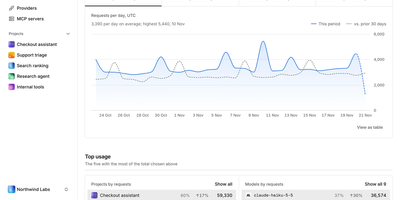
Point every app, SDK, and coding tool at one endpoint, and Kaeso routes each request to the provider or self-hosted model that should answer it, with budgets, logs, and access control built in. Apps keep speaking the OpenAI, Anthropic, Gemini, or ElevenLabs format, and Kaeso translates each request, reply, and stream for whichever provider sits behind the model name. Beyond chat it serves embeddings, reranking, decision models that answer typed questions with probabilities, images, video, speech, transcription, music, and batches. Alias routes add conditions, weighted splits, fallbacks, and retries, key pools spread a project over several keys of one provider, and retiring models send Deprecation and Sunset headers, show who still calls them, and offer a one-click move to the replacement. Hard or soft budgets and rate limits per project, member, service account, or key are checked before the provider is called, and guardrails mask or block secrets, email addresses, IBANs, and card numbers before the model sees them. Teams get single sign-on over OpenID Connect, SCIM 2.0, roles, and request logs that keep content only where the organization, project, or request allows. A playground compares models side by side, and a per-project MCP portal lets claude.ai, ChatGPT, or Cursor call your MCP servers. Claude Code and Codex can use Kaeso as their model provider, so every session is logged and budgeted. Running on a dedicated VPS on RepoCloud with guaranteed CPU, RAM, and SSD, full root SSH access, and a browser serial console. MIT licensed.
Guard Spec
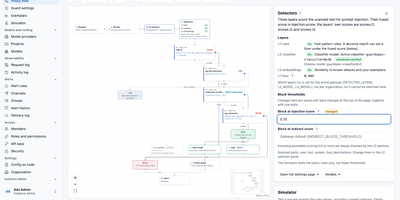
Any web page, document, or tool result your LLM reads can carry hidden orders, so Guard Spec sits between your app and the model and blocks prompt injection before it arrives. Change one base URL and the gateway accepts OpenAI-style chat completions, the Responses API, embeddings, and Anthropic's Messages API for Claude Code, then routes clean traffic to OpenAI, Azure OpenAI, Anthropic, Gemini, vLLM, or Ollama. Each request is sanitized, scored by pattern rules, an in-process classifier, and similarity to known attack examples, and judged against your policies; an injection gets an HTTP 400 and the model is never called. Tool results, retrieved documents, and MCP tool descriptions are scored one by one, so hidden instructions and poisoned tool definitions are caught. An output guard checks answers, including streamed ones, for exfiltration links, personal data, and a leaked canary. Policies per organization and project are written as text or in a visual editor, tested in a simulator, and edited as YAML with a diff. Rules see through Vietnamese diacritics, teencode, leetspeak, and homoglyphs, because detection was built for English and Vietnamese. Alerts reach Slack, Microsoft Teams, Telegram, email, PagerDuty, Opsgenie, or signed SIEM webhooks, and single sign-on works with OpenID Connect or SAML 2.0 plus SCIM provisioning and TOTP two-factor. Running on a dedicated VPS on RepoCloud with guaranteed CPU, RAM, and SSD, full root SSH access, and a browser serial console. Apache-2.0 licensed.
Aegis
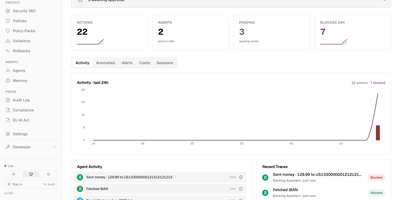
Put a checkpoint in front of every tool call your AI agents make, so a poisoned web page or file cannot quietly move money or send private data. Each call is classified and policy-checked before it executes, then allowed, blocked, or held for a person. Held calls land in an approvals queue that shows what the user asked, which passage the agent read, and the exact recipient or amount in question, with one-click block or allow. Instruction provenance flags destinations that appeared only in untrusted content, like an IBAN hidden in a file. The cockpit lists every run as a timeline of steps with verdicts, groups violations by the protection that caught them, and scores ten attack surfaces on a Security 360 page. An agent registry tracks owners, scope, and call counts. Budgets, anomaly alerts, and a kill switch cap runaway behavior. Sensitive values are redacted from traces, signed receipts prove a call was allowed, and exports produce PDF and CSV audit evidence. Python and TypeScript SDKs plug in with one line, or an LLM proxy catches calls with an environment variable. Running on a dedicated VPS on RepoCloud with guaranteed CPU, RAM, and SSD, full root SSH access, and a browser serial console. MIT licensed.