Rewindarr
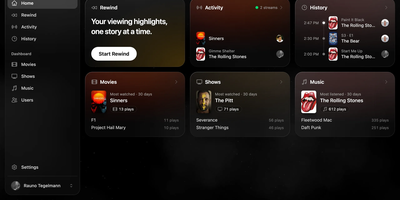
Spotify gets a Wrapped; your media server deserves one too. Rewindarr is an open-source companion for Plex and Jellyfin that turns play history into a story your users step through, card by card: total watch time, how it split across movies, shows, and music, how they rank against the average viewer, and the viewing personality their habits earn them, ending in a summary they can save as an image and share. The same deployment doubles as an everyday dashboard for the whole server, with watch time, requests, library size, and per-library leaderboards for movies, shows, music, and users across a week, a month, a year, or all time. Live activity shows what is streaming right now, and searchable history groups binges together so a weekend disappears into one tidy entry. Ratings from TMDB, IMDb, and Rotten Tomatoes sit beside every title, request buttons reconnect viewers with deleted favourites through Seerr, and anonymisation trims user details when you share the dashboard wider. Statistics flow in from Tautulli or Tracearr for Plex and from Tracearr for Jellyfin, everyone signs in with the Plex or Jellyfin account they already have, and the installable app works on the TV-side phone as happily as on a desktop. Running on a dedicated VPS on RepoCloud with guaranteed CPU, RAM, and SSD, full root SSH access, and a browser serial console. GPL-3.0 licensed.
PocketRisu
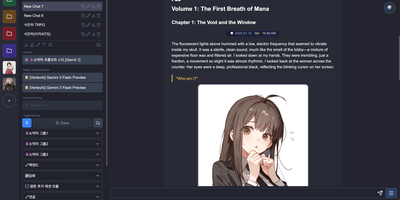
Your AI characters deserve a home that is actually yours: PocketRisu is a private roleplay chat server where your stories, personas, and worlds live on hardware you control instead of someone else's cloud. Create characters or import them from the wider RisuAI ecosystem, including character cards, modules, lorebooks, and presets, then chat from your computer, tablet, or phone against the same single server. Conversations keep generating on the server even when your screen locks or the connection drops, and reconnecting restores the finished reply instead of a lost message. Switch between OpenAI, Claude, Gemini, DeepInfra, OpenRouter, Ollama, and more, set separate auxiliary models for background tasks, and shape behavior with presets, regex scripts, and plugins. Lorebooks and long-term memory features help long stories stay consistent, automatic translation smooths cross-language roleplay, and text-to-speech plus embedded images, audio, and video make scenes richer. Everything, from characters and chats to inlay images, sits in one SQLite database on your server, so backup and restore are a server-side job rather than a browser export ritual. A built-in dashboard shows disk use per character and module, reclaims snapshot space, and keeps the database optimized, while multilingual interface options welcome players in Korean, English, Japanese, Chinese, and beyond. Running on a dedicated VPS on RepoCloud with guaranteed CPU, RAM, and SSD, full root SSH access, and a browser serial console. GPL-3.0 licensed.
VodMax
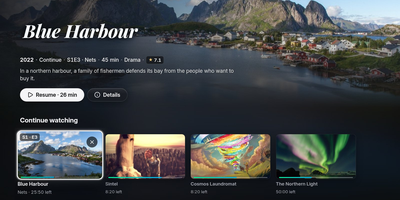
Live TV, movies, and series usually live in separate apps; VodMax gathers them in one home server with a set-top-box feel. Zap channels by number, browse a program guide grid, pause and rewind a live show, or start it from the beginning. Record from the guide or with rules, and even type a sentence like "record tonight's film" to the optional assistant. Playlists from M3U or Xtream Codes sit beside local folders of movies and series, and posters, plots, cast, continue watching, next episode, and skip intro work across all of them. Each person gets a profile with their own progress, favorites, and a kids mode, and TVs and phones pair with a short code or a home sign-in. Plex, Jellyfin, and Emby can see the server as a tuner, and TiviMate, Kodi, and VLC read its playlist and guide. A catalog filter keeps only your countries, years, and categories, and an optional built-in WireGuard tunnel keeps playlist traffic private. Encrypted backups, downloads for offline viewing, and an interface in six languages round it out. Running on a dedicated VPS on RepoCloud with guaranteed CPU, RAM, and SSD, full root SSH access, and a browser serial console. AGPL-3.0 licensed.
Jellyseerr
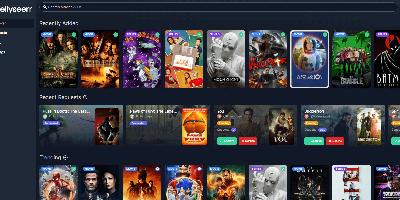
Browse trending titles, search anything, request it in two clicks: Jellyseerr gives Jellyfin, Emby, and Plex users a beautiful storefront for the media library. Born as the Overseerr fork that added Jellyfin and Emby support (the projects have since unified as Seerr), it handles the full request lifecycle - users authenticate with their existing media-server accounts, pick individual seasons or movies in a clean interface, and admins approve or decline from a simple queue, including on mobile. Approved requests flow straight to Sonarr and Radarr, which handle acquisition automatically, with support for separate 4K server instances. Regular library scans keep availability accurate, so users see instantly what already exists instead of requesting duplicates. A granular permission system controls who can request what - auto-approval for trusted users, quotas and limits elsewhere - and override rules adjust request routing by user, tag, or other conditions. Watchlist and blocklist functions curate discovery, notifications reach email, Discord, Telegram, Slack, Pushover, and Pushbullet, and both PostgreSQL and SQLite are supported. Localized into many languages, it turns "can you add this movie?" texts into a self-service system that runs itself.
Reiverr
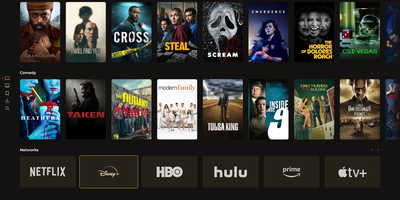
Finding something to watch, requesting it, downloading it, and pressing play all happen on one remote-friendly screen. Browse trending titles, genre rows, and streaming network shelves backed by TMDB, then open a series to pick the episodes to request. Download-ahead rules fetch the next few episodes as you watch, keep the last watched ones, and remove watched files after a chosen period, so the disk does not fill with finished shows. A built-in torrent client does the downloading through an indexer, and each user gets a storage quota that appears next to every request. The library page tracks unwatched and watched series and movies with filters for media type, files on disk, and sort order, plus an A to Z jump bar. A Downloads page lists what is fetching and what each request holds, and the Server page scans library folders, flags managed or external files, and shows logs. Existing media folders are discovered from disk and stay compatible with Jellyfin layouts. Direct playback supports audio track selection and sidecar subtitles. Apps for Samsung Tizen and Android TV talk to the same backend. Running on a dedicated VPS on RepoCloud with guaranteed CPU, RAM, and SSD, full root SSH access, and a browser serial console. AGPL-3.0 licensed.
Universal Media Server
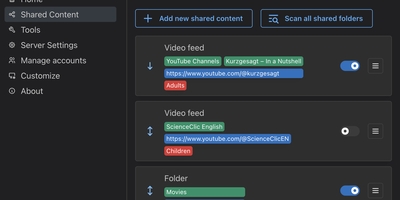
Every screen in the house (browser, TV, game console, or phone) can open the same library of videos, music, and photos once Universal Media Server shares it, with transcoding handled automatically for whichever device asks. A file the device can already play passes through untouched. Anything else is converted on the fly to suit the network, the device, and the preferred language. Folders open at once, with no wait for library scans, and disc drives and disc images play directly. In the web interface, every title gets a page with cover art, cast, and genre details from TMDB, Discogs, and MusicBrainz, and filters narrow the library by actor, director, genre, year, or artist. YouTube channels, online radio, podcasts, and RSS feeds appear beside local files on every connected device. Users and groups, with optional avatars and four-digit PINs, decide which shared folders each person sees; content for children stays apart from the library for adults. A list of detected renderers shows every connected device, and the configuration file of each device can be edited to fix browsing, playback, or transcoding on an unsupported TV. Builds exist for Windows, Linux, and macOS, with AppImage and Docker options for servers. Running on a dedicated VPS on RepoCloud with guaranteed CPU, RAM, and SSD, full root SSH access, and a browser serial console. GPL-2.0 licensed.
Snapcast
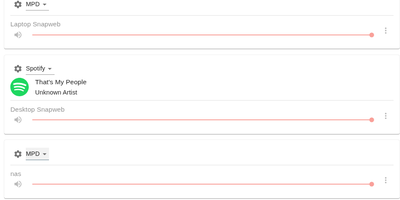
With Snapcast, the music follows you from kitchen to study without a stumble, because every speaker in the house plays the same audio at the same instant. The server grabs sound from your player, a Spotify Connect endpoint, an AirPlay receiver, a turntable line-in, or a network stream, then feeds it to small clients around the house. Each client keeps its clock married to the server time and trims single samples to correct drift, holding sync tight enough that echoes between rooms simply do not happen. Group clients so the downstairs plays the record collection and the office plays a radio stream, switch a room from one source to another from your phone or browser, and set each room volume independently. Clients run on Raspberry Pis, old laptops, Android phones, ESP32 boards, and the server itself, so spare hardware becomes speakers instead of e-waste. Pair it with MPD or Mopidy for a library, librespot for Spotify, or shairport-sync for AirPlay, and choose PCM, FLAC, Vorbis, or Opus per stream to balance fidelity and bandwidth. Running on a dedicated VPS on RepoCloud with guaranteed CPU, RAM, and SSD, full root SSH access, and a browser serial console. GPL-3.0 licensed.
Sonarr
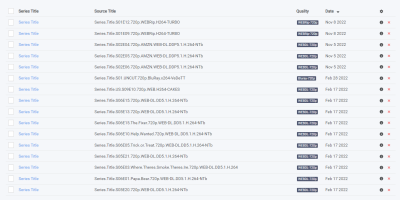
Add a series once, set a quality profile, and everything downstream is automated: Sonarr is the smart PVR for Usenet and BitTorrent users. It monitors RSS feeds from your indexers, detects new episodes the moment they release, sends matching grabs to SABnzbd, NZBGet, qBittorrent, Deluge, or another download client, then renames files with fully configurable templates, sorts them into consistent folder structures, and notifies Plex, Kodi, or Jellyfin to update the library. Quality profiles define what's acceptable (HDTV, WEB-DL, Blu-ray, up to 4K) and an upgrade cutoff - when a better release appears, Sonarr replaces the existing file automatically, stepping from HDTV to WEB-DL to Blu-ray until the cutoff is met. Custom formats add weighted scoring for finer-grained release selection, with community-maintained TRaSH Guides presets as the widely accepted defaults. Failed downloads are handled without intervention: Sonarr retries with another release, and manual search shows every candidate with the reasons any was rejected. It scans existing libraries for missing episodes, fully supports specials, multi-episode files, and daily and anime series types, and a calendar view shows upcoming episodes across every tracked show. Runs on Linux, Windows, macOS, and Raspberry Pi, and pairs naturally with Prowlarr for centralized indexer management.
Shortlist
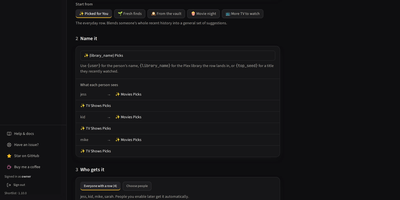
Everyone on your Plex server gets their own private recommendation rows with Shortlist, built from what each person actually watched and visible to nobody else. For each viewer it reads their Plex watch history, picks unwatched titles from your library, and explains every pick with the reason it earned its place. Rows land on Plex Home labelled, hidden from every other account by share filters, and only then promoted, so a row is never visible to the wrong person, not even briefly. Six row kinds, from Picked for You to seasonal picks and personal requests, start from eleven templates instead of a blank form. A seasonal row follows the calendar through Halloween, Christmas, and twenty more ready-made occasions, then hides itself between seasons. Rebuilds run nightly, weekly, or monthly on your cadence, and the dashboard shows what was delivered against what people started and actually finished, per user and per row. Missing a strong pick, Shortlist asks Radarr, Sonarr, or Overseerr for it: the boldest few auto-send nightly, the rest wait for one click in the Requests inbox. No AI key is required; add one and Describe a row turns slow-burn heist films into a themed row filled nightly for each person. Running on a dedicated VPS on RepoCloud with guaranteed CPU, RAM, and SSD, full root SSH access, and a browser serial console. MIT licensed.
Mydia
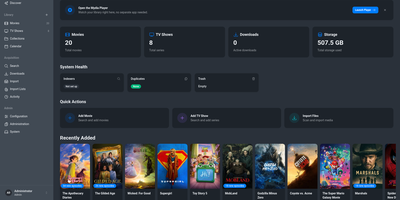
Mydia turns a folder full of movies and TV shows into a polished library that finds, ranks, and upgrades releases on its own. Poster grids, series pages with season and episode lists, and a release calendar keep every title organized with metadata from TMDB and TVDB. Monitored searches send requests to Prowlarr, Jackett, or the built-in indexer engine, then pass the best release to qBittorrent, Transmission, SABnzbd, NZBGet, or a debrid provider. A transparent ranking system explains why one release beat another, and quality profiles with custom formats decide when a better file should replace the old one. Guests can request titles through an approval workflow, and sign-in works with local accounts or OpenID Connect. Import lists pull from TMDB watchlists, popular, and trending charts, and a dashboard shows library size, downloads, duplicates, and storage at a glance. The built-in player streams the library from a browser at the /player path, with apps for desktop and phones that connect through an encrypted peer-to-peer link. Light, dark, and several color themes fit any screen. Running on a dedicated VPS on RepoCloud with guaranteed CPU, RAM, and SSD, full root SSH access, and a browser serial console. AGPL-3.0 licensed.
nodecast-tv
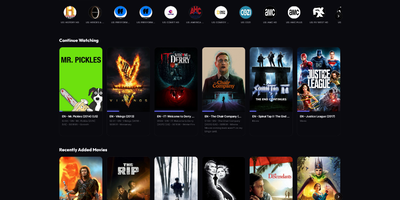
Bring your own IPTV provider and nodecast-tv gives it a fast browser interface for live channels, a program guide, movies, and series. Add an Xtream Codes or M3U provider in Settings, then zap through channels with category grouping and search; playlists of thousands of channels scroll smoothly. The 24-hour TV guide is interactive, and movie and series pages show posters, ratings, metadata, and seasonal episode lists. Favorites sync across channels, movies, and series, and the home page keeps a Continue Watching shelf and recently added titles within reach. Transcoding steps in only when a stream needs it, using hardware encoders and surround-to-stereo downmix presets like Night Mode and Cinematic. Admin and viewer roles control who can change settings, and OIDC single sign-on works with Authentik, Keycloak, and similar providers. Hidden categories, volume memory, and auto-play fine-tune playback. Running on a dedicated VPS on RepoCloud with guaranteed CPU, RAM, and SSD, full root SSH access, and a browser serial console. GPL-3.0 licensed.
TavernAI
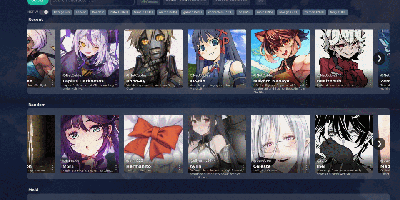
Character-based chat and storywriting with large language models: TavernAI is the open-source frontend that leaves model choice to you. It generates no text itself; it connects to the backend of your choice - OpenAI (including GPT-4), Anthropic Claude, KoboldAI and KoboldCpp, Oobabooga's Text Generation Web UI, NovelAI, Ollama, and the crowdsourced Horde - so cost, model quality, and content policy are decided by your backend, not the interface. Characters are defined by portable card files in PNG or JSON format with personality, scenario, and example dialogue, and tens of thousands of community-made cards from sites like Chub.ai import directly. Conversations support group chats with multiple characters, a story mode for long-form writing, message swiping to branch between alternative responses, and full editing of any message. World Info injects lore into context when keywords trigger, keeping long roleplays consistent. Themes, custom backgrounds, and configurable generation settings round out the interface. It runs on Node.js, and the SillyTavern project began as a fork of it.
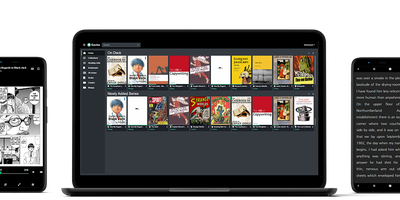
Kavita
Manga, comics, ebooks, and light novels get a streaming-service-style home in Kavita - a fast, cross-platform reading server for the DRM-free collection you share with family and friends. It natively serves CBZ, CBR, CB7, ZIP/RAR/7z archives, raw images, EPUB, and PDF, with hand-crafted web readers per format: webtoon scrolling, single and dual-page spreads with advanced caching for the comic reader, and a book reader with adjustable fonts, spacing, margins, color themes, and column modes. Reading progress tracks per user, so everyone resumes exactly where they stopped on any device. Metadata parses from filenames, ComicInfo.xml, and EPUB fields, feeding index-backed search, smart filters, collections, reading lists with CBL import, and Want to Read queues. Role-based user management covers age restrictions, per-library access, and OIDC authentication. An OPDS feed connects third-party clients - Panels on iOS, Librera on Android, KOReader on e-ink devices - and a comprehensive REST API supports custom integrations. EPUB annotation and highlight support, custom theming, and full localization round it out. Built with .NET and Angular, it handles 50,000+ file libraries without strain; optional Kavita+ adds AniList scrobbling, recommendations, and external metadata.
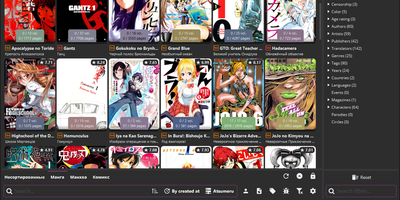
Atsumeru
Atsumeru is the bookshelf server for people whose manga and comic collection lives in CBZ files scattered across drives: point it at the folders and it becomes a tidy library you can read from anywhere. Series organize themselves into auto categories, custom categories, and metacategories, and metadata edits are painless, with automatic import from ComicInfo.xml and book_info.json files and parsing from supported catalogs when you want richer records. Reading happens in native apps for Windows, Linux, Mac, and Android, or in the built-in WebUI, and two-way history synchronization keeps your place when you move from desk to phone. Whole series download inside supported apps for offline reading, which turns a commute into a chapter backlog clearing session. Multiple users get separate histories and powerful access controls, so a household shares one server without sharing reading progress or seeing each other's shelves. A documented REST API with Swagger on board covers automation and custom clients. The server runs as a single jar or a Docker container on port 31337, small enough for the spare machine already holding the files. Running on a dedicated VPS on RepoCloud with guaranteed CPU, RAM, and SSD, full root SSH access, and a browser serial console. MIT licensed.
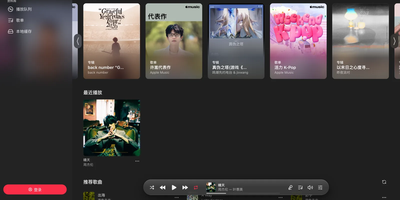
mhub
Apple Music, NetEase Cloud, and QQ Music stop being separate apps with MHub: one self-hosted player searches all three and lines their songs up in a single queue. Search any platform, import its playlists, and MHub matches tracks across services, then keeps imported lists following the originals with a daily sync. The queue takes appends, play-next picks, drag reordering, shuffle, and loop, and an AutoPlay radio built from your recent songs keeps playing when it runs dry. ALAC tracks decode losslessly right in the browser with sample-accurate scheduling, and everything else plays natively, with quality chosen at play time. Lyrics land character by character over a background tinted by the cover art, and they convert between Simplified and Traditional Chinese on request. Lock the phone or switch apps and playback rolls on with system media controls, the next track preloaded for a seamless handoff. Songs and lyrics cache on the device for offline listening, and the player installs as a PWA that behaves like a native app. Add a passkey account and your library syncs live between devices, so the playlist you built at your desk is waiting on your phone with your place kept. One Docker container runs it, bound to localhost by default behind your reverse proxy. Running on a dedicated VPS on RepoCloud with guaranteed CPU, RAM, and SSD, full root SSH access, and a browser serial console. AGPL-3.0 licensed.
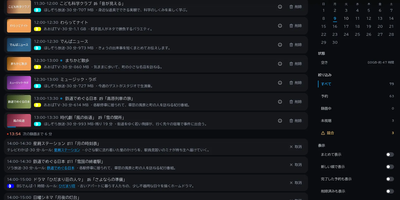
Denpa
Denpa is a home TV recording server that turns a Linux machine and a TV tuner into a private recorder for Japanese terrestrial and satellite broadcasts, with reservations and browser playback. There are no configuration files: plug in a supported tuner and card reader, press scan, and the tuner type, channels, and program guide set themselves up. Reserve from the guide, or save a search as a rule and matching broadcasts record automatically; a repeated episode is ignored after its first airing is captured. Recordings encode to AV1 or H.264 MKV files (H.265 when a GPU is present) with captions exactly as broadcast, and detected commercials become chapters that playback skips entirely. Playback resumes where you stopped, runs at up to double speed, and clips save on the server with captions intact; programs also download to devices for offline viewing. Live viewing runs about a second behind the broadcast: pausing starts chase playback, alternate audio stays selectable, and BML data broadcasting works in the browser. The companion denpa-tv app reaches Android TV and Fire TV through QR pairing, and an API exposes channels, recordings, and audio-only feeds to Home Assistant and scripts. EPGStation and EDCB users can import rules, reservations, and recordings, and the interface stays closed until you open it to trusted networks or protect it with OIDC login. Running on a dedicated VPS on RepoCloud with guaranteed CPU, RAM, and SSD, full root SSH access, and a browser serial console. AGPL-3.0 licensed.
Muse
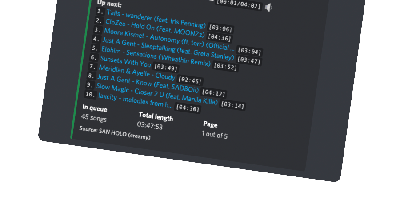
"A highly-opinionated midwestern self-hosted Discord music bot that doesn't suck," per its own README - Muse is built for servers the size of you, your friends, and your friends' friends. It exists because the big public music bots kept getting shut down or paywalled, and self-hosting yours means nobody can take it away. Written in TypeScript on discord.js, it joins voice channels and plays audio resolved from YouTube via yt-dlp, and given optional Spotify API credentials it auto-converts Spotify tracks, albums, artists, and entire playlists to playable equivalents. The playback details show real care: seeking within songs and videos, livestream support, local caching so repeated plays start instantly, volume normalization across tracks, and configurable volume controls including optional ducking that lowers music when people speak. SponsorBlock integration can skip non-music segments automatically. Users save favorite queries as reusable shortcuts, and one Muse instance serves multiple guilds simultaneously - one deployment for all your communities. Configuration is three environment variables (Discord token, YouTube API key, optional Spotify pair) and the personality is free: there is no vote-to-skip, because "this is anarchy, not a democracy," and the bot remains a loyal Green Bay Packers fan. MIT-licensed and easily extendable.
Emby
Point Emby at your movie, music, and photo libraries and it becomes a private streaming service: metadata and artwork arrive from TMDB and TVDB, everything lands in a polished browsable interface, and media transcodes on the fly whenever a client can't play the original format. The client reach is the selling point: native apps span Android TV, Apple TV, Google TV, Fire TV, Roku, LG and Samsung smart TVs, iOS, Android, Apple CarPlay, Android Auto, plus web browsers and desktop apps for Windows, macOS, and Linux, and DLNA devices are auto-detected for casting and remote control. Multi-user support gives each household member their own account, watch history, favorites, and recommendations, with genuinely capable parental controls: content restrictions, access schedules, time limits, and live monitoring with remote control of kids' sessions. Live TV works with hardware tuners like HDHomeRun or M3U playlists, with free guide data in the US, Canada, and UK. The server and core features are free; an optional Premiere key adds hardware-accelerated transcoding, DVR recording, offline sync, and Cinema Mode intros.