RocketRide
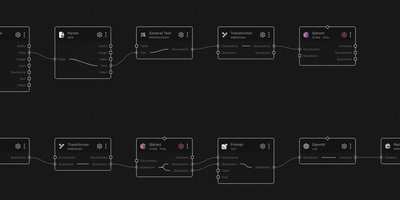
Building an AI pipeline in RocketRide means dragging nodes for models, vector stores, document parsers, and agents onto one visual canvas and wiring their typed lanes together, with no boilerplate in between. Press play on a webhook, chat, or file-dropper source node to start the pipeline. The catalog holds 170 nodes across 21 types, including 16 LLM nodes for OpenAI, Anthropic, Gemini, Mistral, and Ollama, vector stores such as Qdrant, Pinecone, Milvus, and pgvector, OCR, entity recognition, PII anonymization, reranking, and database connectors. Agent nodes run CrewAI, LangChain, LlamaIndex, or Deep Agents, and a persistent memory node carries context from one run to the next. Every pipeline is plain JSON. Commit it, diff it, review it, then run the identical file on a laptop, a server, or RocketRide Cloud. Tracing shows call trees, token usage, latency, and memory for each run, so you can compare models, agents, and tools before scaling up. Applications call pipelines through TypeScript and Python SDKs, and coding agents such as Claude and Cursor can build, change, and deploy them in plain language. Example pipelines cover document intake that reads text from scans and masks personal data, question answering over private files, and agent workflows, while Discord and Telegram source nodes feed chat bots into the pipeline. Running on a dedicated VPS on RepoCloud with guaranteed CPU, RAM, and SSD, full root SSH access, and a browser serial console. MIT licensed.
Deploy