LangBot
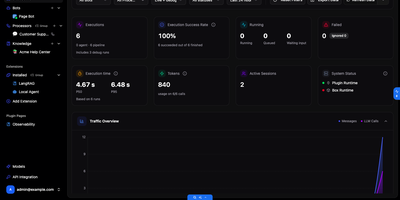
Connect one AI assistant to every chat app your customers already use, then manage it from a single admin panel. Create a bot for Slack, Discord, Telegram, LINE, Lark, DingTalk, WeCom, Matrix, KOOK, or QQ, or embed the Page Bot widget on a website with one script tag. Event routing sends each message to the processor you choose, and a pipeline controls triggers, safety rules, the model and prompt, and how replies are sent. A built-in Debug Chat streams answers as you edit, in private or group sessions. Knowledge bases split uploaded documents into chunks and search them by vector, full-text, or hybrid matching, with query rewriting and reranking options. Add providers like OpenAI, Anthropic, DeepSeek, Gemini, and Ollama, then give each pipeline its own models. The dashboard counts executions, success rate, token usage, and active sessions, and tabs list model calls, user feedback, and error logs. Sessions show the full conversation for each user, with a button to reset context. Install plugins and MCP servers from the extension marketplace to add tools. Use it for a support bot, a community assistant, an internal helpdesk, or a multi-channel front desk. Running on a dedicated VPS on RepoCloud with guaranteed CPU, RAM, and SSD, full root SSH access, and a browser serial console. Apache-2.0 licensed.
Vocero CRM
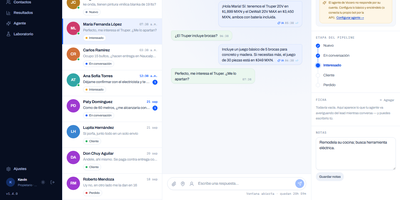
Vocero CRM turns WhatsApp into your sales floor, with a shared team inbox, a visual pipeline, and an AI agent that answers customers using only what your business taught it. Incoming messages land in a three-column inbox within two seconds, showing sent, delivered, and read states, enforcing the official 24-hour window, and offering approved templates when it closes. Every person who writes becomes a contact automatically and enters a Kanban pipeline you can rename, where dragging a card, adding notes, or archiving a lead takes seconds. The AI agent learns from question-and-answer pairs and free-text knowledge blocks, and answers only from what it knows. It bundles message bursts into one reply and hands the conversation to a human whenever the customer asks or the rules say so. Before the agent ever meets a real customer, the Laboratory sends six simulated customers at it, from the decided buyer to the angry one, and an independent judge scores each conversation from 0 to 100 with findings and one-click fixes you can re-test after every change. Owners create team accounts, message templates sync their approval status from Meta, and WhatsApp tokens sit encrypted at rest while every customer record stays on hardware you own. Running on a dedicated VPS on RepoCloud with guaranteed CPU, RAM, and SSD, full root SSH access, and a browser serial console. MIT licensed.
Feedlog
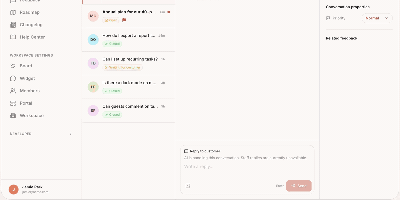
FeedLog gives SaaS teams an AI support agent, a shared inbox, and a feedback-to-roadmap loop in one open-source platform they can host themselves. Customers ask questions inside your product through an embeddable widget, and the agent answers from your help center articles, which you mark as approved knowledge before it can use them. When a question needs a person, the conversation moves into a shared inbox with its full context intact, so customers never repeat themselves and your team replies with email notifications keeping the thread alive. The same widget collects bug reports and feature ideas into feedback boards with posts, voting, comments, and status workflows, while similar-feedback detection finds duplicates and merges fragmented requests before they scatter your priorities. Prioritized work becomes a public roadmap showing what is planned, in progress, and completed, and shipped changes close the loop as changelog entries you can draft with AI from your update notes. Guest access, email and password, Google, GitHub, and SSO sign-in options decide how customers identify themselves, and human support guidance routes billing, account, and privacy requests straight to people. An MCP server connects AI assistants to your boards and articles so agents can query and manage feedback in natural language. Running on a dedicated VPS on RepoCloud with guaranteed CPU, RAM, and SSD, full root SSH access, and a browser serial console. MIT licensed.
Synaplan
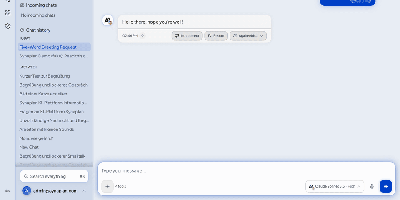
Instead of a separate chatbot for each channel, Synaplan runs one self-hosted AI assistant for your team, website visitors, WhatsApp line, and inbox, and shows what every reply cost. In the web app, connect OpenAI, Anthropic, Gemini, Groq, Mistral, xAI, Hugging Face, or local Ollama. Each kind of work gets its own model, from chat and image to video and audio, and every answer carries a Free, Low, Mid, or High cost badge. A planner splits a big request into a task graph and sends each step to the model that fits. On your website, one script tag adds a chat widget, and a human operator can take over any conversation live. On WhatsApp Business and email, the assistant replies on the channel where the question arrived. Behind every channel sits one knowledge base: upload PDFs, Word and Excel files, or images with OCR, and semantic search feeds them into answers. Saved tasks run on demand or on a schedule, approvals pause any action that writes, and watched pages mail you a diff when a URL changes. Connections reach Microsoft 365, Dropbox, Nextcloud, ownCloud, WebDAV, CalDAV, Jira, and Confluence. An MCP server and an Anthropic-compatible endpoint let Claude, Cursor, and Claude Code use your instance. Users and groups share folders and assistants, and admins see usage and health. Running on a dedicated VPS on RepoCloud with guaranteed CPU, RAM, and SSD, full root SSH access, and a browser serial console. Apache-2.0 licensed.
Basjoo
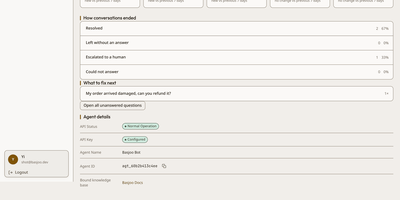
Support tickets that repeat the same twelve questions all week can answer themselves when Basjoo turns your website and documents into an embeddable AI support agent you host yourself. Knowledge bases are built independently of agents, fed by crawling a single page or an entire site, or by uploading PDF, Word, Excel, HTML, and text files that are parsed into searchable chunks. Visitors chat through a widget added with one script tag, in a floating bubble, inline frame, or iframe, and answers stream back with source citations so people can verify what the bot claimed. A curated question and answer index is matched before retrieval, which means correcting a wrong answer takes effect immediately without reindexing the whole collection, and a keyword fallback mode can answer matched questions with no model key at all. When a conversation needs a person, operators watching the live session wall can take over, reply with saved macros, release the chat back to the bot, or resolve it, with business hours deciding when the bot is off duty. Lead capture forms, an unanswered question queue that groups repeats into future answers, thumbs feedback rolled into analytics, and signed outbound webhooks for seven event types round out the operator side. Running on a dedicated VPS on RepoCloud with guaranteed CPU, RAM, and SSD, full root SSH access, and a browser serial console. MIT licensed.
Ollama GUI
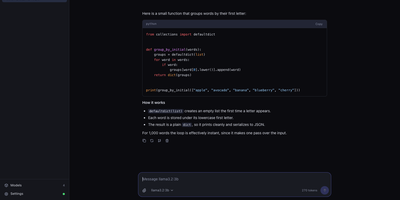
Chat with your own local language models from a clean, fast browser interface. Ollama GUI gives every model on your Ollama server a proper home: streaming replies you can stop, regenerate, or edit, with each edit saved as a version you can flip back to. Reasoning models show their thinking in a collapsible block, and you pick between thinking on, off, or an effort level. Attach images for vision models or drop in text and code files, and answers render with highlighted code, tables, and math. Pull models from a searchable catalog with live progress, check their capabilities and context length, unload them from memory, or delete them in a click. Chats are grouped by date, pinned, archived, renamed, titled automatically, and searched across every message from a command palette. System prompts and generation settings apply globally, per model, or per chat. Light and dark themes, locale-aware dates, and JSON or Markdown export round out the daily routine. Run one shared front end for a whole team or homelab, and every browser keeps its own private history. Running on a dedicated VPS on RepoCloud with guaranteed CPU, RAM, and SSD, full root SSH access, and a browser serial console. MIT licensed.
Tiledesk
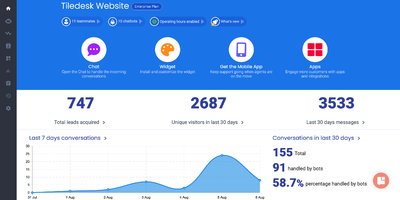
Tiledesk lets you build AI-powered conversational agents with a visual drag-and-drop designer, then deploy them simultaneously across web chat, WhatsApp, Telegram, Facebook Messenger, Instagram, email, and Slack without rebuilding per channel. The no-code Design Studio combines LLM-powered conversations with conditional logic, external API calls, and branching dialogue trees that work identically everywhere. Multi-RAG knowledge management separates content into isolated repositories with hybrid search combining traditional full-text retrieval and semantic understanding via Qdrant vector embeddings, enabling accurate answers even when users phrase queries in unexpected ways. LLM integration supports GPT-4, GPT-4o, Anthropic Claude, and any model exposing an OpenAI-compatible API including locally hosted models via Ollama for complete data sovereignty. The human-in-the-loop system provides seamless escalation from AI agents to live support staff with full conversation context preserved, while multi-agent workflows enable complex orchestration where specialized bots collaborate on different aspects of a customer interaction. REST and MQTT APIs power integration with external systems and webhook-triggered automations, and pre-designed templates accelerate common scenarios. Docker Compose deployment starts the full stack including server, dashboard, messaging engine, and widget. Running on a dedicated VPS on RepoCloud with guaranteed CPU, RAM, and SSD, full root SSH access, and a browser serial console. MIT licensed.
ShibaClaw
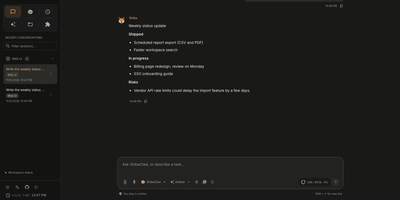
Meet an AI assistant that lives on your own server, remembers who you are, and keeps working after you close the tab. ShibaClaw opens with a four-step onboarding wizard for provider, credentials, and model, then drops you into a chat workspace with agent profiles for building, planning, reviewing, administering, and security work. Long-term memory lives in editable files, a dream diary records what the agent learned, and a Library view maps how profiles relate to each other. Agents call file, shell, and web tools, plug into external MCP servers, and hand work to isolated or forked sub-agents. The Automations page schedules one-shot, interval, or cron jobs like a weekday morning support brief, and a plugin catalog adds services like GitHub, Notion, PostgreSQL, and Google Workspace in one click. An optional knowledge base searches your own documents, and channel integrations reach the agent from Discord, Telegram, Slack, and Matrix. Provider choices span OpenRouter, Anthropic, OpenAI, Gemini, DeepSeek, Groq, Ollama, and any OpenAI-compatible endpoint. A credential vault encrypts keys, and file tools stay inside a restricted workspace. Anyone who wants research, drafting, and recurring chores handled by an assistant they host themselves will feel at home. Running on a dedicated VPS on RepoCloud with guaranteed CPU, RAM, and SSD, full root SSH access, and a browser serial console. Apache-2.0 licensed.