LoopForge
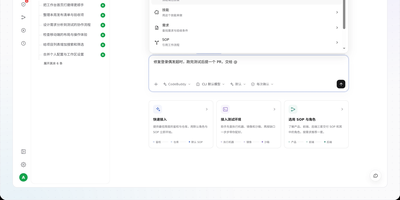
Describe the change in chat, and LoopForge opens a Docker sandbox, checks out your repositories, hands the work to specialist agent roles, and opens the pull request. That is the conversational path: a Main Bot coordinates planning, implementation, review, and testing roles, each with its own prompt, executor, model, rules, skills, and tools, and you can queue or steer messages mid-reply, then pause, resume, or take over a run at any point. When a way of working proves itself, you freeze it as an SOP: a visual canvas of agent steps, deterministic script steps, human gates, and sub-workflows that every requirement then follows in the same order with the same checks. Four built-in SOPs cover backend delivery, frontend delivery, product proposals, and bug fixes, and each one can be copied, edited, and versioned per project. A Needs review inbox collects every gate waiting on you, with per-node status, tool traces, logs, and artifact snapshots as the evidence behind each approval. Recurring AI tasks run on schedules with the same workspace and workflow access, and insights reports track engineering metrics and token costs per run and per conversation. Running on a dedicated VPS on RepoCloud with guaranteed CPU, RAM, and SSD, full root SSH access, and a browser serial console. MIT licensed.
Omnara
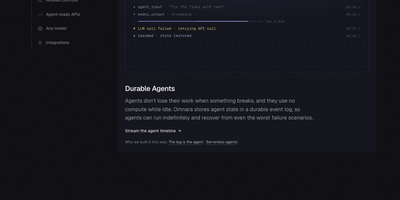
Running AI agents in production takes more than a model call: Omnara supplies the durable runtime, tools, approvals, and complete event history around any model, on your own machines. You define an agent once in a small YAML file: instructions, a model from OpenAI, Anthropic, OpenRouter, Bedrock, LiteLLM, Ollama, or your own endpoint, and the machines it may use. Launch agents from the REST API, the TypeScript SDK, the command line, or the dashboard, then stream every event live or receive it as a webhook while the agent works. Agents run shell commands and edit files on sandboxes from twelve providers, or on your own laptops, VMs, and containers through a daemon that connects outward, so no inbound ports or SSH keys are exposed. Every step is written to Postgres as an event log, which means an agent survives crashes, restarts, and disconnected machines and resumes exactly where it stopped. Tool permissions can run immediately, ask a person first, or block outright, and agents can start subagents, follow cron schedules, and keep shared memory files between conversations. Teams meet the agents where they already talk: mention the bot in Slack or Discord, or let a GitHub pull request trigger a review, with questions and approvals handled in the thread. Running on a dedicated VPS on RepoCloud with guaranteed CPU, RAM, and SSD, full root SSH access, and a browser serial console. Apache-2.0 licensed.
SandBase Harness
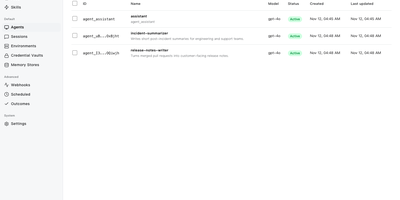
SandBase Harness gives your AI agents a proper home with sessions, tools, sandboxes, and an audit trail instead of a pile of scripts. The console lists agents with their model, status, and version, and an agent page shows its system prompt, attached tools, and skills. Every session keeps a resumable event log, and a transcript view opens any user or agent message as a rendered or raw event. Built-in tools run in a local process, per-session Docker containers, Kubernetes, or a self-hosted worker queue, and permission policies can always allow a tool or always ask a human first. MCP toolsets, credential vaults, and skill packages extend what an agent can reach, with Anthropic's xlsx, pptx, pdf, and docx skills listed next to your own. Memory stores, webhooks, scheduled deployments, and outcome definitions cover longer-running work. Settings include a model provider form, API keys for bearer authentication, and an interactive API reference for sessions, agents, environments, and vaults. A TypeScript SDK and a bundled MCP bridge connect other tools to the same runtime. Running on a dedicated VPS on RepoCloud with guaranteed CPU, RAM, and SSD, full root SSH access, and a browser serial console. Apache 2.0 licensed.
Xiryn
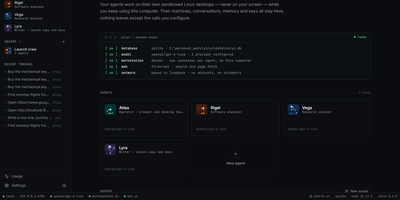
Picture a small staff of AI agents clocking in on your own server, each with a name, a specialty, its own model, and a private Linux desktop it can click around in. Every agent works inside a disposable Docker workstation with a shell, persistent files, and a Chromium browser, so it can research the web, write and run code, and finish multi-step tasks without touching your own files. You watch an agent click and type in real time, and when a login, payment, or one-time code needs a human, you take over the desktop, then hand it back with a note and let it continue. Pair a Telegram bot by scanning a QR code and you can assign work, answer questions, and receive results from your phone, with no public URL or port forwarding. Routines turn recurring requests into schedules, so a morning briefing, a price watch, or a weekly report runs by itself and reports back when it is done. Each agent can use a different model, from OpenAI, Anthropic, Google, xAI, Groq, Mistral, or DeepSeek to a local Ollama endpoint, and every reply shows its cost while a monthly budget pauses paid models automatically. Agents remember what matters about you across every thread, and logins or cards you save sit in an encrypted vault the agents themselves never see. Running on a dedicated VPS on RepoCloud with guaranteed CPU, RAM, and SSD, full root SSH access, and a browser serial console. MIT licensed.
Statewave
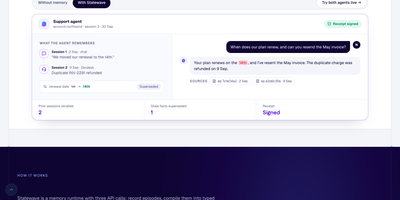
Statewave is the memory runtime that compiles what your AI agents experience into typed, provenance-tagged memories, so the same subject asked the same question receives the same context every time. Recording is append-only: your application writes events as episodes (chat, ticket, commit), and a compiler distills them into structured memories with confidence scores, each traceable to its source episodes. When an agent needs context, Statewave assembles a ranked bundle inside the token budget you set; the same request at the same moment returns identical bytes, so retrieval sampling noise never leaks into an answer. Every bundle leaves an HMAC-signed receipt that a replay endpoint can re-evaluate under the same rules. Memories carry sensitivity labels for personal data, financial details, and secrets, and YAML policies deny or redact them per tenant. One instance serves many products: tenants are isolated by header, pinned to a region for residency with cross-region requests refused, and erasable by subject on request. The default compiler runs fully local on regex heuristics with no API key, or point extraction at any of 100+ LiteLLM providers. Reach it over REST from any language, through typed Python and TypeScript SDKs, LangChain, CrewAI, and AutoGen integrations, or the built-in MCP server that lets Copilot, Claude, and Cursor share one memory. Support agents recognize returning customers across sessions, and coding agents keep project decisions between conversations. Running on a dedicated VPS on RepoCloud with guaranteed CPU, RAM, and SSD, full root SSH access, and a browser serial console. Apache 2.0 licensed.
Hivekeep
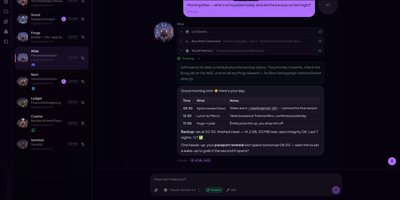
Most AI chats forget you by tomorrow; Hivekeep keeps a team of agents on your own server that remember everything, work together, and answer wherever you already talk. Each agent has a name, a role, and one continuous conversation that never resets, backed by long-term memory it can search. Agents hand tasks to one another, spawn helpers, and run scheduled jobs. Queenie, the built-in setup agent, connects providers and creates your first teammates through plain chat. They reach you on Telegram, Slack, Discord, WhatsApp, Signal, Matrix, or the installable web app, and a channel can move from one agent to another mid-conversation. Agents write custom tools, build mini-apps that open beside the chat, edit files in a workspace with a code editor, and add plugins from a marketplace. Credentials go straight into an AES-256-GCM vault that the model never reads. A context viewer and a token-usage dashboard show what each prompt contains and what each agent, model, and day costs. Running on a dedicated VPS on RepoCloud with guaranteed CPU, RAM, and SSD, full root SSH access, and a browser serial console. MIT licensed.
ODS
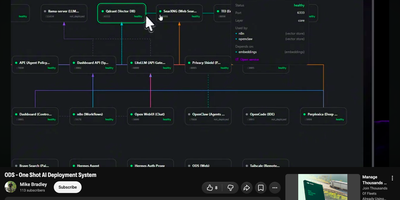
ODS turns a GPU machine or server you already own into a complete private AI stack with a single install command, replacing a shelf of separate tools with one system that serves models, chat, agents, automation, and search from your own hardware. The installer reads your GPU, VRAM, memory, and disk, then downloads a GGUF model matched to that hardware tier, and a compact bootstrap model starts answering within minutes while the full model finishes downloading. From the web dashboard you watch every service's health, ports, and resource use, restart what misbehaves, and check storage and updates without touching a terminal. You chat with local models in Open WebUI, hand background work to the Hermes and Portal agents, and build automations in n8n that connect the stack to more than 400 other apps. Documents you add become searchable knowledge through Qdrant vector storage, so answers cite your files instead of the model's memory. SearXNG and Perplexica answer web questions without trackers or accounts, Whisper transcribes speech, Kokoro reads text aloud, and ComfyUI generates images, all on the same box. Every bundled service is an extension you can enable, disable, or replace, and a Privacy Shield scrubs personal data before anything reaches an optional cloud model through the LiteLLM gateway. Running on a dedicated VPS on RepoCloud with guaranteed CPU, RAM, and SSD, full root SSH access, and a browser serial console. Apache-2.0 licensed.
Cotal
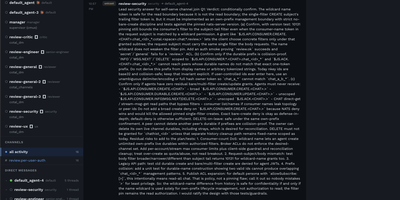
Cotal puts your AI agents in one shared room: Claude Code, Codex, and OpenCode discover each other, message channels, hand off work, and ask you to approve the result. Post to a channel and every subscriber hears it; message one peer and the durable inbox holds it until they are free; address a role like reviewer and one available reviewer claims the job. Presence shows who is actually there, and attention modes decide which channel traffic may interrupt an agent mid-task. A manager starts and stops agent processes in tmux or cmux, here or on remote hosts you authorize, without sitting between their messages. For work that waits and branches, Cotal Lang programs launch agents, pause at human checkpoints with deadlines, and resume from their recorded steps after an interruption. Services join the same space by publishing command contracts that authorized agents can discover and invoke; the bundled Linear adapter shows the pattern. Supervise from a terminal console with the live roster and activity feed, or from the read-only browser dashboard and its graph of agents and channels. Spaces stay separate, every message carries a checked identity, and per-agent grants decide who may delegate, spawn teammates, or call a service. Running on a dedicated VPS on RepoCloud with guaranteed CPU, RAM, and SSD, full root SSH access, and a browser serial console. Apache-2.0 licensed.
LangBot
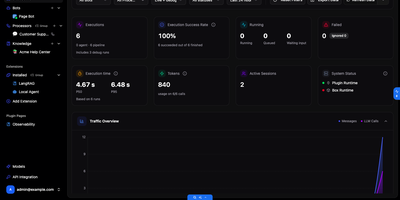
Connect one AI assistant to every chat app your customers already use, then manage it from a single admin panel. Create a bot for Slack, Discord, Telegram, LINE, Lark, DingTalk, WeCom, Matrix, KOOK, or QQ, or embed the Page Bot widget on a website with one script tag. Event routing sends each message to the processor you choose, and a pipeline controls triggers, safety rules, the model and prompt, and how replies are sent. A built-in Debug Chat streams answers as you edit, in private or group sessions. Knowledge bases split uploaded documents into chunks and search them by vector, full-text, or hybrid matching, with query rewriting and reranking options. Add providers like OpenAI, Anthropic, DeepSeek, Gemini, and Ollama, then give each pipeline its own models. The dashboard counts executions, success rate, token usage, and active sessions, and tabs list model calls, user feedback, and error logs. Sessions show the full conversation for each user, with a button to reset context. Install plugins and MCP servers from the extension marketplace to add tools. Use it for a support bot, a community assistant, an internal helpdesk, or a multi-channel front desk. Running on a dedicated VPS on RepoCloud with guaranteed CPU, RAM, and SSD, full root SSH access, and a browser serial console. Apache-2.0 licensed.
Latitude
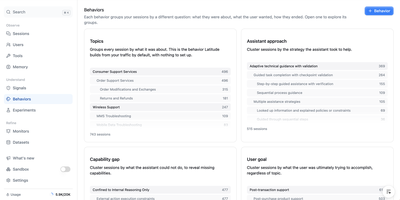
Production AI agents fail in quiet ways, and Latitude records every trace, session, and tool call so each failure can be found, grouped, and fixed. One line of telemetry from the TypeScript or Python SDK, or any OpenTelemetry exporter, sends traces from OpenAI, Anthropic, LangChain, LlamaIndex, CrewAI, and dozens of other providers and frameworks. Failing traces are clustered into signals with status, size, and trend, and flaggers and annotation queues let reviewers score outputs by hand. Evaluations are generated from those judgments and tracked with an alignment score. Semantic and exact-text search covers every trace, and saved searches, filters, and behavior groupings keep recurring questions one click away. Dashboards report cost per session, tool failure rates, and agent score across outcome, reliability, speed, and safety. Memory views show how an agent's stored memory changes over time, with diffs and the trace behind each edit. Monitors raise alerts, regression datasets replay fixes against the traces that failed, and Agent Dispatch hands the evidence to a coding agent. Running on a dedicated VPS on RepoCloud with guaranteed CPU, RAM, and SSD, full root SSH access, and a browser serial console. MIT licensed.
MATE
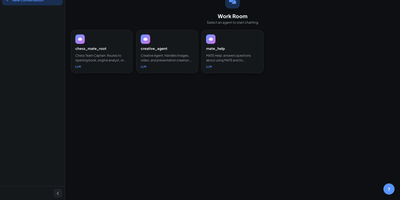
Change an agent's prompt, model, or audience from a dashboard and watch it go live without a single redeploy. MATE opens in a Work Room where any root agent can be picked from a card grid and chatted with directly. The Studio holds the builder: a drag-and-drop canvas draws parent and child agents, attaches tools and MCP servers, and keeps every configuration versioned with one-click rollback. Trace Replay plays a past conversation back across that canvas so each hand-off is visible. A template library imports ready-made agent teams, from research pipelines to support desks. The Control Room covers governance: role-based access per agent, dollar costs per agent and project, budgets that warn or block, guardrails for personal data and prompt injection, and alerts to Slack, Discord, email, or a webhook. Eval suites score replies by exact match, similarity, or an LLM judge, and a Playground compares models or prompts side by side on score, speed, and cost. Agents can be embedded as a chat widget, called through an OpenAI-compatible endpoint, or exposed over MCP and A2A. Agencies running client agents and platform teams juggling dozens of them can manage the lot from one dashboard. Running on a dedicated VPS on RepoCloud with guaranteed CPU, RAM, and SSD, full root SSH access, and a browser serial console. Apache-2.0 licensed.
RustXNG
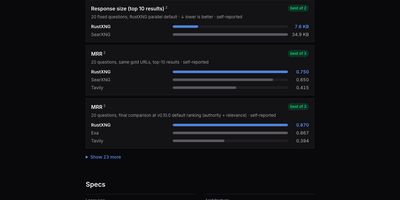
RustXNG gives your AI agents a private web search API that needs no keys, no accounts, and no per-search fees: ask once and get ranked results plus the text of the top pages, ready to ground an answer in real sources. A single request fans out to 180 search engines in parallel, drawn from 226 engine types covering general web, images, video, academic literature, package registries, and news, then merges what comes back with its own ranking that rewards term coverage and canonical-site authority instead of trusting any one engine's order. Engines that time out or keep answering nothing are suspended with backoff and rested automatically, so one dead source never stalls a task, and a repeated query returns from cache in about a hundredth of a second. Call it over HTTP with the familiar SearXNG-shaped JSON, CSV, RSS, or HTML formats, narrow results by domain, engine, or time range, or run the built-in MCP server and hand your agent native search and read_page tools with bounded, truncation-aware responses. Page fetches are hardened against untrusted URLs, an experimental local index can crawl your own corpus and merge it into results, and health, metrics, and per-engine status stay visible through the ops endpoints and the browser UI. Running on a dedicated VPS on RepoCloud with guaranteed CPU, RAM, and SSD, full root SSH access, and a browser serial console. AGPL-3.0 licensed.
Suparagent
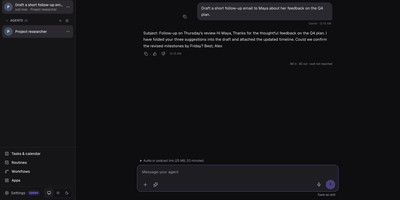
Suparagent turns a single server into a workspace of named AI coworkers that each have a job, a memory, and a folder of their own. Chat with an agent in the browser, pick an engine per conversation, and watch replies stream in as the sidebar keeps every thread searchable. Approval modes decide how much freedom an agent gets: ask first, accept edits, or plan only, so nothing touches a file or runs a command without your say. Routines send a prompt to an agent on chosen weekdays, through a webhook, or on demand, and every run lands in its own conversation. A kanban board with month, week, and upcoming views tracks tasks by owner and priority, and a canvas builds multi-step workflows from schedule triggers, model steps, agent steps, conditions, and approvals. Agents save notes you can edit, delegate to specialists in shared rooms, and reuse saved skills and templates. A usage panel totals turns and tokens by conversation, engine, and day, with a CSV export. Invite teammates with a one-time link, pair a phone, and keep agents working when your laptop is closed. Running on a dedicated VPS on RepoCloud with guaranteed CPU, RAM, and SSD, full root SSH access, and a browser serial console. Apache-2.0 licensed.
Sugabots
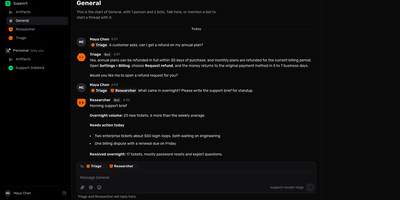
Give your team a shared chat workspace where AI bots sit next to people, answer questions, and pick up recurring work. Organize conversations into pods with channels and threads, and keep a private personal pod for each member. Mention a bot with @ to hand it a task, mention several and each one replies, or let a bot ask another bot for help. Every bot gets its own name, avatar, instructions, and model, picked from OpenRouter, Anthropic, OpenAI, Google Gemini, or any OpenAI-compatible endpoint you add. Connections link a pod to GitHub, Linear, Stripe, Notion, Sentry, Jira, any MCP server, or any HTTP API, and bots act through them with approvals where you want a human check. Routines run a bot on a schedule, a webhook, or a GitHub event, then post the result to the pod channel. Computers give bots an isolated machine for heavier jobs, and web search lets them look things up and cite pages. A Usage page breaks down what bots cost by bot, model, and pod. Use it for a support desk, an engineering ops room, a morning briefing, or a shared research assistant. Running on a dedicated VPS on RepoCloud with guaranteed CPU, RAM, and SSD, full root SSH access, and a browser serial console. MIT licensed.
OhMyBuddy
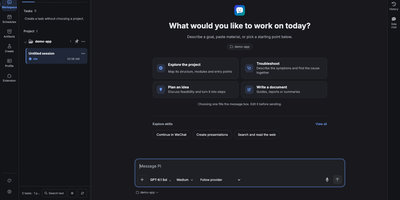
Give your AI assistant a name, a memory you can actually inspect, and a permanent seat on your own server. OhMyBuddy has two sides that share the same models and tools. The Buddy side keeps one ongoing conversation, learns your preferences, and shows a receipt under any reply that saved something, so every memory can be reviewed, edited, or undone. The Workspace side opens real project folders with threads, streaming tool calls, file diffs, side chats, and a branching history view. Add scheduled tasks, an artifacts library, and a media lab for image, video, and speech generation. Connect extensions, MCP tools, a browser, and subagents when a job needs more hands. Sessions live on the server, so a laptop, a tablet, and a phone home screen all continue the same chat, with notifications when a reply finishes. Bring Claude, GPT, Gemini, DeepSeek, or any OpenAI-compatible relay, and protect the instance with an access token. Keep a personal AI on hardware you control, reachable from every device you own. Running on a dedicated VPS on RepoCloud with guaranteed CPU, RAM, and SSD, full root SSH access, and a browser serial console. ISC licensed.
PipesHub
Unify fragmented corporate knowledge across chat channels, documents, and cloud drives with PipesHub, an open-source workplace context platform providing permission-aware search and verifiable answers for teams and autonomous agents. Employees can query enterprise knowledge bases through a conversational interface that retrieves relevant information across Google Workspace, Microsoft 365, Slack, Confluence, Jira, and GitHub while strictly respecting individual user access permissions. Knowledge workers can verify every answer through clickable citation blocks that trace claims directly back to source documents, spreadsheet rows, or chat messages. Teams can assemble custom AI agents visually using a drag-and-drop builder, combining retrieval collections with interactive toolsets to automate multi-step operations like drafting customer responses or creating issue tickets. Autonomous agents connect via Model Context Protocol to inspect shared company knowledge and perform external actions across connected SaaS tools. Organizations can index scanned PDFs, slide decks, markdown pages, and spreadsheets with OCR and document parsing, maintaining synchronized records through automated schedules. Administrators can inspect synchronized records, monitor query history, and manage connector credentials across all integrated business applications. Running on a dedicated VPS on RepoCloud with guaranteed CPU, RAM, and SSD, full root SSH access, and a browser serial console. Apache License 2.0 licensed.
AMUX
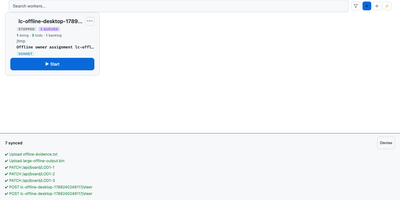
To coordinate swarms of autonomous coding agents across complex software projects, AMUX provides a concurrency-safe kanban workspace with real-time thought stream inspection and live steering controls. Engineers assign development tasks through an interactive board where autonomous worker processes claim cards using compare-and-swap mutexes to eliminate race conditions between parallel sessions. Operators monitor active reasoning streams, inspect streaming terminal outputs, and inject guidance commands mid-turn without interrupting background execution. A cryptographic origin router relays messages between agents, enabling workers to delegate sub-tasks, request automated peer code reviews, and share environment state safely. Built-in schedulers trigger recurring automated maintenance routines, dependency updates, and bug triage sweeps on cron-like timers or autonomous loop cadences. Teams can switch language models dynamically on active sessions to tackle complex architecture challenges with high-capability reasoning engines while conserving resources on routine tasks. An integrated self-healing supervisor watches over agent runtimes, automatically compacting context windows, restarting crashed terminal sessions, and resuming pending instructions seamlessly. Running on a dedicated VPS on RepoCloud with guaranteed CPU, RAM, and SSD, full root SSH access, and a browser serial console. MIT licensed.
Agent Zero
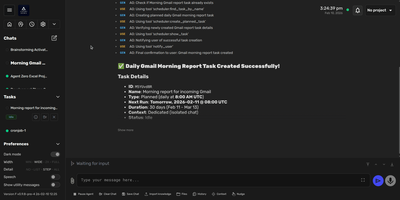
Agent Zero equips large language models with a persistent virtual Linux desktop, letting autonomous AI agents write code, research the web, and execute multistep tasks without supervision. Operating within an isolated container, the system opens an interactive XFCE graphical desktop in your browser canvas where the agent interacts with GUI applications like Blender and terminal sessions directly. Its embedded browser features interactive annotation tools, letting you click web elements to inspect stylesheet hierarchies, extract component markup, or submit automated testing instructions. You can cowork on spreadsheets, presentations, and Markdown specifications in real time alongside the agent, preserving document revisions through snapshot time travel. A multi-tier memory architecture backed by FAISS vector indexing and SearXNG web discovery retains problem-solving context across projects, while hierarchical delegation spins up specialized subordinate agents to parallelize complex engineering audits. The platform connects seamlessly to commercial LLMs via OpenAI, Anthropic, or OpenRouter, runs private local models through Ollama, and integrates custom toolkits via the Model Context Protocol and community Plugin Hub. Running on a dedicated VPS on RepoCloud with guaranteed CPU, RAM, and SSD, full root SSH access, and a browser serial console. MIT licensed.