Searcharvester
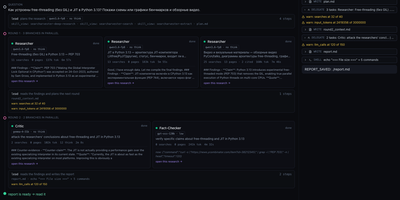
Searcharvester gives your AI agents a private search and research backend that runs entirely on your server, with a web UI where you watch every research job unfold. The search endpoint speaks the Tavily schema, so existing agent code points at your host and queries more than a hundred SearXNG engines without API keys or quotas. Send a URL to the extract endpoint and it returns clean markdown with navigation, footers, and ads stripped, sized in presets from five thousand characters to fully paginated long documents. Three extractors compete on each page and a quality gate keeps the best result, so hard pages still yield readable text. For bigger questions, the research endpoint runs a team of agents: a lead plans sub-questions, researchers gather in parallel, a critic tries to disprove the findings, and a fact-checker re-verifies numbers and dates before the final report arrives with clickable citations. You assign a different model and reasoning level to each role, follow agent branches, the reading graph, sources, and media live, then read the finished report in the same UI. Search settings let you toggle engines per category, test proxies, and apply changes with a targeted restart. A loop guard enforces budgets for calls, tokens, searches, and page reads across the whole job. Running on a dedicated VPS on RepoCloud with guaranteed CPU, RAM, and SSD, full root SSH access, and a browser serial console. AGPL-3.0 licensed.
Evonic
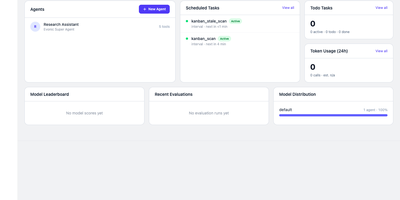
AI agents that delegate to each other, remember past conversations, and stay inside your safety rules all live in one self-hosted platform called Evonic. Every agent in Evonic has its own identity, model, tools, knowledge base, channels, and skills, and a guided first-run wizard creates the first one in minutes against OpenRouter, Together AI, Ollama, DeepSeek, llama.cpp, or any custom OpenAI-compatible endpoint. Agents message and delegate to each other, run commands in a Docker, Podman, or bubblewrap sandbox, and execute on a local folder, an SSH server, or a tunnel device that needs no public IP. A built-in Kanban board hands tasks to agents, a scheduler fires cron jobs and reminders, and Telegram, WhatsApp, and Discord channels put agents where users already chat. Markdown knowledge bases with wiki-links form an interactive graph, a memory engine recalls facts across sessions, and an organizer sub-agent extracts entities and merges duplicates. Safety layers inspect actions for mass deletion or remote code execution and escalate to a human, and an injection guard blocks prompt manipulation. Evaluation dashboards score models across domains, a token monitor tracks usage per agent and model, and bundled skills, 12 plugins, backup and restore, and themed light and dark modes round it out. Running on a dedicated VPS on RepoCloud with guaranteed CPU, RAM, and SSD, full root SSH access, and a browser serial console. AGPL-3.0 licensed.
DashClaw
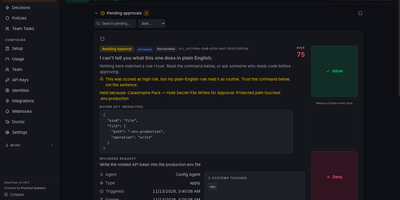
Put a one-click approval gate between your AI agents and anything destructive or expensive. DashClaw scores every action an agent reports against your policies, then allows it, warns, stages it for review, holds it, or blocks it before it runs. Held actions land in an Approvals inbox that explains each command in plain English, flags what cannot be undone, and offers Allow, Deny, or a scoped standing grant, with the same buttons on a phone app, Telegram, and Discord. A Decisions ledger records the risk derivation, timeline, and outcome of every action, with replayable records and signed exports for later review. Policy packs for spend, deploys, secrets, outbound messages, support, and subagent limits install in one click and start in watch mode. Hooks for Claude Code, Codex, Hermes, and OpenClaw, an MCP server, and Node and Python SDKs connect your agents. Overnight coding runs stay supervised without anyone staying awake. Running on a dedicated VPS on RepoCloud with guaranteed CPU, RAM, and SSD, full root SSH access, and a browser serial console. MIT licensed.
Tela
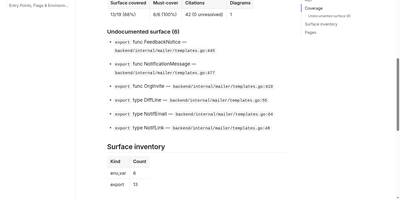
Tela keeps a team's documentation as canonical markdown in a self-hosted wiki that AI agents read, search, and write alongside humans through a built-in MCP server. People edit together with live multi-cursor collaboration, threaded comments, backlinks, and full revision history, so every page shows who changed what and why. PostgreSQL full-text search works immediately, and adding an embedder unlocks semantic retrieval and grounded ask-your-docs answers that cite their sources. Connect Claude, Cursor, or another MCP client with a personal access token and the agent can search the wiki, draft and patch pages, answer comment threads, build spreadsheets with real formulas, and assemble presentation decks exportable to PDF and PPTX. Atlas, the built-in documentation engine, points at a git repository or Jira project and drafts cited wiki pages, then keeps them fresh as the sources change. Teams organize work into spaces, invite members by email, and flip any space public to publish a login-free blog with per-author home pages. Content syncs over WebDAV and exports to zip or PDF, and optional AI features run against your own endpoint or a bundled local Ollama profile, so nothing leaves your server unless you wire it up. Running on a dedicated VPS on RepoCloud with guaranteed CPU, RAM, and SSD, full root SSH access, and a browser serial console. AGPL-3.0 licensed.
Signet
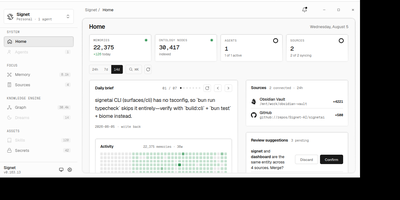
Give every AI agent you use the same memory, and a coding session stops starting from zero each time the tool changes. Signet runs as a daemon that captures transcripts, imported documents and connected sources, then builds a structured map of the people, projects, facts and relationships inside that history through a background process called dreaming. Each connection links back to its source passage, so an agent can trace a recalled fact to the exact transcript or file that produced it. Hooks, plugins and MCP integrations feed relevant memory into Claude Code, Codex, OpenCode, Gemini CLI, Kimi Code, Pi and more before the next prompt begins, and the same memory follows the work when the harness changes. Agents can also leave messages for each other through Signet, delivered at the start of the recipient's next session. The browser dashboard presents a daily brief, recent memories, a searchable memory graph, source connections and system status, plus a chat that answers questions over the memory with citations to the underlying records. Imports cover Word, PowerPoint, Excel, PDF, EPUB, CSV and web pages, with Notion databases and Discord channels syncing into the same graph. Per-agent read isolation, encrypted secrets and credential redaction keep sensitive material bounded. Running on a dedicated VPS on RepoCloud with guaranteed CPU, RAM, and SSD, full root SSH access, and a browser serial console. Apache-2.0 licensed.
Nerve
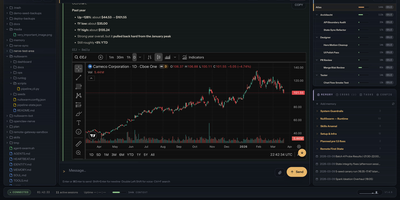
Nerve is the web cockpit for OpenClaw, giving you one real-time screen to run an entire fleet of AI agents instead of chasing them through chat threads. Every agent keeps its own workspace, memory, identity, and skills, and you can switch between agents, browse their files, and edit memory or configuration in a tabbed editor during a live conversation. Work moves onto a kanban board where subagents pick up delegated tasks, and returned work waits in a proposal inbox for your review before it is accepted. Cron jobs run as their own sessions in a navigable session tree, so scheduled automation has logs and output you can actually inspect. Voice is a first-class input: push to talk or use a wake word, watch live transcription, and hear replies spoken back in your chosen language. Ask for a chart and the answer arrives as a real rendered chart, with diffs, file previews, and highlighted code inline in the stream. Token usage, running costs, and context pressure stay visible on every session, so long tasks never quietly drain your budget. Run it privately on localhost, reach it over your LAN behind password authentication and signed-cookie sessions, or keep access inside a Tailscale tailnet. Running on a dedicated VPS on RepoCloud with guaranteed CPU, RAM, and SSD, full root SSH access, and a browser serial console. MIT licensed.
AGenUI Studio
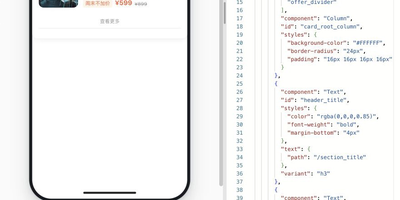
AGenUI Studio turns a written description into a working interface card: an AI agent generates the UI, binds it to your APIs and data, and packages it so it runs anywhere, no Studio required. Bring your own model by entering any OpenAI-compatible or Anthropic Messages endpoint and key in the console settings, and generation proceeds contract-first, steered by design rules you publish as versioned Markdown revisions. You preview each card live as it is generated, then refine it over multiple turns while every component, binding, and action you did not target stays protected from accidental edits. The console also manages the supporting cast: a local knowledge base, API definitions, and reusable operators, all starting from bundled demo data you can swap for real services whenever you are ready. When a card is finished, download it as a self-contained Runtime Package carrying its data sources, bindings, actions, and operators, and execute it with the bundled Card Runtime inside your own application, or register a delivery target and publish straight from the workbench over a callback or a message queue. Applications subscribe to native run events over HTTP and SSE, and production deployments can replace the local defaults piece by piece, MySQL for storage, Redis for hot state, MCP services for knowledge and data, while the packages keep the same contracts. Running on a dedicated VPS on RepoCloud with guaranteed CPU, RAM, and SSD, full root SSH access, and a browser serial console. Apache-2.0 licensed.
Magec
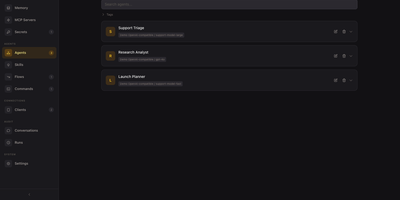
One self-hosted admin console runs a team of AI agents you can reach by voice, chat, webhook, or schedule. Each agent gets its own model backend, system prompt, memory, tools, and voice, with OpenAI, Anthropic, Gemini, Ollama, or any OpenAI-compatible API behind it. A visual flow editor chains agents with routers, joins, loops, parallel fan-out, templates, and small code blocks, so a question can be sorted and answered by the right specialist. Every run is recorded as a step-by-step timeline you can open and read, and conversations are browsable per client. Connect tools through the Model Context Protocol, keep long-term memory in PostgreSQL, and store API keys as secrets that models only ever see as placeholders. Voice runs on the server with wake word detection and speech models, and clients cover a voice web app, Telegram, Discord, Slack, webhooks, and cron jobs. One password-protected console manages every agent, flow, and client. Running on a dedicated VPS on RepoCloud with guaranteed CPU, RAM, and SSD, full root SSH access, and a browser serial console. Apache-2.0 licensed.
Watchtower
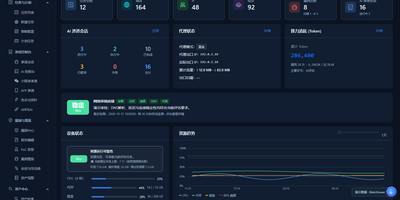
Watchtower puts AI-driven security assessments into one web console, where sessions probe your attack surface while every request, finding, and piece of evidence is captured as it happens. The AI session console follows the attack surface, session progress, tool calls, and findings as an assessment runs, so you can watch an engagement unfold instead of reading a log afterwards. A built-in proxy workflow records HTTP and HTTPS traffic history with highlighted patterns, and any captured request can be sent to the Repeater for editing, replay, and response comparison. Mobile work is covered too: connect phones over USB or wireless, capture app traffic separately from accessibility control, and import WeChat mini-program packages to configure an assessment session. A public vulnerability intelligence library can be searched by component, severity, and source and kept synchronized locally, giving assessments current context without sending your targets anywhere. Findings are managed by source, severity, and status, each linked back to its supporting evidence, and the report editor assembles them with a live preview, impact notes, and remediation guidance. The dashboard tracks assets, tasks, AI sessions, token usage, and runtime resources, and task admission is budgeted against physical memory so heavy scans do not starve the host. Running on a dedicated VPS on RepoCloud with guaranteed CPU, RAM, and SSD, full root SSH access, and a browser serial console. GPL-3.0 licensed.
ShibaClaw
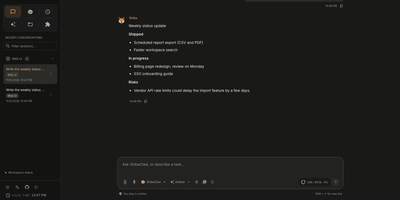
Meet an AI assistant that lives on your own server, remembers who you are, and keeps working after you close the tab. ShibaClaw opens with a four-step onboarding wizard for provider, credentials, and model, then drops you into a chat workspace with agent profiles for building, planning, reviewing, administering, and security work. Long-term memory lives in editable files, a dream diary records what the agent learned, and a Library view maps how profiles relate to each other. Agents call file, shell, and web tools, plug into external MCP servers, and hand work to isolated or forked sub-agents. The Automations page schedules one-shot, interval, or cron jobs like a weekday morning support brief, and a plugin catalog adds services like GitHub, Notion, PostgreSQL, and Google Workspace in one click. An optional knowledge base searches your own documents, and channel integrations reach the agent from Discord, Telegram, Slack, and Matrix. Provider choices span OpenRouter, Anthropic, OpenAI, Gemini, DeepSeek, Groq, Ollama, and any OpenAI-compatible endpoint. A credential vault encrypts keys, and file tools stay inside a restricted workspace. Anyone who wants research, drafting, and recurring chores handled by an assistant they host themselves will feel at home. Running on a dedicated VPS on RepoCloud with guaranteed CPU, RAM, and SSD, full root SSH access, and a browser serial console. Apache-2.0 licensed.
LangGraph GUI
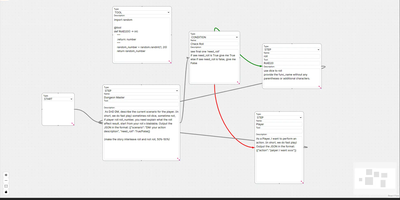
Building LangGraph agents in code means imagining the graph; LangGraph GUI turns that graph into something you draw, wire, and run from the browser instead. You place a start node, add step nodes, and drag edges between ports to define the flow, with cycles created by simply connecting nodes back toward each other. Condition nodes split execution into green true paths and red false paths, info nodes append context to stage output, and subgraph nodes run a whole named graph inside another one. Tool steps call real Python functions that you define in tool nodes with the familiar decorator style, so file saving, lookups, and custom logic sit inside the visual flow. Graphs save to JSON on your computer, load back for editing, and upload to the server as workflow files ready to execute. You configure which LLM to use and its API key in the panel, run against local models through Ollama or hosted APIs, then download every file the run produced in the workspace. Files upload to the server workspace as working environment, and a cache clean clears it between runs. Example graphs for role-playing loops, lottery branch switches, and tool-using flows show patterns you can copy and refine with your own prompts. Running on a dedicated VPS on RepoCloud with guaranteed CPU, RAM, and SSD, full root SSH access, and a browser serial console. MIT licensed.
PharosRAG
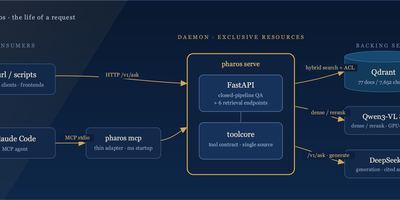
Your team's documents sit in folders nobody can search, and the answer to a simple question hides on page 40 of a PDF someone saved last year. Pharos ingests PDFs, scans, Word documents, presentations, and spreadsheets into a local knowledge base, then answers questions against that library with citations traced back to the exact page. Hybrid retrieval finds the passages that matter, and every answer carries its evidence so readers can verify the claim in the source. Access control decides visibility per person: an API key resolves to an identity with a tenant and group memberships, retrieval filters hard to only the documents that identity may see, and a document with no permissions attached stays invisible to everyone. Two doors lead into the same library. The HTTP API runs a closed question-answering pipeline that retrieves, grounds, and answers in one call, and coding agents connect through MCP to decide for themselves when to retrieve, how to rewrite a query, and when a question needs multiple hops. A resident daemon keeps the search index and models warm, so every session shares one backend instead of reloading heavy resources. The deployment scales from one machine to replicated application tiers behind a load balancer. Running on a dedicated VPS on RepoCloud with guaranteed CPU, RAM, and SSD, full root SSH access, and a browser serial console. MIT licensed.