Econumo
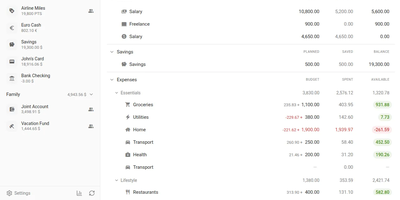
Econumo gives couples and families one budget they can both edit, built from joint accounts, envelope categories, and a month-by-month plan, with each account kept in its own currency. Each month splits into Income, Savings, and Expenses, with budget, spent, and available amounts on every expense envelope. A month start day between 1 and 28 aligns the budget with payday. The Plan view lays several months out as a spreadsheet with a drag handle for repeating amounts and a running balance row at the foot. Loans become debts that report payments left, the payoff date, and the interest and principal split of every payment. Invite a partner with a five-minute code, then choose which accounts and budgets they see. Transactions arrive through CSV import, Apple Pay purchases via Apple Wallet, or SimpleFIN bank sync (mostly US and Canadian banks). Import rules then file them under the right category, with AI suggesting rules when the server has an AI provider. Recurring payments never post by themselves; each waits for you to post or skip it. Ctrl+K search forgives typos, and the net worth report charts one year, three years, or everything. Claude, Claude Code, and Codex can read balances and log purchases through the built-in MCP address after a browser sign-in. Running on a dedicated VPS on RepoCloud with guaranteed CPU, RAM, and SSD, full root SSH access, and a browser serial console. MIT licensed.
PayMe
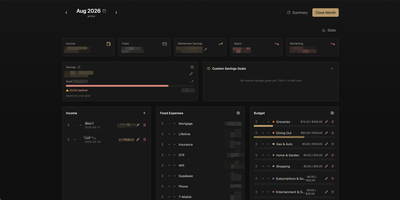
PayMe is a privacy-first personal finance dashboard that runs entirely on your own hardware with zero third-party service dependencies. The Rust backend compiled to a single binary serves a React 19 frontend built with Vite, TypeScript, and Tailwind CSS 4, storing all financial data in a local SQLite database that auto-migrates on startup. Monthly dashboards track income entries, fixed expenses like mortgage and utilities, and budget categories with real-time progress bars showing spending against configurable limits. The savings module includes goal tracking with percentage-based progress indicators, custom savings goals for targeted objectives, retirement savings projections with breakdown analysis, and projected savings calculations. Variance analysis compares actual spending against budgets across categories. Drag-and-drop reordering powered by dnd-kit lets you arrange income sources, expenses, and budget items to match your workflow. The interactive charts rendered by Recharts visualize spending trends, income patterns, and savings trajectories. Month-by-month navigation tracks financial history over time, while the Summary and Stats views aggregate data across periods. JWT-based authentication secures access, and the full OpenAPI Swagger documentation at the /swagger-ui endpoint exposes every API route for automation and integration. Docker Compose deployment creates a minimal image with the compiled Rust binary and static frontend assets, running on port 3001 behind nginx, Caddy, or Traefik reverse proxy with HTTPS. On RepoCloud, deploy PayMe on a dedicated VPS with persistent SQLite storage, root SSH access, and complete privacy over your household financial data, all under the MIT license.