Apache Airflow
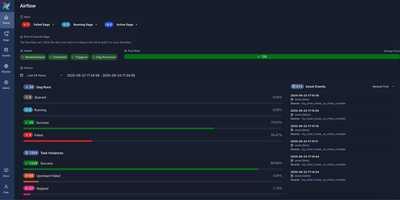
With over 46,000 GitHub stars and one of the largest communities in data engineering, Apache Airflow is the workflow orchestration platform that lets teams define, schedule, and monitor complex data pipelines as Python code through directed acyclic graphs. Airflow 3.x introduced a modernized architecture with a task execution API, the Language Task SDK for writing task implementations in Java and Go alongside Python, asset-based partitioning with FanOutMapper and FixedKeyMapper for data-driven scheduling, a first-class state store for tasks and assets, pluggable retry policies, and a redesigned React-based web UI built on FastAPI. The provider ecosystem ships 80+ packages covering AWS, Google Cloud, Azure, Snowflake, Databricks, Apache Spark, Apache Kafka, PostgreSQL, MySQL, MongoDB, Slack, HTTP, SSH, Docker, Kubernetes, and dozens more, enabling a single deployment to orchestrate jobs across multi-cloud and on-premises infrastructure. The scheduler supports cron expressions, timetable plugins, data-aware scheduling triggered by asset events, and dynamic task generation through Python loops and conditionals. Built-in operators include BashOperator, PythonOperator, DockerOperator, KubernetesPodOperator, and sensor operators that poll external systems. The web UI provides DAG visualization with Gantt charts, grid views, and graph views, task instance logs, SLA monitoring, connection and variable management, and role-based access control. Deployment options include standalone mode, Docker Compose with CeleryExecutor or KubernetesExecutor, Helm charts for Kubernetes, and managed cloud services. Running on a dedicated VPS on RepoCloud with guaranteed CPU, RAM, and SSD, full root SSH access, and a browser serial console. Apache License 2.0 licensed.
Prefect
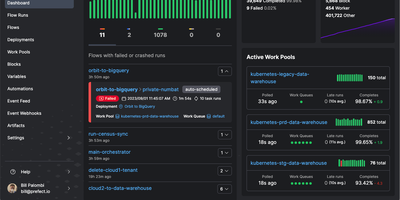
With 23,600 GitHub stars, 13 million monthly PyPI downloads, and 425+ contributors automating over 200 million data tasks monthly for Fortune 50 companies like Progressive Insurance and disruptors like Cash App, Prefect is the most widely deployed open-source workflow orchestration framework for Python — turning any script into a resilient production pipeline with a single @flow decorator while eliminating rigid DAG structures entirely. The durable execution engine persists task results and automatically resumes from failures without replaying expensive upstream work, guaranteeing exactly-once execution for any Python function. Event-driven automation triggers workflows from webhooks, cloud events, or state changes through a real-time event bus that detects what happens or fails to happen across your entire data platform. Work pools decouple workflow code from infrastructure, enabling seamless switching between Docker, Kubernetes, AWS ECS, Azure Container Instances, GCP Cloud Run, and serverless environments without modifying pipeline logic. Native Ray and Dask task runners extend execution across clusters for compute-intensive workloads. The self-hosted server provides a monitoring dashboard with flow run timelines, task state visualization, scheduling, and automation configuration. The third-generation engine reduces overhead by over 90 percent compared to Prefect 2, supporting batch, event-driven, interactive, and background task workflows. Deploy via Docker Compose with PostgreSQL, Redis, server, background services, and worker containers, or use official Helm charts for production Kubernetes. Running on a dedicated VPS on RepoCloud with guaranteed CPU, RAM, and SSD, full root SSH access, and a browser serial console. Apache-2.0 licensed.
Vibe-Trading
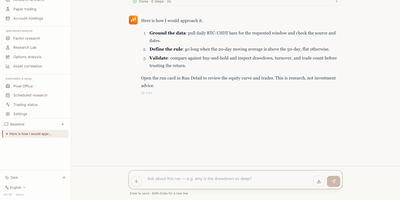
Ask for a backtest of a 20/50 moving-average crossover on BTC-USDT for 2024, and Vibe-Trading plans the run, fetches the bars, writes the strategy, and returns a run card with drawdown, trades, and a buy-and-hold comparison. The web chat keeps every session, accepts uploaded filings and spreadsheets, and links each answer to a Run Detail page with the equity curve and the data source used. Eleven backtest engines cover A-shares, global equities, crypto, futures, forex, options portfolios, and cross-market composites, and the alpha zoo benchmarks factor libraries like GTJA191 across a chosen universe. Swarm teams (investment committee, quant desk, risk review) split a question among macro, quant, and catalyst workers and merge the result into one report. Paper trading tracks cash, fills, and NAV between sessions, the portfolio view proposes allocation changes, the options page draws multi-leg payoffs and Greeks, and scheduled playbooks repeat a brief on a timetable. The Shadow Account reads broker trade journals, extracts implicit rules, and replays your trades against a rule-based alternative. Model providers include OpenRouter, OpenAI, Anthropic, DeepSeek, and local Ollama, and any broker execution is opt-in within limits you set and can halt. Running on a dedicated VPS on RepoCloud with guaranteed CPU, RAM, and SSD, full root SSH access, and a browser serial console. MIT licensed.
Risk-Aware Trading Agents
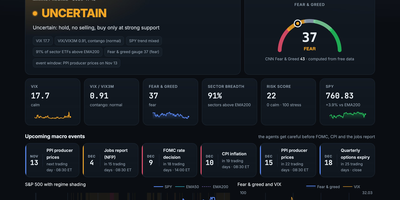
Risk-Aware Trading Agents gives a US-stock trader a patient robot that buys quality pullbacks, keeps a cash floor, and never sells in a panic. The Market page names the current regime, from risk-on to risk-off, beside a fear and greed gauge, VIX, sector breadth, and the coming FOMC, CPI, and jobs dates. Signals scans a watchlist and shows each idea with its conviction and reasons, and every score carries a question mark that explains how it was calculated. Agents runs several strategies side by side, each with its own simulated account, ranked against SPY every trading day. A decision opens into the setups found, the risk check, and an optional bull analyst, bear analyst, and risk judge from a language model. News shows which stories are confirmed by two outlets or an SEC filing. Backtest replays strategies with headlines arriving at the minute they were published and runs a look-ahead check on every research run. Claude, Codex, or Gemini can write and test a strategy through the built-in MCP server. Running on a dedicated VPS on RepoCloud with guaranteed CPU, RAM, and SSD, full root SSH access, and a browser serial console. MIT licensed.
Apache DolphinScheduler
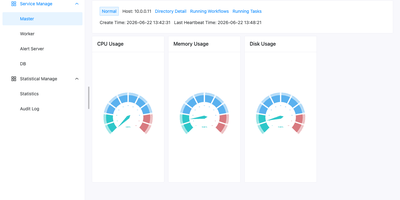
When nightly SQL, Spark, and Python jobs outgrow cron, Apache DolphinScheduler replaces the tangle with a visual workflow orchestrator where every dependency is a line on a drag-and-drop canvas. More than 30 built-in task types cover Shell, SQL, Python, HTTP, Spark, Flink, Kubernetes, SeaTunnel, and Jupyter, while logic nodes add sub-workflows, conditions, switches, and dependencies across projects. Workflows can also be written as code through a Python SDK, YAML, or the Open API and run on timezone-aware cron schedules. Backfill reruns a workflow across a date range or a hand-picked list of dates, in serial or parallel, and any instance can be modified, rolled back, and rerun without touching the saved template. Kill, pause, and resume running tasks, and choose whether a failure ends the run or lets parallel branches continue. Alert groups route results to Email, Slack, Telegram, PagerDuty, Feishu, DingTalk, webhooks, or custom scripts. Tenants, worker groups, and environments isolate teams on shared infrastructure, with project and data source permissions. A Resource Center stores scripts and task files locally or on HDFS, MinIO, and cloud object storage, and the monitor page shows master, worker, and database health at a glance. Standalone, Cluster, Docker, and Kubernetes deployments scale from one node to many masters and workers that can join or leave a running cluster. Running on a dedicated VPS on RepoCloud with guaranteed CPU, RAM, and SSD, full root SSH access, and a browser serial console. Apache 2.0 licensed.
ComposeToolbox
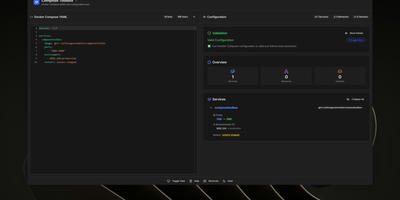
To eliminate YAML indentation errors and cryptic container misconfigurations before running docker compose up, ComposeToolbox pairs a full-featured code editor with a live configuration analyzer in a single self-hostable web workspace. Paste or write any docker-compose.yml file in the left pane to see immediate syntax validation alongside actionable best-practice warnings, such as unpinned latest image tags, missing healthchecks, or deprecated version declarations. On the right side, an interactive Configuration Overview breaks down every defined service, exposed port mapping, persistent volume mount, environment variable, and custom network into structured tabs. Built-in Quick Insert buttons let operators drop new service blocks, volume definitions, or network stanzas into the editor with one click. By mounting the persistent /app/data directory, administrators can define custom quick-insert YAML snippets with selectable hardware and networking icons in custom-templates.yml. Teams can also customize startup-template.yml so the editor opens with their organization's standard homelab or production boilerplate every time the page loads. Keyboard shortcuts, light and dark themes, and one-click YAML formatting or file export streamline daily container authoring. Running on a dedicated VPS on RepoCloud with guaranteed CPU, RAM, and SSD, full root SSH access, and a browser serial console. MIT licensed.