Saleor
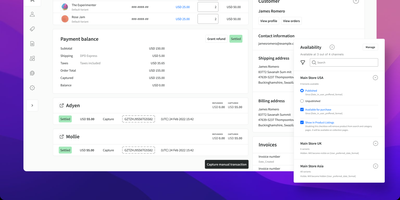
Backed by 23,000+ GitHub stars and trusted by global brands processing millions of orders, Saleor delivers the open-source headless commerce API that replaces monolithic ecommerce platforms with a composable, GraphQL-native architecture where APIs are the only way to interact with the system. The core engine built on Python and Django handles catalog management, order processing, payment orchestration, inventory tracking, and fulfillment workflows while remaining completely decoupled from any frontend technology. Native multichannel support enables per-channel control of pricing, currencies, warehouses, product availability, and payment methods, managing Instagram, Amazon, regional websites, and retail POS from a single backend. The extensibility layer provides 160+ webhooks spanning synchronous payment callbacks, asynchronous event notifications via Google Cloud Pub/Sub and AWS SQS, and subscription queries that shape webhook payloads to deliver only the data your services need. Dashboard UI Extensions offer 45+ mount points for embedding custom interfaces via iframes without forking, while the Apps system allows building payment gateways, PIM integrations, loyalty programs, and discount logic in any language. The React-based administration dashboard provides product management, order processing, customer segmentation, and analytics with multi-language and multi-currency support. OIDC integration connects existing identity providers for single sign-on across the merchant organization. Running on a dedicated VPS on RepoCloud with guaranteed CPU, RAM, and SSD, full root SSH access, and a browser serial console. BSD 3-Clause licensed.
ClearFlask
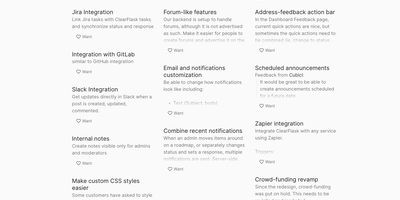
Instead of digging requests out of email and chat threads, ClearFlask collects them on a branded portal where customers vote, comment, and follow each idea from submission to release. The portal can be a simple feedback form or an open board where customers browse, vote on, and discuss each other's ideas. Visitors identify themselves through single sign-on from your own app, OAuth providers you configure, email with an optional domain whitelist, browser push notifications, or as guests. In the dashboard, the Feedback page turns a request into a task, sends a reply, merges duplicates, or shelves it for later. The Roadmap page is a drag-and-drop Kanban board with editable columns, and moving a card notifies the people following that idea. Each content category has its own statuses, transitions, and tag groups, so an idea board, a knowledge base, a blog, and a Q&A section can behave differently. Announcements double as a changelog that visitors can subscribe to. Votes can be simple upvotes, up and down votes, or weighted emoji, and threaded comments keep every discussion organized. Posts import from CSV, project data can be exported for outside analysis, a documented API and webhooks connect other tools, and the interface ships in over twenty languages. Running on a dedicated VPS on RepoCloud with guaranteed CPU, RAM, and SSD, full root SSH access, and a browser serial console. Apache-2.0 licensed.
Astuto
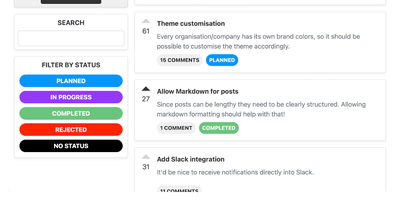
Feature requests, bug reports, upvotes, and a public roadmap: Astuto (Ruby on Rails backend, React frontend) gives users a Canny-style feedback portal so product decisions rest on visible demand rather than the loudest voice in the room. Feedback organizes into as many boards as you want (features, bugs, integrations), each post carrying a custom status you define - "planned," "in progress," "shipped," or whatever matches your process - and those statuses feed a public roadmap view showing users what is actually being worked on. Participation friction is adjustable at both ends: sign-in works with plain email or any OAuth2 provider, anonymous feedback can be enabled for unregistered users, and a moderation queue lets you approve posts before they appear when spam is a concern. Integration hooks are practical rather than sprawling - webhooks fire on events to connect Jira, Trello, or Slack, and a REST API manages the whole feedback space programmatically. Brand customization, an invitation system, private-site settings, and recap emails for administrators complete a deliberately minimal tool: it collects, organizes, and prioritizes feedback well, for free, forever.
ABC User Feedback
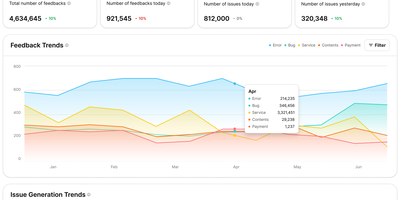
One board holds every piece of customer feedback, from app store reviews to survey answers, and turns the repeating ones into tracked issues. Each project defines channels like App Review, VOC, or Survey with custom fields for text, numbers, dates, selects, images, and AI-generated values. The feedback table filters by keyword, date, and field, expands rows for detail, and exports results when a report is due. Issues carry status labels and appear in a kanban or list view, with ticket links that point to Jira or another tracker. A dashboard charts feedback and issue trends over any date range, with counters for today and yesterday. The AI field can summarize, translate, or score sentiment on incoming messages, and issue recommendation suggests where a new message belongs, with token usage limits and notifications to cap spending. Webhooks announce events to other systems, API keys let apps submit feedback directly, and role-based access limits what each member can do. Members join by email invitation, and single sign-on connects an existing identity provider. A CLI starts the full stack, and optional OpenSearch improves search and AI accuracy. Running on a dedicated VPS on RepoCloud with guaranteed CPU, RAM, and SSD, full root SSH access, and a browser serial console. Apache-2.0 licensed.