Formbricks
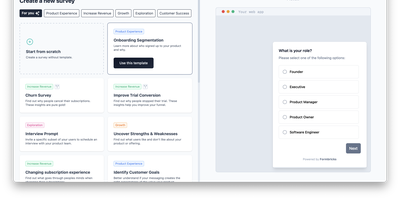
In-app, website, link, and email surveys feed one open-source experience management platform: Formbricks. Its distinguishing strength is targeted in-app research: a JavaScript SDK triggers surveys on user events and attributes, with segmentation rules like "power users who have not seen a survey in 10 days," so questions reach the right cohort at the right moment instead of a mass email blast. The no-code editor offers 20+ question types including NPS, CSAT, CES, matrix, ranking, and file upload, with skip logic, conditional branching, best-practice templates, and full brand theming. Responses feed built-in analytics with summaries and CSV/JSON export, and integrations push data to Slack, Notion, Google Sheets, Airtable, Zapier, and n8n, with webhooks and an open API on every tier. Because self-hosted surveys load from your own domain rather than a blacklisted third-party script host, ad blockers do not suppress them - in-app surveys reach users that Hotjar-style tools silently miss, which measurably raises response rates. Self-hosting also removes the third-party sub-processor from your privacy policy entirely: survey responses often contain PII, and keeping them on your own server matters for GDPR-sensitive and regulated industries. The Community Edition has no response caps or tier-gated features, so core functionality and your data stay accessible regardless of any subscription. Next.js on PostgreSQL, AGPLv3.
SurveyKing
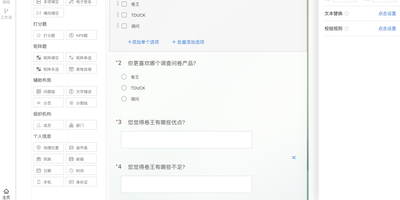
SurveyKing combines survey creation and online examination in a single platform — generate complete questionnaires from plain English via built-in LLM integration, administer timed exams with anti-cheating proctoring, and collect structured data through 20+ question types including matrix questions, cascading selectors, file uploads, and electronic signatures. Built on Spring Boot 3 with a React and TypeScript frontend using the UMI framework and Ant Design components, version 1.12 delivers each question type with independent validation rules, data type controls, and formula calculations. The AI engine connects to mainstream LLMs for survey generation from natural language prompts and provides real-time answer explanations during practice sessions. Exam mode features item banks with Word and Excel bulk import, fixed and randomized question selection, composite paper assembly, live proctoring dashboards with anti-cheating controls, automatic and manual grading with per-question scoring, and PDF score report archiving. The visual logic designer and DSL expression engine handle show/hide conditions, required rules, skip branching, quota controls, randomization, and cross-tabulation analysis with SPSS export. Role-based access controls support multi-user collaboration with department and permission management via Spring Security and JWT authentication. Redis handles caching and queuing while MyBatis Plus manages database operations. Deploy via a single Docker command with embedded H2 for trials or Docker Compose with MySQL for production. Running on a dedicated VPS on RepoCloud with guaranteed CPU, RAM, and SSD, full root SSH access, and a browser serial console. MIT licensed.
HeyForm
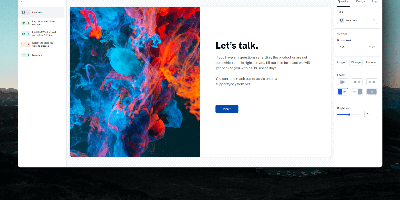
Typeform's conversational format, self-hosted: HeyForm is the open-source form builder that presents one question at a time. Forms present one question at a time, which measurably improves completion rates compared to long static pages. It supports 40+ field types, from text, email, and phone inputs to picture choices, date pickers, star ratings, signatures, and file uploads. Conditional logic shows or hides questions based on earlier answers, routes respondents to different endings, and redirects to URLs, so a single form can serve multiple flows. Completed submissions land in a results dashboard with drop-off and completion analytics, and connect outward through webhooks or integrations with Zapier, Make, Google Sheets, Notion, Airtable, and Slack. Theming covers fonts, colors, backgrounds, and custom CSS, so embedded forms look native to your site rather than like a third-party widget; the JavaScript embed library renders them inline, as popups, or full-page, with shareable standalone links as the default. Team workspaces and projects with member management let multiple teams share one instance without mixing data. Self-hosting removes per-response pricing entirely - unlimited forms and submissions for flat hosting cost - and keeps lead data, feedback, and quiz answers in your own MongoDB, simplifying GDPR compliance. The stack is a NestJS server and React webapp backed by MongoDB and KeyDB, distributed under GPLv3 as a Docker image.
Budibase
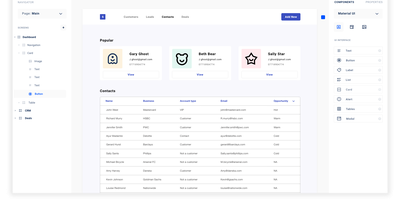
Step right up to the magical world of Budibase, the open-source wizardry that turns the grueling task of building internal tools into a walk in the digital park. Imagine crafting mighty tools and formidable forms in less time than it takes to brew a cup of coffee, all without typing a single line of code! With Budibase, you can charm data from an ancient external database, summon information from a Rest API, conjure up figures from a CSV, or create something entirely new with Budibase's own mystical database. Design your digital dominion with a flick of the drag-and-drop, and automate your kingdom's workflows as if by magic. Join the ranks of the 75,000 teams who've harnessed the power of Budibase to accelerate their business quests. Need to safeguard data like a digital fortress, automate tasks like a sorcerer, or streamline operations like a high-speed chariot? Budibase is your trusty steed in the race to operational victory. And with RepoCloud hosting, you'll save a treasure chest of gold compared to those other cloud-dwelling giants!
Typebot
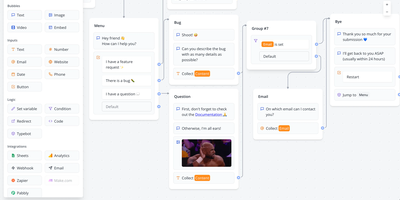
A fair-source chatbot and conversational-form builder: Typebot assembles conversations in a visual graph editor. In a visual graph editor you chain blocks from four categories: bubbles display text, images, video, audio, and embeds; inputs collect data through text fields, email, phone, buttons, picture choices, date pickers, file uploads, and Stripe payments; logic blocks handle conditional branching, variables, URL redirects, A/B testing, and custom JavaScript; integration blocks call webhooks, OpenAI, Google Sheets, Google Analytics, Meta Pixel, Zapier, Make, and Chatwoot. Build once, deploy anywhere: custom domains, WhatsApp, or embedded in any site as a container, popup, or chat bubble through a fast native JS library with no iframe and no external dependencies - plus an HTTP API for executing bots programmatically from any language. Theming covers fonts, colors, roundness, and shadows with custom CSS and reusable templates, and results arrive in real time with drop-off and completion analytics plus CSV export. Two Next.js apps (builder and viewer) self-host via Docker under the Functional Source License, which converts to Apache 2.0 after two years.