Project NOMAD
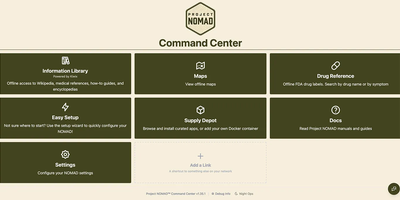
When the connection drops, Project NOMAD keeps serving offline Wikipedia, Khan Academy courses, maps, and an optional private AI assistant from a single Debian-based Linux server. The core needs only about 5 GB of disk and under 1 GB of RAM. Content is what fills the drive, and a setup wizard sorts it into Essential, Standard, and Comprehensive tiers while a storage bar tracks the running total. Wikipedia runs from a quick-reference set of the top 100,000 articles to the complete English edition with images at about 121 GB, and Kiwix also serves medical references, survival and repair guides, and Project Gutenberg ebooks. Kolibri adds Khan Academy courses with multi-user progress tracking, and any browser on the network can study. Offline maps cover the whole globe, single countries, or regions, with markers you can search, color, and navigate to by coordinate. The AI assistant is the heavy part, bringing the install to roughly 25 GB. It chats through Ollama or any OpenAI-compatible server such as LM Studio, searches uploaded documents, lists sources with dates when known, and lets vision models read attached images. CyberChef handles encoding and hashing, and FlatNotes keeps Markdown notes. The Supply Depot adds one-click apps or your own Docker containers. Opt-in auto-updates for the Command Center, installed apps, and downloaded content run inside a window you set. Running on a dedicated VPS on RepoCloud with guaranteed CPU, RAM, and SSD, full root SSH access, and a browser serial console. Apache 2.0 licensed.
NextChat
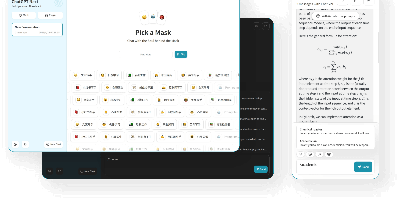
Thirteen-plus LLM providers, one unified client: NextChat (formerly ChatGPT-Next-Web) is an open-source AI chat interface built on Next.js that spans OpenAI GPT-4, Anthropic Claude, Google Gemini, DeepSeek, Groq, Azure endpoints, and self-hosted backends like Ollama, LocalAI, and RWKV-Runner. Its defining trait is minimalism - the first screen loads in about 100 KB, the desktop client is roughly 5 MB, and there is no database or user system to operate; chat history lives locally in the browser with optional WebDAV or UpStash Redis sync. The Mask system saves reusable prompt-template personas you can share and debug, long conversations auto-compress to fit context windows, and Markdown rendering covers LaTeX, Mermaid diagrams, and code highlighting with streaming responses. Plugins add web search and calculators, MCP support enables external tool calling, and Artifacts previews generated content in a separate pane. Ships as a web app, Docker image, and Tauri desktop builds for Windows, macOS, and Linux, translated into 20+ languages. MIT-licensed.
Presenton
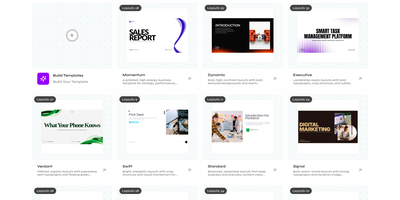
Describe a topic in a sentence, or drop in a document, and get back a finished slide deck that you can still edit slide by slide. You write a brief, pick a design from the template gallery, and review an outline of every slide before generation starts, so the story is settled before any layout work happens. The editor then shows each slide on the canvas with thumbnails on the left and a side panel for blocks, text, charts, tables, images, and shapes. Charts, icons, and speaker notes arrive with the slides, and an AI panel sits beside the canvas for further changes. Finished decks export as PowerPoint or PDF files, and a dashboard keeps every deck you have made. Any text model works, from hosted services at OpenAI, Gemini, Anthropic, Azure, or Bedrock to local ones on Ollama or LM Studio, and image sources include AI image models and stock libraries. A custom template builder turns an existing PowerPoint file into reusable layouts, and a REST API and built-in MCP server let other tools generate decks on demand. Use it for sales reports, weekly status reviews, training material, or pitch decks. Running on a dedicated VPS on RepoCloud with guaranteed CPU, RAM, and SSD, full root SSH access, and a browser serial console. Apache-2.0 licensed.
Open Executive
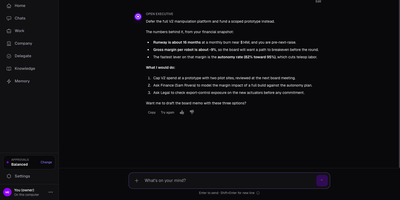
One executive voice, backed by nine specialist agents, answers business questions from your own documents instead of generic management advice. Ask if a product line should be built or deferred and the reply cites your financial snapshot, roadmap, and legal notes, then lists the numbers behind the call and the next steps. The Agent Council covers strategy, finance, people, legal, operations, marketing, product, sales, and board communications, and each agent accepts its own instructions and model. A company profile stores mission, target customer, and competitors. Departments and Goals track owners, weekly check-ins, and at-risk or off-track status. Knowledge accepts PDF, Word, Excel, CSV, Markdown, and text files, and can sync from Google Drive, OneDrive, Confluence, or Notion. Memory records decisions and what the company has learned, and a built-in scheduler surfaces follow-ups and alerts on its own. The same executive answers in Slack, Discord, Telegram, Google Chat, Gmail, Outlook, or any MCP client, with spend approval thresholds that govern how it works with people. Founders get a chief of staff, small teams a fractional advisor, and board prep a head start before the next investor update. Demo companies are bundled for a quick tour. Running on a dedicated VPS on RepoCloud with guaranteed CPU, RAM, and SSD, full root SSH access, and a browser serial console. Apache-2.0 licensed.
Higress
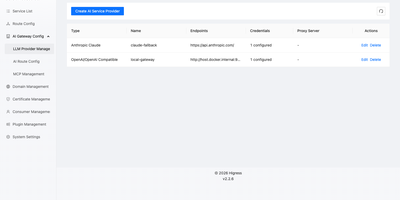
Send every AI request through one gateway that holds your model providers, API keys, and access rules. The web console starts with a first-run admin setup, then an LLM Provider page where OpenAI-compatible endpoints, Anthropic Claude, Azure OpenAI, Tongyi Qianwen, Moonshot, Zhipu, and other services are added with their tokens. AI Route Config maps path prefixes and model match rules to weighted target services, with token failover and first-packet timeouts to keep traffic moving when a key fails. Consumer Management issues key, OAuth2, and JWT credentials, and each route can limit access to named consumers. Plugin Management lists ready-made AI plugins for caching, context limits, data masking, prompt templates, prompt decorators, load balancing, and intent checks, plus traffic and security plugins that can be configured per route. MCP Management hosts MCP servers behind the same authentication and rate limits so agents call tools through one governed address. Service Sources import backends from Nacos, Zookeeper, Consul, Eureka, static addresses, or domains, and domain and certificate pages handle HTTPS, including free automatic certificates from Let's Encrypt. An LLM proxy for a product team, a shared model endpoint for several agents, or a replacement for an ingress controller all fit this console. Running on a dedicated VPS on RepoCloud with guaranteed CPU, RAM, and SSD, full root SSH access, and a browser serial console. Apache-2.0 licensed.
CUGA
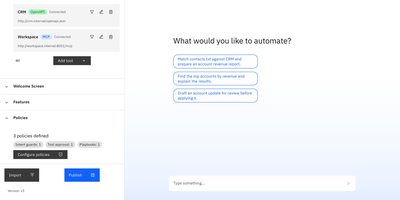
Turn a plain business request into a finished workflow, with a human sign-off on anything risky. CUGA is an agent harness you run on your own infrastructure, with a browser workspace where you build agents, test them beside a draft chat, and publish a versioned configuration when it behaves. Connect tools through MCP servers or OpenAPI specs, then write five kinds of policy: intent guards, playbooks, tool guides, tool approvals, and output formatters. A supervisor agent can route work to specialists that each carry their own tools and instructions. The chat workspace keeps conversation threads, uploaded files, and a knowledge panel for cited answers from company documents. Event Studio runs watchers on cron schedules, polling, or push triggers, with run history showing tools used and results. Memory records task guidance and user preferences, shows where each came from, and lets users switch it off or forget items, and administrators set retention rules. OIDC sign-in separates chat users from managers. Point it at any OpenAI-compatible endpoint, including a private inference server. Operations teams, internal tooling groups, and platform engineers can automate CRM reports, document review, and recurring briefs without sending data outside their boundary. Running on a dedicated VPS on RepoCloud with guaranteed CPU, RAM, and SSD, full root SSH access, and a browser serial console. Apache-2.0 licensed.
Tabby
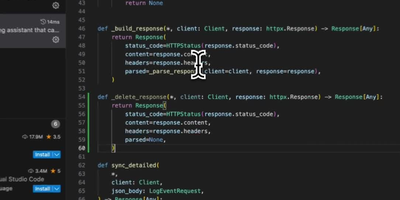
With over 33,000 GitHub stars and a codebase written in 92.9% Rust for maximum performance and memory safety, Tabby is the most widely adopted self-hosted alternative to GitHub Copilot — delivering real-time code completions entirely on your own infrastructure with zero code leaving your network. Deploy a single Docker container on any NVIDIA CUDA, Apple Silicon Metal, AMD ROCm, or CPU-only server and connect VS Code, JetBrains IDEs (IntelliJ, PyCharm, WebStorm, GoLand), Vim, Neovim, and Emacs through native extensions. The completion engine supports a curated registry of models including StarCoder2 (1B to 15B parameters), DeepSeek-Coder, CodeLlama, CodeGemma, Qwen2.5-Coder, and Mistral Code — swappable at runtime through the admin dashboard without redeployment. Repository indexing parses your Git repositories and feeds project-specific types, function signatures, and patterns into completion context via RAG, producing suggestions that understand your codebase rather than generic boilerplate. The Answer Engine provides instant responses to code queries within the IDE, while inline chat enables contextual code editing and explanation without switching windows. The admin dashboard manages per-developer API tokens, usage analytics, and model configuration. Enterprise features include SSO via LDAP, OAuth, and SAML, role-based access control, and audit logging for compliance environments. A single RTX 4090 workstation serves a team of 10-15 developers with sub-500ms completion latency. Running on a dedicated VPS on RepoCloud with guaranteed CPU, RAM, and SSD, full root SSH access, and a browser serial console. Apache 2.0 licensed.
CPA Usage Keeper
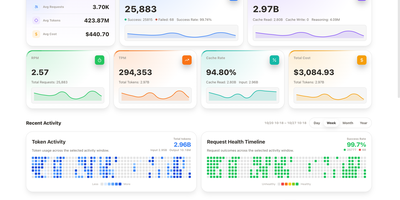
Somewhere between the third coding agent and the fifth model subscription, nobody can say where the tokens went. CPA Usage Keeper keeps the receipts for a CLIProxyAPI gateway, saving every request locally with scheduled backups so history survives restarts. The Overview page shows requests, success rate, tokens, cache hit rate, and estimated cost with sparklines and a calendar heatmap, and Realtime plots time to first token against total latency and shows rolling cache levels and model speed. Analysis breaks usage down by API key, model, credential, or provider with donut charts and ranked lists. The Request Events log filters by model, source, and status, adjusts its columns, and exports records. Credentials cards show success rates, remaining five-hour and weekly quotas, priorities, and enable switches, and quota history charts how many tokens and dollars each percentage point costs over a cycle. Individual API keys can be given a read-only usage view. Deployment uses a Docker Compose file that bundles CPA with Keeper or runs Keeper beside an existing gateway, and the interface switches between English and Chinese and between light and dark themes. Check the dashboard before the invoice arrives and see exactly who spent what. Running on a dedicated VPS on RepoCloud with guaranteed CPU, RAM, and SSD, full root SSH access, and a browser serial console. MIT licensed.
CPA Manager Plus
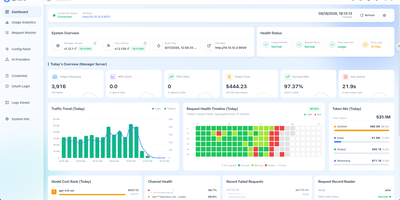
CPA Manager Plus is a self-hosted observability dashboard and management panel that tracks every AI request flowing through your CLI Proxy API gateway, breaking down failures, costs, and account health across providers like OpenAI, Anthropic, xAI, and Codex in one interface. When a request fails, drill into the persistent history to see status codes, affected models, latency, and redacted failure evidence without exposing raw response bodies. The cost analytics engine breaks down token consumption and estimated spend by model, provider, account, API key, project, channel, and time range while tracking input, output, reasoning, cache, and service-tier pricing semantics separately. Model prices sync automatically from models.dev with LiteLLM and OpenRouter fallbacks, and you can add local overrides for aliases or internal models. For teams running Codex or xAI accounts, the health inspector reads quota windows, reset evidence, credential state, and workspace status on a configurable schedule, routing credential failures into an action queue for review rather than letting them silently degrade throughput. Deploy the Lightweight Panel to replace your existing CPA management UI without adding another service, or run Full Mode as a single Docker container that adds the Manager Server with persistent SQLite storage for request history, historical analytics, and automated account inspections. Export or import request history as JSONL for external analysis, and back up the SQLite files alongside your encrypted management keys. Running on a dedicated VPS on RepoCloud with guaranteed CPU, RAM, and SSD, full root SSH access, and a browser serial console. MIT licensed.
Obsidian Arc
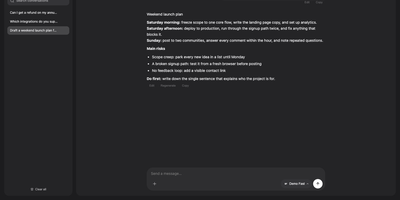
Teams and communities sign in to a private AI chat site, and one admin console routes and meters every request. Users pick a model from the menu and chat with streamed answers, visible reasoning, projects that share a system prompt, searchable history, archives, and an Image Lab for generated pictures. Administrators connect providers that speak the OpenAI or Anthropic protocols, map several models onto each, and place users in groups with their own allowances counted in requests, tokens, or credits per five hours, week, or month. A developer endpoint accepts API keys and serves chat completions, Anthropic messages, responses, images, and a model list, so coding assistants and scripts can share the same pool. The dashboard charts requests, tokens, and spend by model and by person, and Availability probes idle models and trips a circuit breaker after repeated failures. Registration can be open, invite-only, or closed, with invite codes, email rules, authenticator-app two-step sign-in, and GitHub, Google, or OpenID Connect login. Announcements, a feedback inbox, an optional leaderboard, a guest trial chat, and scheduled backups to S3-compatible storage round out the operator toolkit. A company AI portal, a classroom, a research group, or a paid community with trial codes can all run on it. Running on a dedicated VPS on RepoCloud with guaranteed CPU, RAM, and SSD, full root SSH access, and a browser serial console. MIT licensed.
a13n Agent Foundation
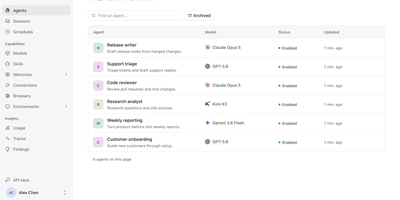
Agents that keep working after you close the tab: a13n gives a team one shared place to define them, run them, and watch what they did. In the Console, an administrator adds models from OpenAI, Anthropic, Gemini, Bedrock, Azure, OpenRouter, DeepSeek, Ollama, and others, then creates agents with instructions, skills, memories, connections, browsers, and sandbox environments. A Try agent button opens a conversation, and the Debug view lays out every run step by step, with model calls, tool calls, token counts, cache rates, and durations. Sessions and schedules keep a history of conversations and recurring jobs. The Usage page charts spend, runs, requests, and tokens by agent, model, or member across a time range. Findings analyzes traces, flags answer quality and tool failures, and lets reviewers confirm or dismiss each one with a suggested improvement. Each agent has a Connect to app screen with its ID, service URL, and API key, so applications can call it over an HTTP API or SDK. Workers lease runs from PostgreSQL and save checkpoints to object storage, so interrupted work resumes. Customer support teams, internal platform groups, and product builders use it to ship agent features without writing their own orchestration layer. Running on a dedicated VPS on RepoCloud with guaranteed CPU, RAM, and SSD, full root SSH access, and a browser serial console. Apache-2.0 licensed.
Dify
Dify turns the notoriously complex process of building production-grade AI applications into a visual drag-and-drop experience that teams can actually ship and maintain. With over 87,000 GitHub stars and backing from prominent investors, the platform has become the go-to open-source LLMOps solution for organizations that refuse to be locked into proprietary AI stacks. The visual workflow canvas lets developers wire together LLM calls, conditional logic, iteration loops, tool invocations, and human-in-the-loop checkpoints without writing boilerplate integration code. Its RAG pipeline engine handles the full document lifecycle from ingestion of PDFs, Word documents, and HTML through configurable chunking strategies, embedding with models from OpenAI or open-source alternatives, vector storage in Weaviate, Qdrant, Pinecone, or pgvector, and hybrid semantic-plus-keyword retrieval with citation tracking. Dify integrates with hundreds of model providers including OpenAI GPT-4o, Anthropic Claude, Google Gemini, Mistral, Llama, and any OpenAI-compatible endpoint like Ollama for fully local inference. The agent framework supports both ReAct and function-calling strategies with 50-plus built-in tools spanning Google Search, DALL-E, Stable Diffusion, WolframAlpha, and custom API definitions. Published apps can be deployed as hosted web interfaces, embedded chat widgets, REST API endpoints, or MCP-compatible tools. Enterprise features include role-based access control, SSO integration, and audit logging. A built-in marketplace enables teams to share and reuse model providers, tools, and workflow templates across projects. Running on a dedicated VPS on RepoCloud with guaranteed CPU, RAM, and SSD, full root SSH access, and a browser serial console. Apache 2.0 licensed with an open-source community edition.
Dagu
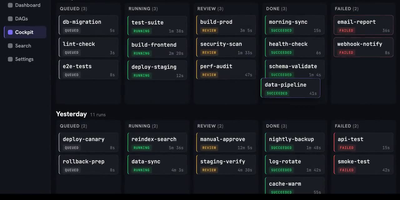
With over 3,700 GitHub stars and growing adoption among teams tired of managing complex orchestration platforms, Dagu delivers a complete workflow engine as a single Go binary that requires no external database, message broker, or framework installation. Define directed acyclic graphs in declarative YAML — specifying dependencies, schedules, retries, timeouts, approvals, and notifications — while keeping existing shell scripts, containers, and tools completely unchanged. The built-in Web UI provides live pipeline visualization, per-step log streaming, run history browsing, artifact previewing, manual retry controls, and workflow YAML editing without SSHing into servers. Execute steps as shell commands, Docker containers, Kubernetes Jobs, SSH remote commands, SQL queries, or HTTP requests, with conditional branching and parallel execution handled natively. The integrated Model Context Protocol server exposes dagu_read, dagu_change, and dagu_execute tools, enabling AI agents like Claude, Codex, and Cursor to inspect workflow state, preview YAML modifications, and control runs through authenticated endpoints. The harness.run executor lets external coding-agent CLIs operate inside DAG steps with full scheduling and approval gate support. Scale beyond a single machine with the distributed worker mode, which dispatches tasks to remote nodes via gRPC with automatic label-based routing and worker selection. Deploy with Docker, the official Helm chart for Kubernetes, or a simple binary download requiring only a Linux, macOS, or Windows host. Running on a dedicated VPS on RepoCloud with guaranteed CPU, RAM, and SSD, full root SSH access, and a browser serial console. GPLv3 licensed.
Kong
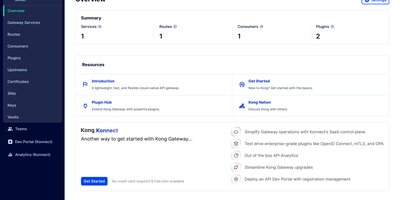
With over 43,000 GitHub stars and adoption by companies including Nasdaq, Samsung, and Expedia, Kong Gateway is the world's most deployed open-source API gateway, processing billions of API requests daily across hybrid-cloud and multi-cloud architectures. Built on the battle-tested NGINX engine with OpenResty's LuaJIT runtime, Kong delivers sub-millisecond proxy latency while supporting REST, gRPC, GraphQL, WebSocket, SOAP, and Kafka protocols. The plugin architecture includes authentication via JWT, Basic Auth, HMAC, key authentication, OAuth 2.0, and LDAP, alongside rate limiting with configurable windows per consumer, IP address, or API key. The AI Proxy plugin provides a universal LLM API that routes across OpenAI, Anthropic, Google Gemini, AWS Bedrock, Azure AI, Databricks, Mistral, and Hugging Face through a single standardized interface, while MCP proxy capabilities convert REST APIs into MCP tools and provide traffic governance for AI agents. Kong supports declarative configuration via YAML for GitOps workflows, a RESTful Admin API for dynamic configuration, and decK CLI for version-controlled infrastructure-as-code management. Upstream health checking with active and passive probes enables automatic failover, and the ring balancer distributes traffic across upstream targets with consistent hashing, round-robin, or least-connections algorithms. The Kong Plugin Hub hosts over 100 community and official plugins covering logging, monitoring, transformation, security, and traffic control. Running on a dedicated VPS on RepoCloud with guaranteed CPU, RAM, and SSD, full root SSH access, and a browser serial console. Apache 2.0 licensed.

Wardrowbe
Your closet already knows what you own; Wardrowbe is the part that remembers it for you and decides what goes together tomorrow morning. Photograph garments one at a time or several in a single shot, and a vision model tags each piece with its type, color, pattern, fabric, style, and formality, with a confidence score you can correct. From that catalog the app builds complete outfits out of clothes you already have, weighing your local weather, the occasion, notes you attached to individual pieces, and the aesthetic you described. A daily suggestion can arrive on a schedule through ntfy, Mattermost, or email, so the outfit is waiting before you are. Accept, reject, and rate what you wear, and the history calendar keeps every past recommendation while the feedback sharpens the next ones. Pairings work the other way around too: pick one item and get outfits built around it, each with a plain-language explanation of why the combination works. Analytics show what you actually wear, what never leaves the rail, and how your colors distribute, and the wardrobe view flags pieces that need washing. Households manage several members' wardrobes with personalized suggestions for each person. Everything runs against any OpenAI-compatible endpoint, so Ollama with a local multimodal model keeps the whole pipeline offline and free. The interface speaks eight languages and follows your browser by default. Running on a dedicated VPS on RepoCloud with guaranteed CPU, RAM, and SSD, full root SSH access, and a browser serial console. MIT licensed.
AI Native Call Center
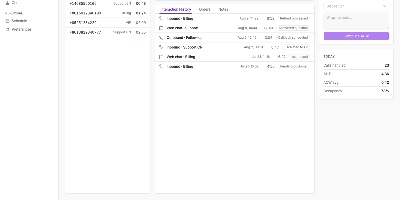
AI Native Call Center is a self-hosted call center where a voice model answers the phone first and people step in only when the conversation actually needs one. Calls land on FreeSWITCH and connect straight to a speech-to-speech provider, and a flow engine steers each call through phases that carry instructions and the tools the model may use, with transitions firing on tool results. When a person is required, the call transfers into a real queue and the agent's browser screen has already popped with the caller's details and the bot-phase transcript ready to read. Agents handle presence, call control, and callbacks from the web interface, and a companion browser extension holds their SIP registration and audio. Supervisors watch a live wallboard with the queue view and the agent roster. Persona, rules, and voice are published and versioned together, and flows are plain documents you can author and validate before loading. Every conversation, bot-answered, handed over, and finished by an agent, lands in a single call record holding one transcript and one recording stored on a filesystem or an S3-compatible bucket. The interface and the bot work in English and Chinese, with provider choices for different regions including an option to run your own realtime gateway. Running on a dedicated VPS on RepoCloud with guaranteed CPU, RAM, and SSD, full root SSH access, and a browser serial console. Apache-2.0 licensed.
GitNexus
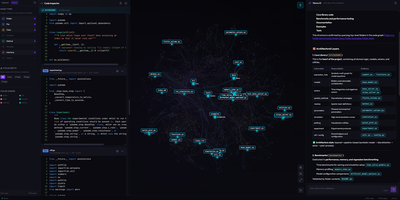
GitNexus turns any codebase into an interactive knowledge graph that maps every dependency, call chain, functional cluster, and execution flow, giving AI coding assistants the deep structural awareness they need to stop breaking things. Drop a repository URL or ZIP file into the browser-based explorer and watch Tree-sitter parsers decompose your code into a navigable property graph you can zoom, click, and query. The MCP server integrates directly with Cursor, Claude Code, Codex, Antigravity, and other editors through 16 specialized tools covering architectural queries, impact analysis, safe multi-file renames, change detection, and cross-repo contract matching. Need to know the blast radius before touching a shared utility? The impact analyzer traces every caller, implementer, and downstream consumer in milliseconds. Teams reviewing pull requests get automated blast-radius annotations powered by the same graph. The registry architecture lets a single MCP server manage multiple indexed repositories simultaneously, so switching between projects requires zero re-indexing. For visual exploration, the web interface renders interactive community-clustered graphs where you can trace execution paths, browse file trees, and chat with an AI agent grounded in the graph's structural data rather than raw file snippets. Everything runs locally; your source code never leaves the machine. Running on a dedicated VPS on RepoCloud with guaranteed CPU, RAM, and SSD, full root SSH access, and a browser serial console. PolyForm Noncommercial 1.0.0 licensed.
AgentSDR
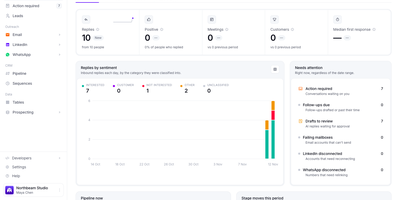
Outbound sales eats hours on list building, sequencing, and reply triage, and AgentSDR puts all three in one self-hosted workspace where AI drafts every reply for your approval. Leads holds every person and company as one record per contact, imported from CSV or Excel, so a reply on any channel lands in the same place. Tables enriches lists row by row with fifteen data providers, AI columns, and HTTP calls. Email sequences send from your own mailboxes with merge fields, sending windows, and daily limits. LinkedIn adds invitations with notes and follow-ups after acceptance, and WhatsApp covers chats and recorded calls. The Action required queue shows each reply with its AI classification, like Meeting Requested or Case Study, next to a drafted answer you edit and approve in one click. Nothing sends on its own. The Pipeline board groups open leads into needs action, waiting on them, and follow-ups exhausted, and Analytics charts replies, positive replies, meetings, and customers by channel. Do Not Contact rules, teams, and organization roles come built in. Founders, small sales teams, and agencies running outbound for clients get a lead-to-meeting engine. Running on a dedicated VPS on RepoCloud with guaranteed CPU, RAM, and SSD, full root SSH access, and a browser serial console. MIT licensed.