Categories
Self-Hosted Developer Tools Privacy Networking System Administration Ad Blocking DNS ServerStars
Forks
Watchers
Developer links
Numa
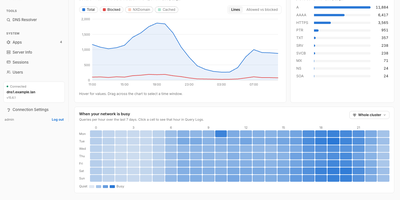
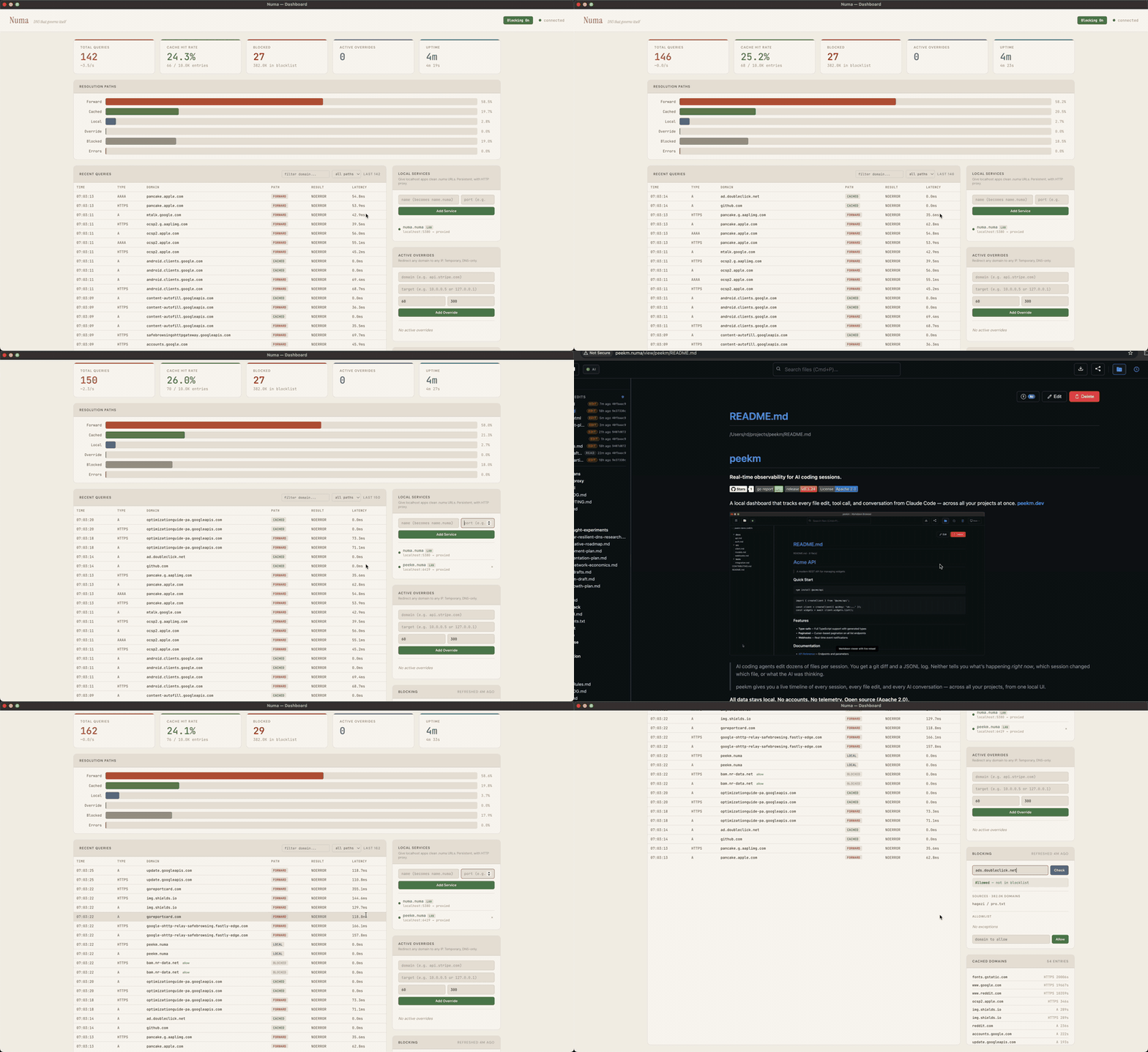
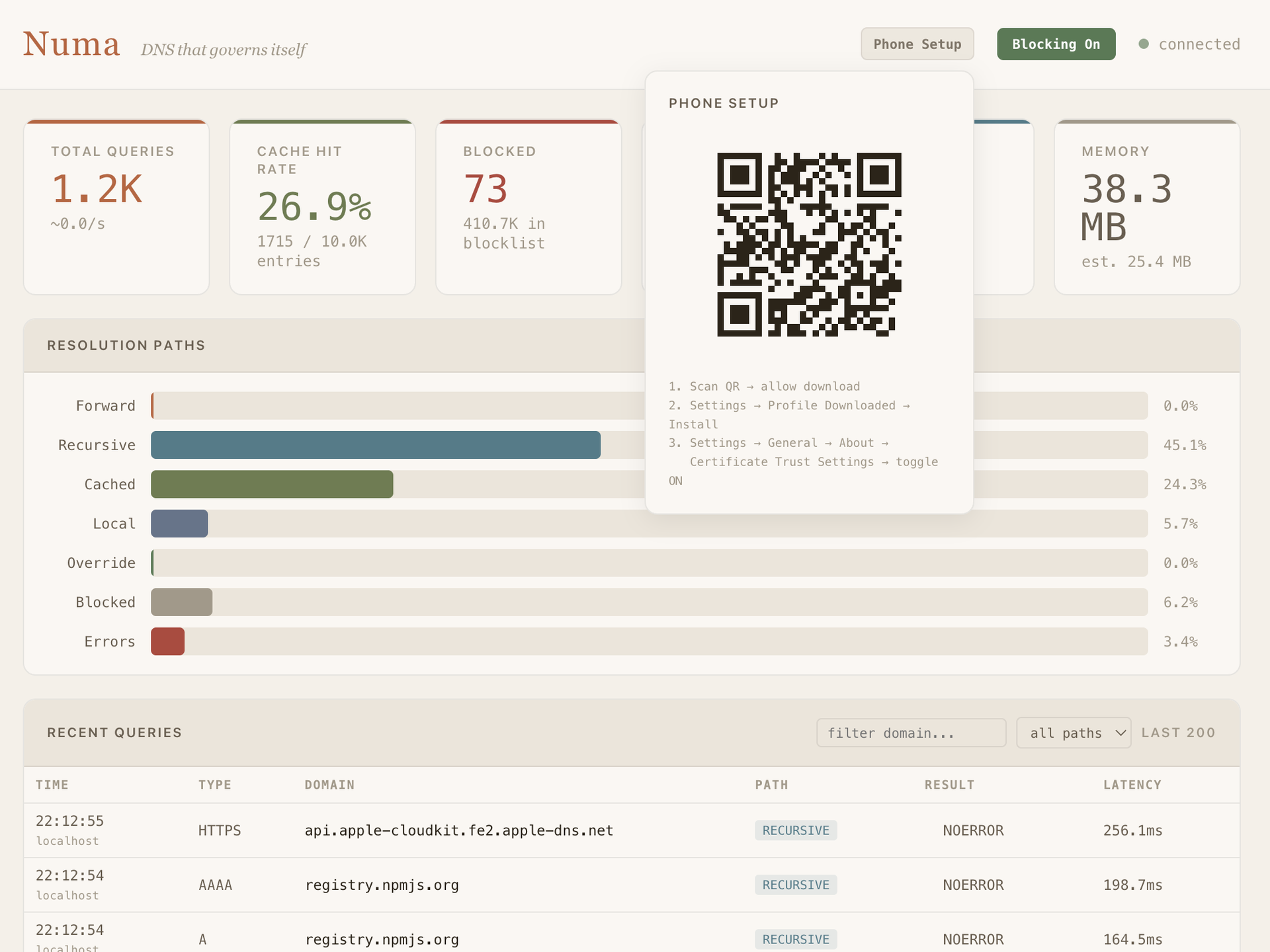
Numa is a DNS resolver you run yourself that gives every service on your network a real name, blocks ads and trackers before they load, and keeps your queries private with encrypted DNS. Register a frontend on port 5173 once, and https://frontend.numa opens in your browser with a valid certificate and WebSocket passthrough, no mkcert, no nginx, no editing hosts files. Path-based rules send app.numa/api to a backend on another port, so multi-service projects get one clean address instead of a spreadsheet of port numbers. Tracker and ad domains die at resolution time through the Hagezi Pro blocklist, refreshed daily, and every device that points its DNS at your instance inherits the filtering. Temporary overrides redirect any hostname for testing or debugging and revert on their own, and scripts can create them through the REST API. You choose how answers are found: forward to your existing DNS, resolve recursively from the root servers, or seal queries with Oblivious DNS over HTTPS so no single party sees both your address and your question. Phones and laptops connect over DNS-over-TLS on port 853, a QR-code flow points an iPhone at your resolver in minutes, and mDNS discovery lets one machine reach services registered on another. The dashboard on port 5380 manages services, overrides, and diagnostics, with token sign-in away from loopback. Running on a dedicated VPS on RepoCloud with guaranteed CPU, RAM, and SSD, full root SSH access, and a browser serial console. MIT licensed.
Benefits
- Names instead of port numbers
- Register a service once and reach it at https://name.numa with a valid certificate and WebSocket passthrough. Local development stops depending on memorized ports, hosts files, and certificate tooling.
- Ads blocked at resolution
- The Hagezi Pro blocklist, refreshed daily, stops ad and tracker domains from resolving at all. Every phone, laptop, and TV that uses your resolver gets network-wide filtering without per-device apps.
- Queries nobody can profile
- Forward, recursive, and Oblivious DNS over HTTPS modes let you decide who sees your lookups. ODoH splits knowledge between relay and target, so neither side can build a browsing profile.
- One binary, every platform
- Numa ships as a single Rust binary for Linux, macOS, Windows, and Docker with amd64 and arm64 images. The install command registers the service, points system DNS at it, and trusts its local CA.
Features
- Local .numa services
- Register a name and target port through the dashboard or REST API. Numa proxies it over HTTPS with its local CA, including WebSocket passthrough and path-based routing rules.
- Encrypted DNS everywhere
- Serves DoH (RFC 8484) and DoT (RFC 7858, port 853) clients, and sends upstream queries over DoH, DoT, or ODoH (RFC 9230) with self-signed or bring-your-own certificates.
- Overrides with auto-revert
- Redirect any hostname temporarily for testing, development, or debugging. Overrides expire and revert on their own, and the REST API makes them scriptable from deploy pipelines and shell scripts.
- Recursive DNSSEC resolution
- Resolve from the root servers with DNSSEC validation, serve-stale caching (RFC 8767), prefetch, and request hedging across upstreams. Out-of-zone answers and private nameserver targets are dropped.
- mDNS LAN discovery
- Instances on the same network find each other through mDNS. A service registered as grafana on one machine answers at grafana.numa from every other Numa host on the LAN.