Stars
Forks
Watchers
Developer links
Database Lab Engine
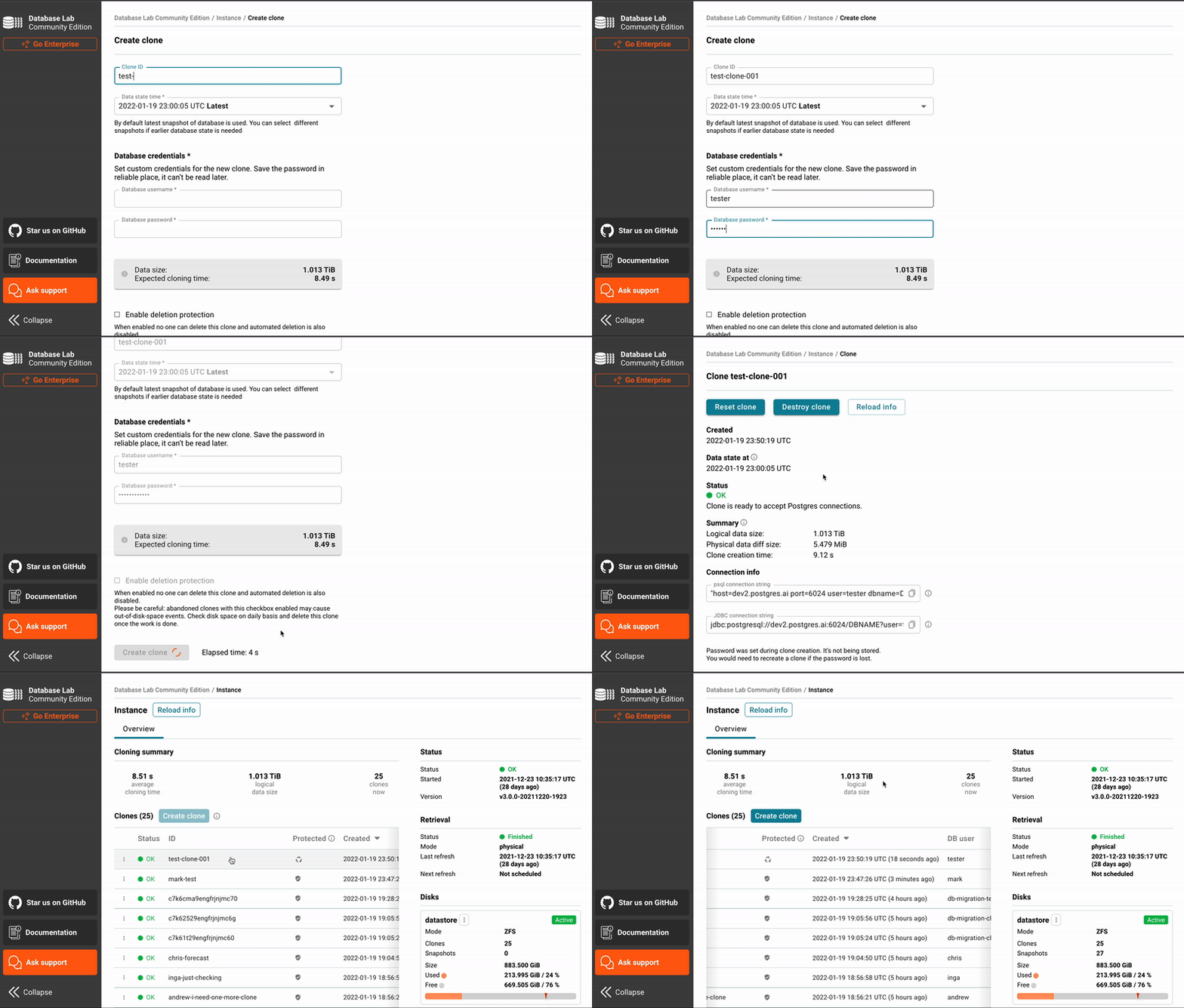
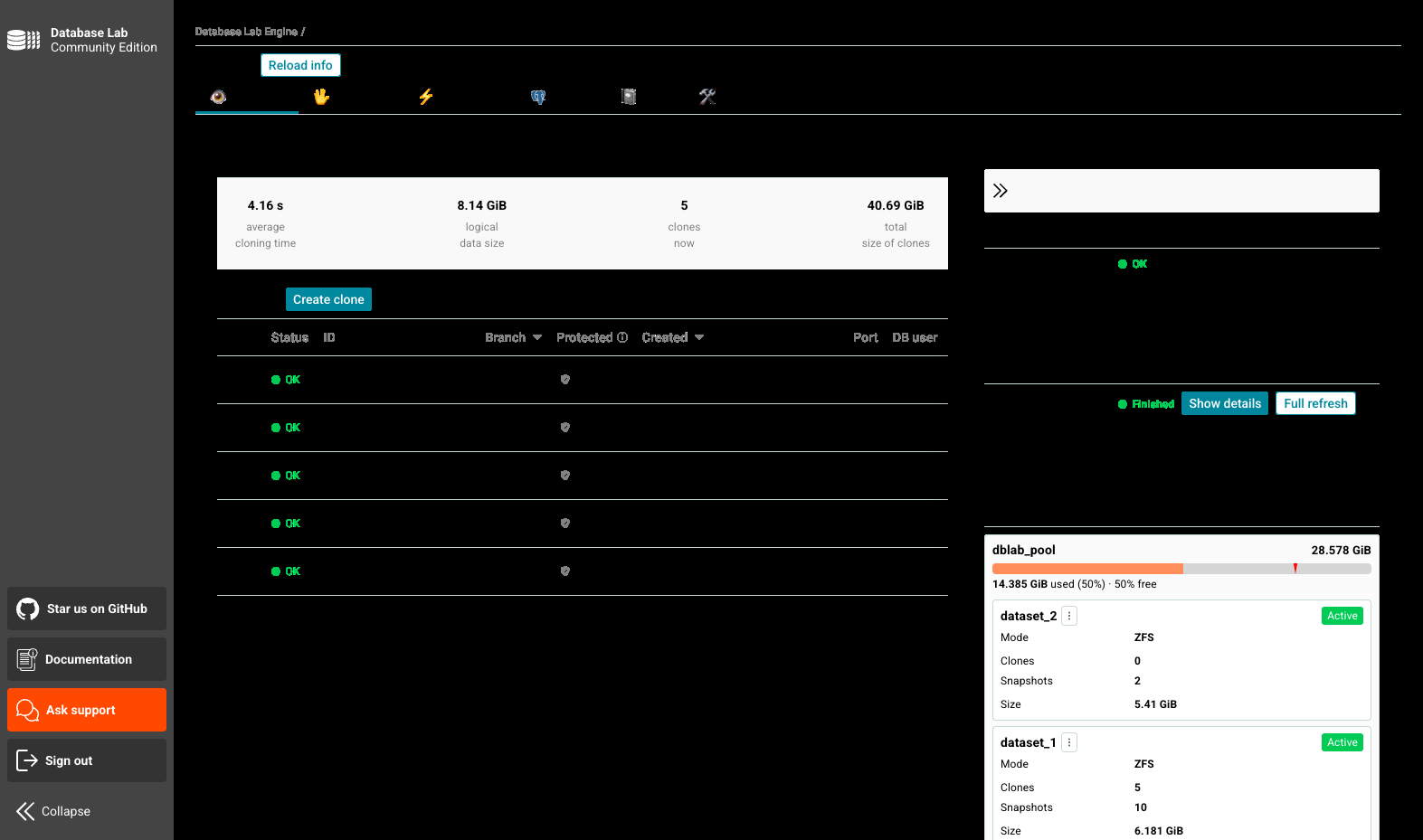
Testing a migration against a toy database proves almost nothing. Database Lab Engine is an open-source platform that clones production-sized PostgreSQL databases in seconds, giving every developer, CI job, and query experiment a full-fidelity copy without waiting hours for a restore or paying to store ten of them. The trick is thin cloning: copy-on-write snapshots taken on ZFS or LVM let a one-terabyte database materialise as a writable branch in about ten seconds, with dozens of independent clones sharing one physical dataset until their changes diverge. Teams point CI at a fresh clone for every migration, so 100 percent of schema changes get rehearsed against real data shapes and volumes before they touch production; analysts get disposable copies for testing query rewrites and index ideas; and a bad experiment costs one delete, not one restore. Clones are managed through a web UI, API, and CLI, draw from self-managed Postgres or managed sources on RDS, Cloud SQL, and Supabase, and carry popular extensions in their containers. Resets, upgrades, deletion protection, retention rules, and resource quotas keep the fleet tidy as it grows into branches and snapshots numbering in the dozens. Running on a dedicated VPS on RepoCloud with guaranteed CPU, RAM, and SSD, full root SSH access, and a browser serial console. Apache-2.0 licensed.
Benefits
- Terabytes In Seconds, Not Hours
- Copy-on-write means a one-terabyte production clone appears in about ten seconds, replacing restore queues that made realistic test data a weekly event.
- Every Migration Rehearsed On Reality
- CI receives a fresh full-size clone per change, so schema migrations meet real volumes, distributions, and edge cases before they meet production traffic.
- Experiments Cost One Delete
- Analysts test query rewrites and index ideas on disposable clones; failure is discarded instantly instead of rolled back from a shared staging database.
- Dozens Of Clones, One Dataset
- Branches share physical storage until they diverge, so a whole team's worth of environments fits on a single machine without extra hardware spend.
Features
- ZFS And LVM Thin Cloning
- Snapshot-based copy-on-write on ZFS by default or LVM, with snapshot and clone counts limited by the filesystem rather than the platform.
- Any PostgreSQL Source
- Self-managed servers plus AWS RDS, Google Cloud SQL, Azure, and Supabase sources, provisioned physically via WAL-G or pgBackRest or logically by dump.
- UI, API, And CLI Management
- Create, reset, upgrade, and delete clones and branches from the web console or automation, with deletion protection and retention rules guarding accidents.
- Extension-Ready Containers
- Clones run in containers with popular extensions including pgvector and HypoPG, configurable CPU and memory quotas per clone.