Categories
Developer Tools Docker CI/CD Infrastructure as Code Cloud Infrastructure AWS Emulator Local Development Integration TestingStars
Forks
Watchers
Developer links
MiniStack
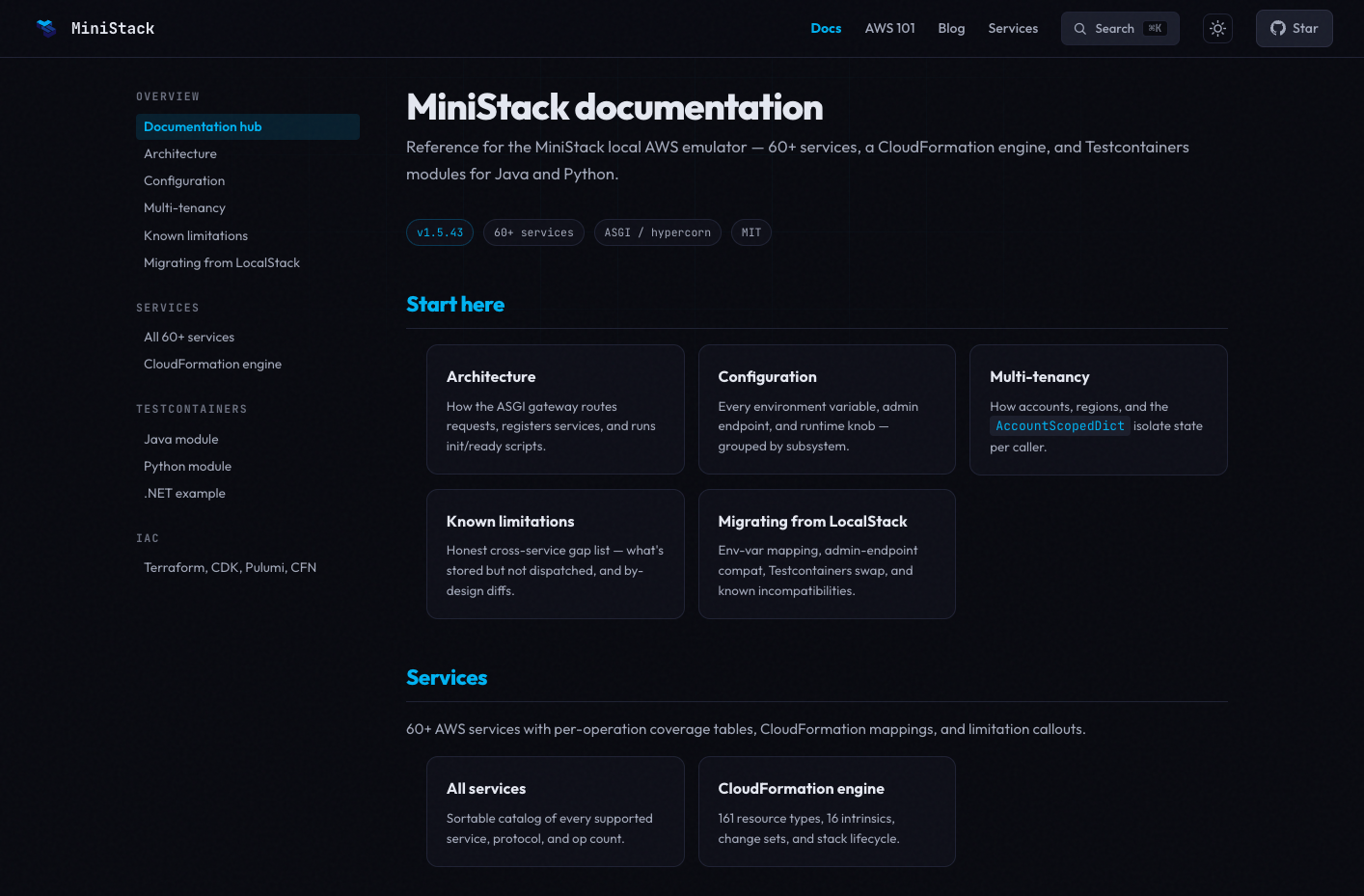
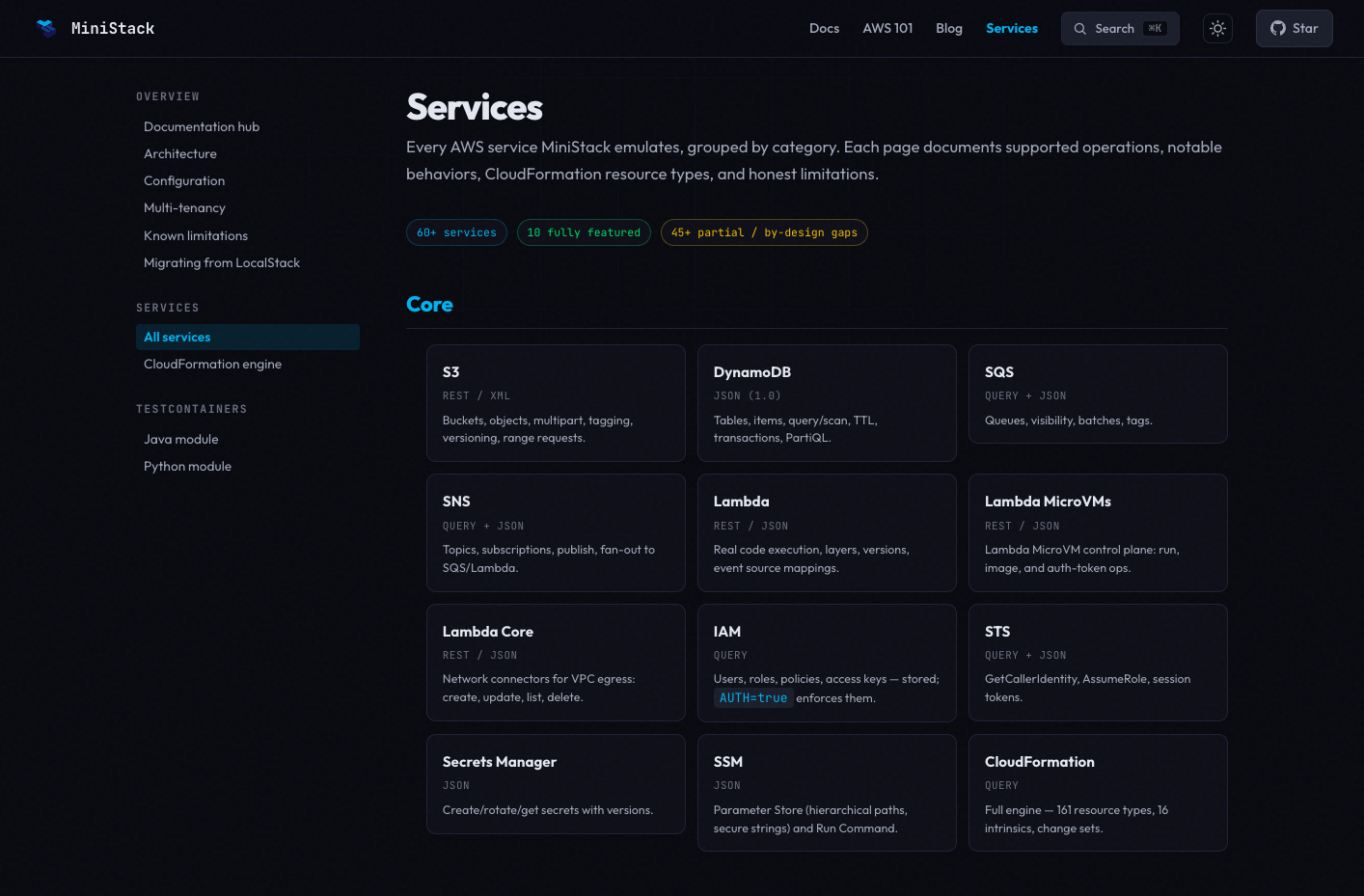
MiniStack is a free local AWS emulator that lets you build, test, and demo cloud applications without an AWS account, credit card, or surprise invoice. One endpoint on port 4566 answers more than 60 services, including S3, SQS, SNS, DynamoDB with streams, Lambda, IAM, STS, Secrets Manager, SSM Parameter Store, EventBridge, Kinesis, Step Functions with a full ASL engine, and both generations of API Gateway. CloudFormation support covers more than 160 resource types, change sets, and 16 intrinsic functions, so existing Terraform, CDK, and Pulumi projects work after changing only the endpoint URL. Where it matters nothing is faked: RDS launches real Postgres or MySQL containers, ElastiCache starts real Redis, ECS runs real Docker tasks, and Athena executes SQL through DuckDB in the full image. A Bedrock emulation can forward Converse and InvokeModel calls to Ollama, llama.cpp, or vLLM, so AI features get real completions offline. A 12-digit access key becomes an isolated account and the SigV4 region scopes state, which gives you multi-account and multi-region testing on one port. Internal endpoints let tests inspect captured SES emails, SQS messages, and SNS text messages, a reset call wipes every service between runs, init and ready scripts seed resources, and optional state persistence survives restarts. It starts in about two seconds and idles near 30 MB of RAM, which suits CI pipelines and team sandboxes. Running on a dedicated VPS on RepoCloud with guaranteed CPU, RAM, and SSD, full root SSH access, and a browser serial console. MIT licensed.
Benefits
- Free Local AWS Without Accounts
- Run S3, DynamoDB, Lambda, SQS, and 60+ other services against a local endpoint, with no AWS account, license key, or telemetry, so experiments never create a bill.
- Real Databases Behind AWS APIs
- RDS creates actual Postgres or MySQL containers and ElastiCache starts real Redis, so application code talks to genuine databases through the same AWS API calls it uses in production.
- Fast Clean Slate for CI
- The container boots in about two seconds and idles near 30 MB of RAM, and a reset endpoint wipes every service between tests, so pipelines start from known state.
- Drop-In for Existing Tooling
- Point boto3, the AWS CLI, Terraform, CDK, Pulumi, or the Java and Go SDKs at port 4566 and existing infrastructure code applies unchanged, with LocalStack-style health endpoints and environment variables supported.
Features
- Single Port Gateway
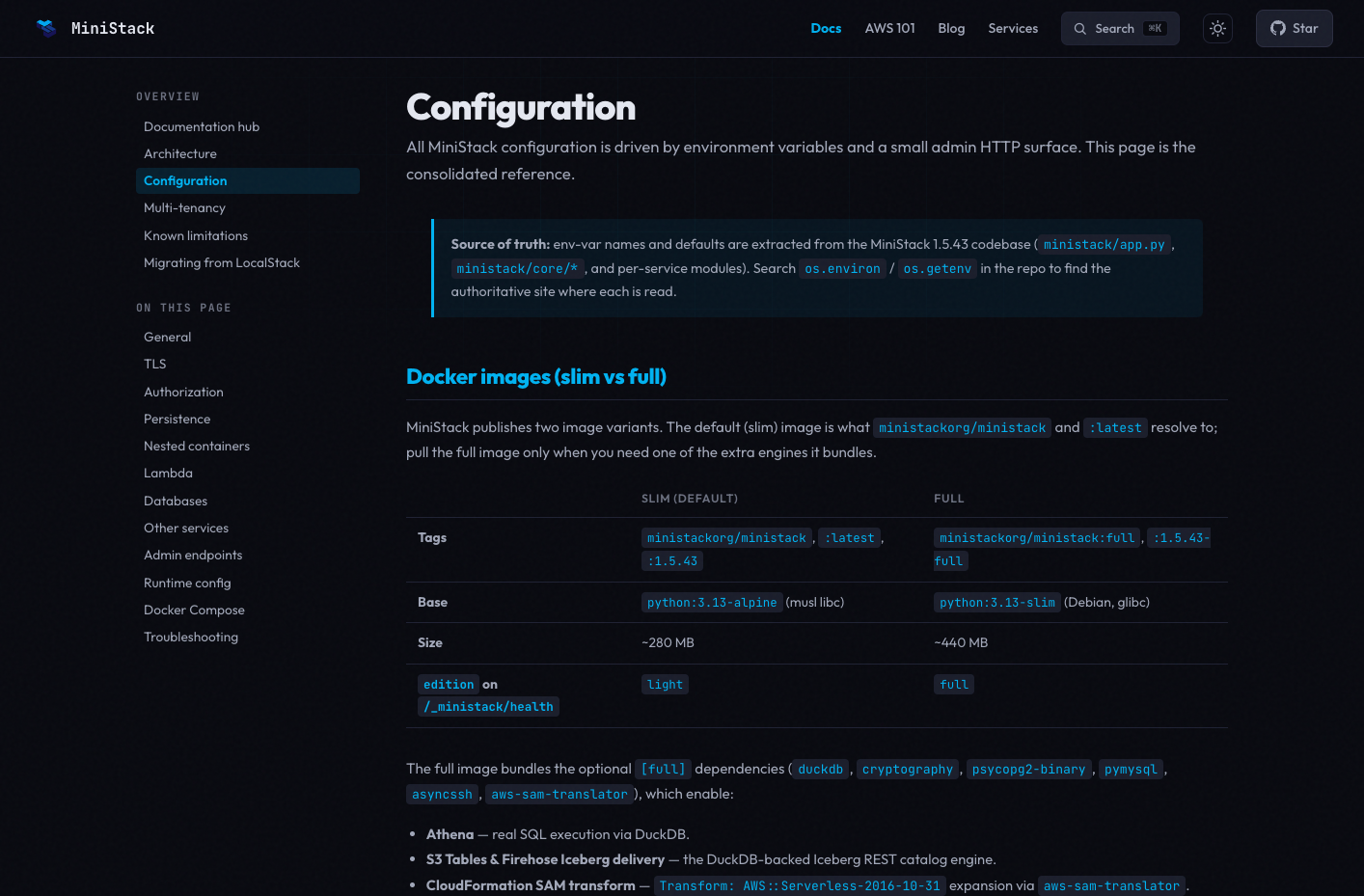
- Every service answers on port 4566 using AWS wire protocols (REST/XML, JSON, and Query), with HTTP/2 support, SigV4 region scoping, and a health endpoint at /_ministack/health.
- Real Container Infrastructure
- RDS, ElastiCache, and ECS start real Postgres, MySQL, Redis, and Docker containers through the mounted Docker socket, while Athena executes real SQL through DuckDB in the full image.
- CloudFormation Engine
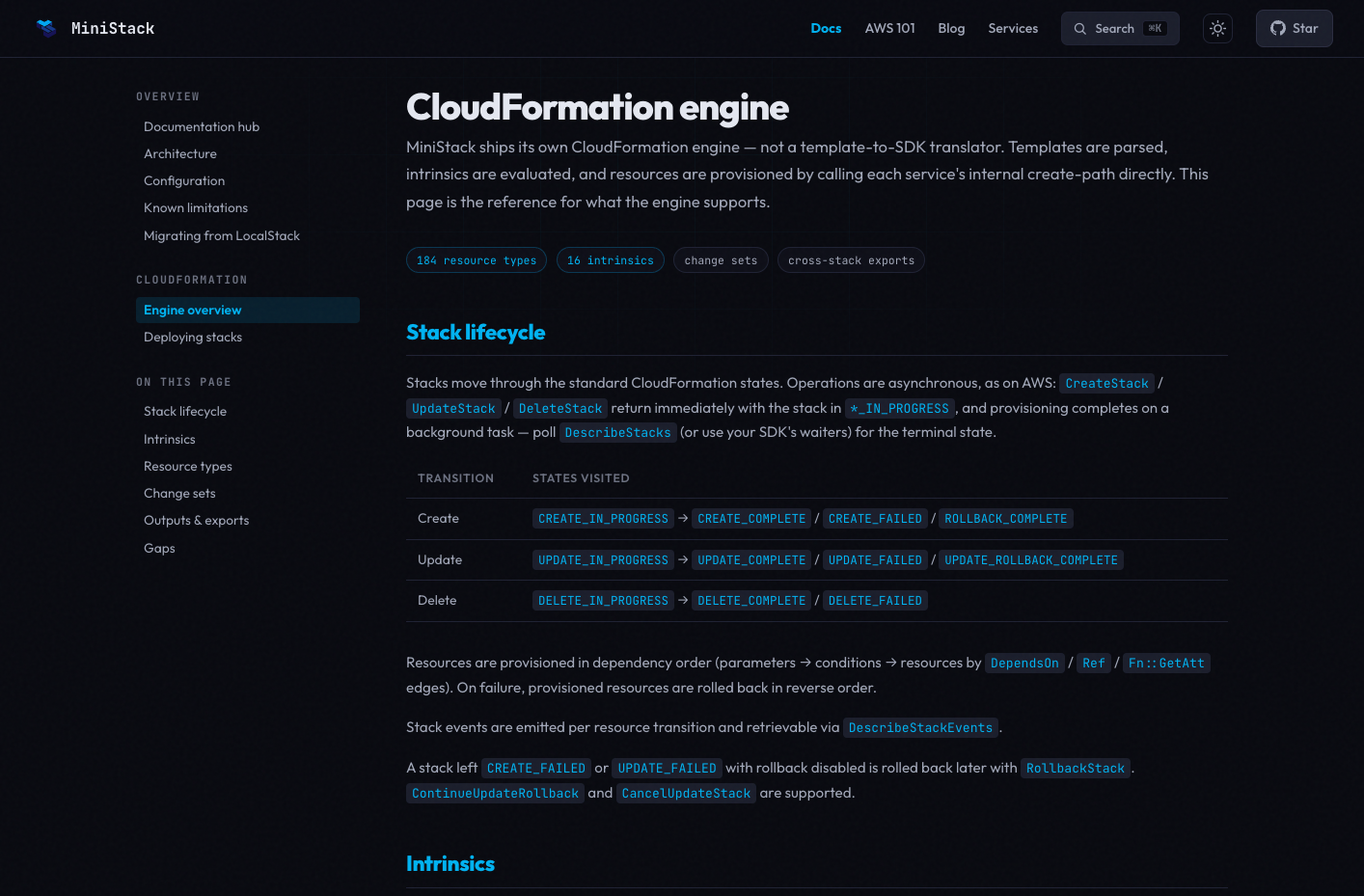
- Stack lifecycle, change sets, rollback, cross-stack exports, YAML and JSON templates, over 160 resource types, and 16 intrinsic functions, so existing templates deploy locally.
- Multi-Account Multi-Region
- A 12-digit access key selects an isolated account and the SigV4 region scopes state, so one endpoint hosts separate tenants and regions just as real AWS does.
- Local Bedrock Proxy
- Bedrock Converse and InvokeModel calls return AWS-shaped responses, and setting MINISTACK_BEDROCK_PROXY_URL forwards them to Ollama, llama.cpp, or vLLM for real model completions without leaving your machine.
- Testcontainers Modules
- Testcontainers modules for Java and Python, including an official Maven Central artifact with JUnit 5 and Spring Boot support, start MiniStack inside automated test suites.