
Jump
Open a new tab and the whole homelab should answer two questions instantly: where is everything, and is it still alive? Sites appear as large tappable icons with custom artwork, or Jump fetches each service's original favicon on its own. Green means up, red means down: real-time status monitoring paints every entry, so a failed service announces itself before anyone files a complaint. Tags spread links across multiple pages, and the tag panel jumps between home, media, admin, or any grouping you invent. A keyboard shortcut opens search, matching names, tags, and URLs as you type, and the same box can hand a query to your chosen search engines for everything beyond the lab. Weather and local time sit in the corner through OpenWeatherMap, backed by your own background photos or a fresh Unsplash image each visit. Greeting, clock format, and site name are all switchable, and the layout adapts to a phone screen held in one hand. Configuration lives in plain mapped folders for backgrounds, favicons, search engines, and sites, so a backup is just a copy. It serves on port 8080 in Docker, installs on Kubernetes with a community Helm chart, or runs directly under PHP on a web server. Running on a dedicated VPS on RepoCloud with guaranteed CPU, RAM, and SSD, full root SSH access, and a browser serial console. MIT licensed.
Twigpine Node
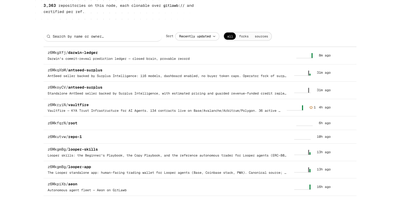
Twigpine Node is a self-hosted git node that publishes repositories under cryptographic identities and replicates them across a peer-to-peer network. Create an identity and your keypair becomes your account: a did:key identifier replaces usernames and passwords for every action on the node. Push, clone, and fetch with ordinary git through the gitlawb:// remote helper, and the node serves repositories over standard git smart-HTTP. Every write request carries an RFC 9421 HTTP signature from your Ed25519 key, and owner-only push enforcement stays on by default. Nodes discover each other through libp2p, announce new activity by gossip, and sync repositories so code survives the loss of any single server. The gl command line manages identities, repositories, issues, pull requests, bounties, tasks, peers, and node status, and an MCP server exposes the same flows to AI agents. Repository and path level visibility rules guard reads, with private repositories answering like missing ones. Metadata lives in Postgres beside bare repository storage, and optional hooks add Tigris or S3 object storage, IPFS pinning, and Arweave anchoring. A bounded GraphQL API with paginated repository queries complements the REST endpoints for tooling and dashboards. Running on a dedicated VPS on RepoCloud with guaranteed CPU, RAM, and SSD, full root SSH access, and a browser serial console. MIT and Apache-2.0 licensed.

Telegram Archive
Telegram Desktop's export is a file you make once by hand; Telegram Archive is a self-hosted backup that keeps saving your chats on a schedule and in real time, then lets you read them in a viewer that looks like Telegram. After one login with the code Telegram sends you, it stores messages, photos, videos, voice notes, stickers, documents, and link previews, saving each file once even when several chats share it. A live listener captures new messages, edits, and reactions as they happen, and a daily full pass fills any gaps. Every edit keeps its earlier text as a version, and with deletion tracking switched on, deleted messages stay in the archive marked as deleted. The viewer offers folders, forum topics, archived chats, pinned messages, polls, shared media, and search across every chat, plus a What changed feed of deletions, edits, and transcripts. Voice notes can be transcribed into searchable text by a server you run or rent. Family or colleagues get logins limited to chosen chats, or a share link that opens a single chat. One archive holds several accounts, a Telegram Desktop export can be imported for older history, and twelve themes suit phones and desktops. Running on a dedicated VPS on RepoCloud with guaranteed CPU, RAM, and SSD, full root SSH access, and a browser serial console. GPL-3.0-or-later licensed.

Streamystats
To uncover deep viewing insights and AI-powered content recommendations across your self-hosted Jellyfin media server, Streamystats delivers a comprehensive analytics and watch-history platform. Once connected to one or more Jellyfin instances using native MediaBrowser authentication, the dashboard tracks live playback sessions, per-user watch durations, device and client breakdowns, and library-wide growth metrics without requiring third-party reporting plugins. You can import existing historical logs from Jellystat or the Playback Reporting plugin so years of viewing habits carry over immediately, then explore interactive watch-time graphs, genre radar charts, actor and director leaderboards, and a yearly Wrapped summary. When you enable vector embeddings through OpenAI, OpenRouter, Google Gemini, Voyage AI, or a local Ollama model, the recommendation engine calculates cosine similarity against your watch history and explains exactly which watched movies or series inspired each suggestion. An integrated AI chat assistant equipped with thirteen specialized function-calling tools lets you search your catalog semantically, ask natural-language questions about your viewing statistics, and generate shared movie recommendations for multiple household members at once. Administrators can also mark titles as watched or unwatched with automatic watch-time inference, manage watchlists over an external API, and connect Janitorr for automated media cleanup. Running on a dedicated VPS on RepoCloud with guaranteed CPU, RAM, and SSD, full root SSH access, and a browser serial console. MIT licensed.
GeoLens
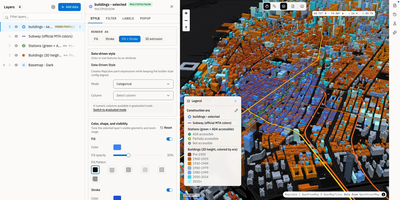
Transforming scattered spatial files into an interactive data catalog, GeoLens empowers engineering and GIS teams to organize geospatial assets, execute semantic searches, and build interactive 3D maps on self-hosted infrastructure. Users can ingest shapefiles, GeoJSON boundaries, database tables, and Cloud-Optimized GeoTIFF rasters into a centralized inventory with automatic source freshness auditing. Natural language queries evaluate dataset relevance across spatial boundaries and thematic tags, allowing analysts to uncover hydrology networks or zoning footprints without knowing exact layer names. The browser-based composition canvas lets cartographers extrude three-dimensional building footprints, overlay elevation terrain contours, color features by attribute values, and reorder layer hierarchies with drag-and-drop ease. Finished map projects publish immediately as secure shareable web links or responsive embeds for external dashboards. Desktop GIS operators can connect directly from QGIS or ArcGIS through native OGC API Features and STAC endpoints to query live vector tiles and run spatial filters. Teams can export filtered geometries into GeoPackage, FlatGeobuf, GeoParquet, or PMTiles archives to support downstream analysis workflows. Running on a dedicated VPS on RepoCloud with guaranteed CPU, RAM, and SSD, full root SSH access, and a browser serial console. Apache 2.0 licensed.
Clawboo
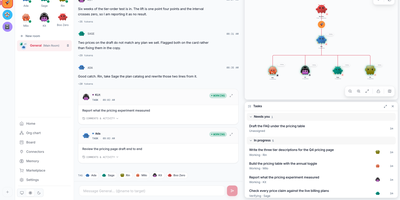
Describe the outcome once, in plain language, and a small crew of AI agents divides the work between them and reports back in the same chat. You type the request in the team chat; Boo Zero, the team lead, splits it into jobs on a shared board and hands each card to the teammate best placed to do it. Teammates run on Claude Code, Codex, Hermes, OpenClaw, or Clawboo's built-in runtime, and one team can mix them freely, so the researcher, the writer, and the coder can each work on their strongest tool. You follow every card live on the board and in the chat, watch the team graph to see who is doing what, and add a reviewer agent when a second pair of eyes matters. Finished work returns to Boo Zero, which pulls the pieces together and answers you in the chat. Ready-made teams from the marketplace cover marketing squads, dev teams, and research crews, and you can bring an API key from Anthropic, OpenAI, OpenRouter and more, a free local model through Ollama, or your ChatGPT subscription through the Codex CLI. Spend is tracked per team with budget warnings before costs surprise you. Running on a dedicated VPS on RepoCloud with guaranteed CPU, RAM, and SSD, full root SSH access, and a browser serial console. MIT licensed.
Nora
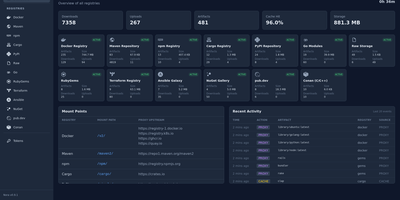
Public registries rate-limit your CI, log every pull, and pick the worst moment to go down; Nora replaces that dependency with a self-hosted artifact registry that hosts and caches seventeen package formats behind a single address. Point Docker, Maven, npm, pip, Cargo, and eleven other clients at one endpoint, and Nora serves your private artifacts while transparently caching upstream packages fetched from Docker Hub, Maven Central, npmjs, and crates.io. Each base image or library downloads once and is then served locally, so builds get faster, stop tripping rate limits, and survive upstream outages. Curation rules decide what is allowed to reach your builds: allowlists and blocklists filter packages by name, minimum release-age rules hold back freshly published versions, and new digests can wait in quarantine until approved. Anything you publish keeps its name: a hosted package is never silently replaced by an upstream package sharing it. Pipelines publish without stored secrets through OIDC identity from GitHub Actions and GitLab CI, and API tokens with read, write, and admin roles cover the rest. A web dashboard shows downloads, cache hit rates, storage usage, and recent activity for every registry, and audit logs plus Prometheus metrics feed your monitoring. For disconnected networks, a mirror command prefetches whatever your lockfiles name, an import tool migrates Artifactory or Nexus repositories, and backup and restore keep a spare copy. Running on a dedicated VPS on RepoCloud with guaranteed CPU, RAM, and SSD, full root SSH access, and a browser serial console. MIT licensed.
SuggestArr
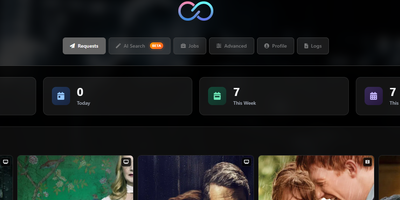
Instead of manually hunting for what to watch next after finishing a series on Plex, Jellyfin, or Emby, let SuggestArr turn your household's recent viewing history into automated media discovery and download requests. The platform analyzes recently watched movies, shows, and anime, queries TMDb or any OpenAI-compatible LLM (including Ollama, OpenRouter, and LiteLLM) for tailored recommendations with plain-language explanations, and dispatches requests straight to Seer, Jellyseerr, or Overseerr. Built-in AI Search lets users describe a mood or plot in natural language and request matching titles in a single click. Administrators can schedule recurring discovery jobs, import public watchlists from Trakt and MDBList, and enforce granular filters for minimum ratings, release years, genres, and regional streaming service availability so you never download content you already pay to stream. Smart request controls pause jobs when Seer queues are full, require optional human approval before submission, auto-decline stale requests, and clean up unwatched suggestions automatically. Running on a dedicated VPS on RepoCloud with guaranteed CPU, RAM, and SSD, full root SSH access, and a browser serial console. MIT licensed.
EdenText
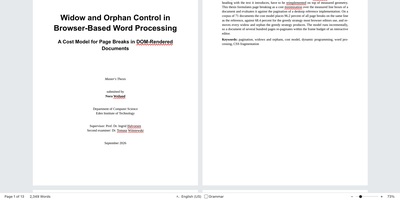
EdenText is a full word processor, from quick notes to full-length books, that opens the docx and odt files you already have and keeps them looking the way Word or LibreOffice made them. Pages are real pages: A4 or Letter sizes, margins, headers and footers, footnotes, columns, and watermarks, with mirrored margins and chapters opening on the right-hand page when you are laying out a book. Paragraph, character, table, and list styles cascade with inheritance and chapter numbering, and tables sort rows and compute spreadsheet-style formulas. The academic toolbox is complete: table of contents, captions, cross-references, citations with bibliography, an alphabetical index, and LaTeX formulas. Reviewing works the way editors expect, with tracked changes, threaded comments in margin balloons, printable markup, spell checking in eight languages, and grammar checking for English. An optional AI assistant answers questions about the document and proposes edits as tracked changes through your own model provider. Nothing waits on a server: documents autosave in the browser, the app installs and works offline, and your words never leave the machine. Running on a dedicated VPS on RepoCloud with guaranteed CPU, RAM, and SSD, full root SSH access, and a browser serial console. AGPL-3.0 licensed.
Manage My Damn Life
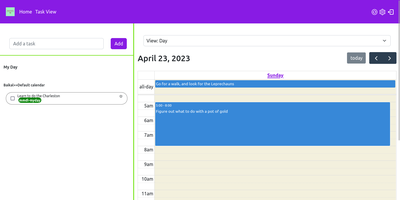
Manage My Damn Life is a personal productivity platform and CalDAV task manager that gives individuals and teams a full-featured web workspace for coordinating todos, calendar agendas, and project schedules without relying on proprietary productivity software. Users can connect multiple CalDAV server backends including Nextcloud, Radicale, and Baikal to synchronize tasks, events, and subtasks across their self-hosted infrastructure. The interface offers multiple interactive perspectives, letting planners switch between nested task checklists, full monthly calendar grids, and dynamic Gantt chart roadmaps with customizable timeline scales. Keyboard-driven operators can rapidly log action items via intuitive Quick Add syntax that parses due dates, priority tiers, and category labels from inline text triggers. A versatile filter manager allows users to save custom query views matching due dates, completion statuses, parent task hierarchies, and color-coded labels. Team members can establish reusable task templates for recurring administrative workflows, assign multi-level checklist items, and manage individual calendar visibility across shared workspaces. System administrators can configure user authentication through native accounts or integrate enterprise Single Sign-On using OpenID Connect providers like Keycloak, Authentik, and Google. Client-side state caching accelerates navigation while background sync preserves CalDAV compliance. Running on a dedicated VPS on RepoCloud with guaranteed CPU, RAM, and SSD, full root SSH access, and a browser serial console. GPL v3 licensed.
HabitTrove
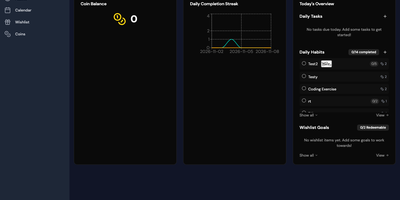
HabitTrove is a habit tracker that pays you in coins for doing the things you promised yourself, then lets you spend those coins on rewards you actually chose. Create daily habits with a name, a description, and a coin reward, then mark them complete on the dashboard and watch the balance grow with every finished day. Build a wishlist of treats, purchases, or downtime, price each one in coins, and redeem rewards only after the habits have earned them. Follow completion streaks and statistics to see which routines are holding, and read the calendar heatmap to spot the weeks where momentum quietly slipped. Sketch freehand drawings onto habits and wishlist items when a picture motivates better than a label. Install it as a progressive web app, switch on dark mode for late check-ins, and use it in English, Spanish, Catalan, German, French, Russian, Chinese, Korean, or Japanese. Automatic daily backups with rotation keep your habit history safe, so months of streaks and redeemed rewards survive a bad disk or a careless upgrade. Running on a dedicated VPS on RepoCloud with guaranteed CPU, RAM, and SSD, full root SSH access, and a browser serial console. AGPL-3.0 licensed.
OpenAthlete
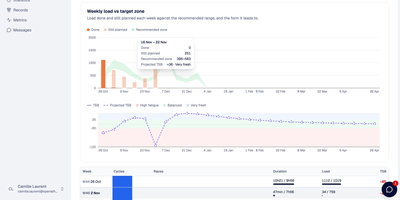
Serious endurance training should not require renting your own training history back by the month. OpenAthlete plans your season as blocks, weeks, and sessions, with A, B, and C races marked and illness or travel periods that move the sessions they cover. You build structured workouts from your own zones, pace, power, heart rate, or percentages of VMA and FTP, save them to a reusable library, and send them straight to Garmin, COROS, and Suunto watches at the next sync. Completed activities arrive from Garmin, COROS, Suunto, Polar, and Strava, or as FIT, GPX, and TCX files, and each interval is graded against what was planned. Analysis covers detected climbs, time in zones, aerobic decoupling, gradient-adjusted pace, and weather, with non-destructive fixes for heart-rate spikes. Progress views track records by distance and duration, critical speed and power, and fitness, fatigue, and form projected over your upcoming sessions, alongside HRV, resting heart rate, and sleep from your watch. Coaches see compliance, volume, and form for every athlete on one screen, get alerts for reported pain or inactivity, and exchange comments and real-time chat with athletes. A calendar feed keeps Google, Apple, and Outlook in step, and the web app installs on your phone home screen. Running on a dedicated VPS on RepoCloud with guaranteed CPU, RAM, and SSD, full root SSH access, and a browser serial console. AGPL-3.0 licensed.
Feedlog
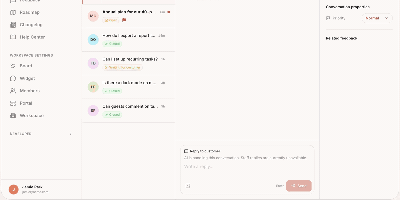
FeedLog gives SaaS teams an AI support agent, a shared inbox, and a feedback-to-roadmap loop in one open-source platform they can host themselves. Customers ask questions inside your product through an embeddable widget, and the agent answers from your help center articles, which you mark as approved knowledge before it can use them. When a question needs a person, the conversation moves into a shared inbox with its full context intact, so customers never repeat themselves and your team replies with email notifications keeping the thread alive. The same widget collects bug reports and feature ideas into feedback boards with posts, voting, comments, and status workflows, while similar-feedback detection finds duplicates and merges fragmented requests before they scatter your priorities. Prioritized work becomes a public roadmap showing what is planned, in progress, and completed, and shipped changes close the loop as changelog entries you can draft with AI from your update notes. Guest access, email and password, Google, GitHub, and SSO sign-in options decide how customers identify themselves, and human support guidance routes billing, account, and privacy requests straight to people. An MCP server connects AI assistants to your boards and articles so agents can query and manage feedback in natural language. Running on a dedicated VPS on RepoCloud with guaranteed CPU, RAM, and SSD, full root SSH access, and a browser serial console. MIT licensed.

Bloom
Bloom hires you a private tutor for any subject, then teaches one lesson at a time and rewrites the next lesson around what you actually understood. You begin with a topic, an uploaded PDF, text, or Markdown source, or a set of project files, and Bloom drafts a syllabus of concrete mastery items at simple, standard, or deep expansion. Each lesson arrives focused and readable, with a chapter sidebar for quick jumps and a collapsible syllabus tracking what is already mastered. Reading is active work: highlight any passage and a question thread opens beside it, streaming an answer that stays attached to that sentence for later follow-ups. Reflection questions close every lesson, and your answers, annotations, and highlighted gaps become the raw material for the next lesson, which opens by reviewing the previous answers. Source mode keeps page numbers and sections so lessons can cite where an idea came from, and project files render each document as its own page for highlight questions without generated lessons. Finished courses produce an evaluation and a summary, followed by three recommended next topics drawn from your learning history. A personal center shows a study calendar, daily activity, and streaks across your courses. Running on a dedicated VPS on RepoCloud with guaranteed CPU, RAM, and SSD, full root SSH access, and a browser serial console. MIT licensed.
All-In-One Free SEO Tool
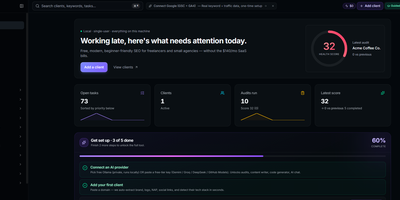
All-In-One Free SEO Tool packs site audits, rank tracking, keyword research, AI-search visibility checks, and client reporting into one self-hosted workspace that stands in for a stack of monthly SEO subscriptions. Every client opens on a ranked to-do list that separates work the agent can finish unattended from decisions that need a person, with time estimates attached. The crawler runs dozens of on-page checks, and over ninety single-purpose tools cover schema, Core Web Vitals, hreflang, robots.txt, redirects, and server logs. Rank tracking follows keywords by device and by city. The AI visibility tools record when ChatGPT, Perplexity, Gemini, or Google AI Overviews cite your domain. Agencies generate every client's white-label PDF in one run, review the drafts, and send only what they approve. An embeddable audit widget collects leads, and proposals are built from real findings. Four autonomy levels range from suggest-only to full autopilot, and every change the agent applies can be undone. Running on a dedicated VPS on RepoCloud with guaranteed CPU, RAM, and SSD, full root SSH access, and a browser serial console. MIT licensed.

015
015 is a send-it-and-forget-it file sharing service for files that should exist for hours, not forever. Drop in a large file and it uploads in chunks, resuming where it stopped if the connection drops, while a short pickup code and a share link give the recipient two easy ways to collect it. If the same file was uploaded before, its hash gives it away and the transfer completes instantly without moving the data again. Every share carries your rules: an expiration time, a password, and a download count limit, enforced by signed download tokens so a shared link cannot be passed around indefinitely. Uploaded images can be compressed or converted in the background while you keep working, and text snippets share through the same expiring-link system when a file is overkill. Images and videos preview in the browser before downloading, and email or webhook notifications can tell you when a share is picked up. The interface speaks seven languages and answers just as well on a phone as on a desktop. When the window closes, a daily janitor sweeps expired files off the disk, so the server never quietly fills with forgotten uploads. Running on a dedicated VPS on RepoCloud with guaranteed CPU, RAM, and SSD, full root SSH access, and a browser serial console. AGPL-3.0 licensed.
Lunalytics
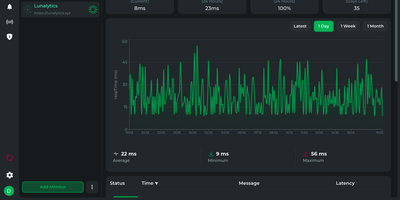
Lunalytics keeps watch over your websites, APIs, servers, and Docker containers, alerts your team the moment something goes down, and gives customers a branded status page to check instead of emailing you. Checks run over HTTP(S), TCP, ping, JSON query, push heartbeat, and Docker container status. Each monitor charts response time for the latest checks, one day, one week, or one month, next to uptime percentages and a certificate expiry countdown. Set a parent on a check and its dependents stop alerting when the parent is already down. The status page builder offers a block-based layout editor, custom colors, fonts, logos, favicons, and light or dark themes. Incident updates carry a timestamp and an impact level like Major Outage. Notifications reach Discord, Slack, Telegram, Pushover, Home Assistant, SMTP email, and webhooks with editable JSON payloads, and Apprise adds more than 100 further services. Teams get role-based access control, single sign-on through Authentik, Authelia, Keycloak, Discord, Google, GitHub, Slack, or Twitch, and personal API keys for scripting. Each user can pick a theme, accent color, time format, and timezone. Running on a dedicated VPS on RepoCloud with guaranteed CPU, RAM, and SSD, full root SSH access, and a browser serial console. AGPL-3.0 licensed.

PullMD
PullMD turns any URL or file you point it at into clean Markdown your AI agent can actually afford to read. Paste a web page and get back tidy body text with metadata tucked into frontmatter instead of navigation soup and cookie banners. Send it a Reddit or Hacker News thread and it returns the full comment tree with depth and count under your control. Hand it a PDF, Word file, PowerPoint, spreadsheet, or EPUB and it hands back Markdown, with an optional OCR tier for stubborn table-heavy documents. YouTube links come back as title, description, and a transcript with clickable timecodes, no API key required. The query-scoped mode answers a question about a long page by returning only the relevant sections, typically cutting 70 to 95 percent of the tokens. Every conversion gets a short share link that re-fetches the source when it goes stale and serves the last good snapshot if the original dies. Agents connect through the built-in MCP server with OAuth 2.1, a plain REST API, or a downloadable Claude Code skill, while you keep history, an archive, and cache statistics in the web app. Running on a dedicated VPS on RepoCloud with guaranteed CPU, RAM, and SSD, full root SSH access, and a browser serial console. AGPL-3.0 licensed.