LibreDesk
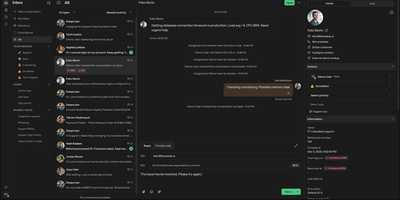
LibreDesk unifies live chat, email, and future channel integrations into a single agent inbox where every customer conversation converges regardless of origin, replacing per-seat-priced tools like Zendesk, Intercom, and Freshdesk with a zero-cost alternative that has surpassed 2,000 GitHub stars. Built on a Go backend with a Vue.js 3 and ShadcN UI frontend, it ships as a single binary requiring only PostgreSQL and Redis. The embeddable live chat widget drops onto any website with a snippet, while the AI assistant handles initial customer queries using answers grounded in your knowledge base before escalating to human agents when needed. Agent copilot drafts replies, summarizes conversation threads, and rewrites messages for tone adjustment directly within the inbox interface. Automation rules trigger on conversation events to tag, assign, and route tickets based on configurable conditions, while auto-assignment distributes workload by agent capacity or custom criteria. SLA management tracks response and resolution time targets with breach notifications, and automated CSAT surveys measure satisfaction after conversation closure. Macros save frequently sent responses as reusable templates that simultaneously set tags and assign conversations. Role-based access control provides granular per-action permissions for teams and individual agents, and SSO supports Google, Microsoft, and any OIDC provider. The HTTP/JSON API and webhook system enable custom integrations with external tools. Running on a dedicated VPS on RepoCloud with guaranteed CPU, RAM, and SSD, full root SSH access, and a browser serial console. AGPL-3.0 licensed.
AnythingLLM
Chat with your own documents: AnythingLLM, from Mintplex Labs, wraps retrieval-augmented generation (RAG) in an open-source application anyone can run. You organize content into workspaces, each an isolated namespace with its own documents, vector embeddings, chat history, and settings, so one instance can hold several separate knowledge bases. Upload PDFs, DOCX, TXT, and other formats, or scrape web pages; the built-in collector parses and chunks them into a vector database (LanceDB by default, with Pinecone, Chroma, Qdrant, and others supported). Answers cite their source documents. It works with both cloud LLMs (OpenAI, Anthropic, Gemini) and local ones via Ollama or LM Studio, and the embedding model is separately configurable. Beyond RAG chat, it includes AI agents that can browse the web and run tools, an embeddable chat widget for your website, a developer API, and multi-user mode with admin, manager, and default roles plus per-workspace access control. Context assembly is smarter than naive RAG: pinned documents, attached files, vector search hits, and recent chat history are combined under a token budget so the model's context window is filled efficiently, and each workspace supports multiple independent conversation threads against the same knowledge base. Because the embedding model, vector store, and chat LLM are all independently swappable, you can move between providers without re-ingesting a single document. The stack is Node.js with a React frontend, MIT-licensed.
Open WebUI
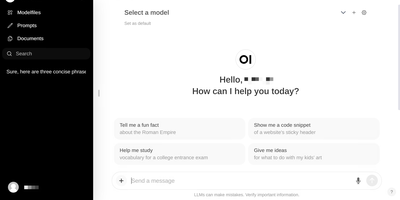
Large language models get a polished front end that can run fully offline: Open WebUI is the self-hosted front end of choice. It talks to local model runners, primarily Ollama, and to any OpenAI-compatible API, so LM Studio, vLLM, Groq, Mistral, OpenRouter, and cloud providers all plug into the same chat interface and can be mixed per conversation. RAG is built in: upload files to knowledge bases or reference them in chat with the # command, backed by a choice of nine vector databases (ChromaDB and PGVector officially maintained) and multiple extraction engines including Tika and Docling, with hybrid BM25-plus-vector search and cross-encoder reranking. Web search results from providers like SearXNG, Brave, and Tavily inject directly into conversations. Extensibility comes from Python tools and functions that run inside the chat, a Pipelines plugin framework, and native MCP support. Multi-user features include RBAC, SSO, and group permissions, and the instance itself exposes an OpenAI-compatible API your own apps can call.
Agenticos
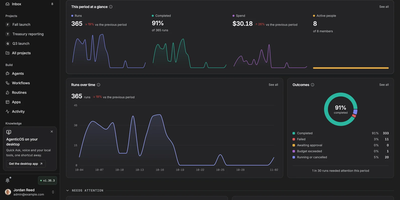
Give each team an AI teammate that works where the team already works: AgenticOS lets colleagues and agents share one live chat and the same project files, so an agent can answer in the thread, apply a correction from a reply, and show its work as it writes. You build an agent in the browser by writing its instructions, picking a model, and switching on tools, then publish it to web chat, Slack, Teams, Discord, Mattermost, Telegram, a website widget, or an API. Agents analyze spreadsheets, run code in a sandbox, browse the web in a browser you can watch and take over, and hand programming work to Claude Code or Codex. Company knowledge comes from uploaded documents and synced drives, searched with cited answers, while reusable skills teach agents how your team writes reports, reviews code, or researches a market. Agents can draw charts and diagrams in chat and publish dashboards as apps with stable links your team opens anywhere. Administrators set roles and department groups, cap each agent's monthly budget, require approval for sensitive tools, and read a recorded run history with costs. Running on a dedicated VPS on RepoCloud with guaranteed CPU, RAM, and SSD, full root SSH access, and a browser serial console. Apache-2.0 licensed.
Nod
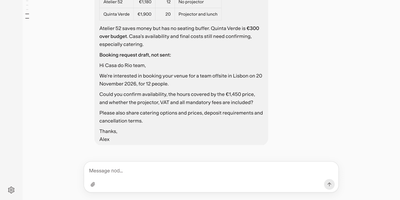
Nod is a personal AI assistant with its own computer, so you can hand it an errand like chasing an unpaid invoice or cancelling a trial and watch it finish the job on real websites. One ongoing conversation follows you from the browser to Telegram and WhatsApp, and long jobs become saved tasks with live status lines on a Scheduled page. Connect Gmail, Calendar, Slack, Notion, Linear, or an n8n instance, and it reads threads, drafts the replies you owe, and prepares a one-page brief before each call. Every action that could change something is checked against your rules, and anything uncovered waits for your yes. Passwords, codes, and cards sit in a Vault that the server types into websites, so the model never sees them. Memory notes are visible, editable, and tied to the message they came from. Schedules run recurring checks like a weekly recap or a price watch that speaks up only on change. Usage lists every action with costs and a monthly spending limit. Pick OpenAI, Anthropic, Gemini, OpenRouter, Bedrock, or a local Ollama server as the model. Running on a dedicated VPS on RepoCloud with guaranteed CPU, RAM, and SSD, full root SSH access, and a browser serial console. Apache-2.0 licensed.
Colanode
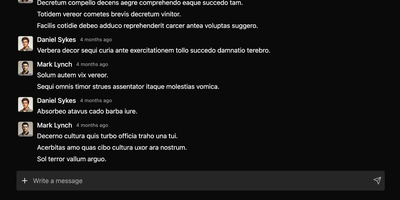
With nearly 5,000 GitHub stars and a Hacker News launch that garnered 147 points, Colanode delivers the first genuinely local-first alternative to both Slack and Notion in a single self-hosted workspace — writing every operation to a client-side SQLite database before syncing to your server, so teams work at full speed offline, on planes, or through intermittent connections without ever losing a draft. The real-time chat system provides channels and direct messages with instant delivery via WebSocket, while the rich text editor offers Notion-style block-based pages for documents, wikis, meeting notes, and knowledge bases with headings, code blocks, embeds, and nested hierarchies. Customizable databases organize structured data with custom fields and three dynamic views — table for spreadsheet-style browsing, kanban for visual workflow boards, and calendar for time-based planning. Conflict-free Replicated Data Types powered by Yjs handle concurrent editing across pages and database records: multiple users modify the same document simultaneously and the system merges changes automatically without manual conflict resolution. File management supports upload, sharing, and organization within workspaces using pluggable storage backends including local filesystem, S3-compatible services, Google Cloud Storage, and Azure Blob Storage with TUS resumable uploads for large files. The server runs Fastify with Zod validation on Node.js 20+, persists to PostgreSQL with pgvector extension, uses Redis for event broadcasting, and deploys via a single Docker image. Running on a dedicated VPS on RepoCloud with guaranteed CPU, RAM, and SSD, full root SSH access, and a browser serial console. Apache-2.0 licensed.
OpenAgent
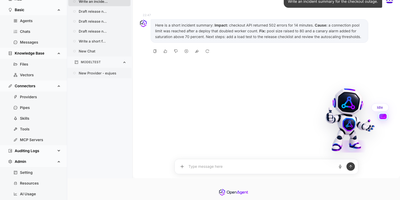
Chat, research, and everyday chores all run through OpenAgent, a private AI assistant hosted on a server you control. Pick from more than thirty model providers, including OpenAI, Anthropic, Gemini, DeepSeek, and local Ollama models, and switch models inside a conversation. Agents can drive a real browser, search the web, run shell commands, read and write Word, Excel, and PowerPoint files, and call any MCP server. Every tool call shows its arguments and result. Upload PDFs and spreadsheets to build isolated knowledge bases with semantic search, then attach them to a chat. A drag and drop workflow builder chains steps with branches, parallel tasks, and schedules. The admin console tracks token use and cost per user and model with charts and a message heatmap, lists every tool, records audit logs, and shows live CPU, memory, and API latency. Single sign-on through OIDC, OAuth2, LDAP, or SAML and separate workspaces keep teams apart, and a REST API with Swagger docs exposes every feature. Running on a dedicated VPS on RepoCloud with guaranteed CPU, RAM, and SSD, full root SSH access, and a browser serial console. Apache-2.0 licensed.
Text Generation Web UI
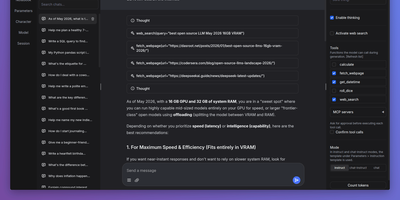
Your prompts never have to leave the building: TextGen runs open large language models on your own hardware behind a chat interface and an API that speak fluent OpenAI. Load GGUF or Hugging Face weights through llama.cpp, ik_llama.cpp, Transformers, ExLlamaV3, or TensorRT-LLM, and switch models or backends from the interface without restarting the server. Chat mode gives you conversations with characters and system prompts, notebook mode behaves like a familiar completion editor, and both accept image attachments for vision models and documents for context. Models that support tool calling can search the web, fetch pages, and do math through single-file Python tools, and MCP servers plug in for larger tool catalogs. Start it with the API flag and the same model answers at chat, completions, and messages endpoints that mirror OpenAI and Anthropic, complete with streaming, logprobs, embeddings, and optional API key authentication. Portable builds for Linux, Windows, and macOS bundle every dependency, so the distance from download to a running model is an unzip and one shell command. Because everything is local, prompts, documents, and outputs stay on machines you control, and parallel request handling lets a single loaded model serve a whole team's tools at once. Running on a dedicated VPS on RepoCloud with guaranteed CPU, RAM, and SSD, full root SSH access, and a browser serial console. AGPL-3.0 licensed.
Typebot
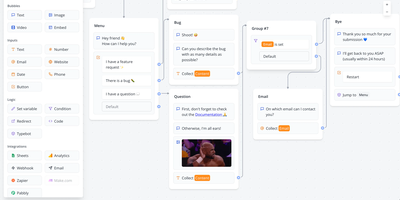
A fair-source chatbot and conversational-form builder: Typebot assembles conversations in a visual graph editor. In a visual graph editor you chain blocks from four categories: bubbles display text, images, video, audio, and embeds; inputs collect data through text fields, email, phone, buttons, picture choices, date pickers, file uploads, and Stripe payments; logic blocks handle conditional branching, variables, URL redirects, A/B testing, and custom JavaScript; integration blocks call webhooks, OpenAI, Google Sheets, Google Analytics, Meta Pixel, Zapier, Make, and Chatwoot. Build once, deploy anywhere: custom domains, WhatsApp, or embedded in any site as a container, popup, or chat bubble through a fast native JS library with no iframe and no external dependencies - plus an HTTP API for executing bots programmatically from any language. Theming covers fonts, colors, roundness, and shadows with custom CSS and reusable templates, and results arrive in real time with drop-off and completion analytics plus CSV export. Two Next.js apps (builder and viewer) self-host via Docker under the Functional Source License, which converts to Apache 2.0 after two years.
Botpress
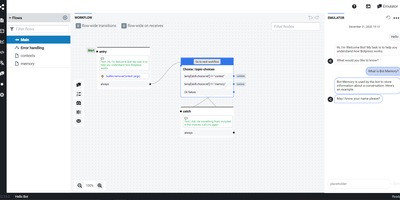
Build, deploy, and monitor chatbots and LLM-powered agents on one open-source conversational AI platform: Botpress. Its Studio is a visual development environment: a drag-and-drop canvas arranges conversation logic with nodes for messages, questions, choices, and actions, while a built-in emulator simulates conversations for debugging before anything goes live. Agents ground their answers in a knowledge base assembled from uploaded documents, ingested websites, and past conversations via retrieval-augmented generation, and the LLM layer connects to multiple model providers - GPT-4, Claude, Mistral - with a configurable model strategy. An autonomous engine handles reasoning, tool orchestration, persistent memory across sessions, and sandboxed code execution, and custom code actions in TypeScript extend agents past prebuilt workflows. Over 100 integrations deploy the same bot to WhatsApp, Telegram, Slack, Microsoft Teams, and web chat, and connect it to HubSpot, Zendesk, Zapier, and arbitrary APIs and webhooks. Human handoff, conversation analytics, and quality monitoring cover production operation. Originating in 2017 from a Montreal team, the community edition is developed openly on GitHub.
OvertChat
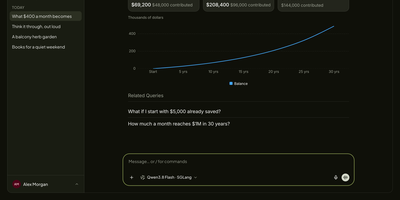
Your household gets one private chat front door for the models you already run, local or hosted, with voice, search, and coding agents included from the same server. Point it at Ollama, vLLM, llama.cpp, SGLang, or LM Studio, then add OpenAI, Anthropic, Gemini, DeepSeek, Bedrock, or OpenRouter beside them. Models that support tools can answer with charts, tables, forms, and follow-up buttons instead of plain paragraphs. Ask for a live conversation and speak, hear the reply, cut in mid-sentence, and keep going; Parakeet handles recognition and Kokoro speaks back on CPU or GPU. Documents open beside the chat for drafting and revising Markdown, code, web pages, SVG, and Mermaid diagrams. Attach spreadsheets, PDFs, images, Word, Excel, CSV, or source files and run Python on them in an offline sandbox that returns charts, cleaned data, or finished documents. Search the web through bundled SearXNG or Brave, read pages with inline citations, connect MCP servers, and set thinking controls per local model. Replies keep streaming after you close the tab, full-text search finds old answers, and read-only links share a conversation. Coding agents run on your machines or over SSH and stay reachable from browser, desktop, Android, or iOS. Running on a dedicated VPS on RepoCloud with guaranteed CPU, RAM, and SSD, full root SSH access, and a browser serial console. MIT licensed.
Rocket.Chat
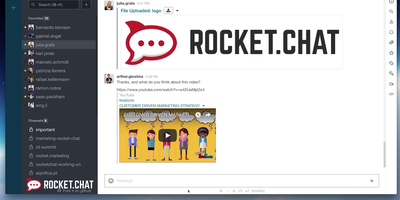
Blast off into productivity space with Rocket.Chat SIX, the ultimate team collaboration cosmos! Imagine a place where your messages, tasks, and projects all live in harmony, orbiting around your team's efficiency like a well-organized galaxy. This isn't just any old chat platform; it's a customizable universe where you're the master of your data domain, with the power to tweak, integrate, and innovate to your heart's content. Ready to provide stellar customer service? Engage with your clients in a way that's so contextually on-point, they'll feel like you're mind-reading across the cosmos. Plus, with a chat engine that's like a gravitational pull for user engagement, your app or website will become the center of your users' universe. And for the security-conscious space cadets, fear not! Rocket.Chat SIX is locked down tighter than a spaceship hatch, with end-to-end encryption and a buffet of deployment options to satisfy your security appetite. All this, hosted on RepoCloud, where the cost is as lightweight as zero-gravity. So why settle for a terrestrial tool when you can have a celestial experience? Rocket.Chat SIX: because your team deserves to collaborate in a universe that's light-years ahead!
QwenPaw
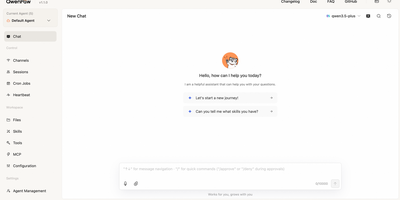
Designed as a unified personal AI workstation, QwenPaw operates as an autonomous digital copilot that coordinates scheduled automations, interactive coding sessions, and multi-channel team communication across everyday messaging apps. Users can dispatch long-running research tasks, process office documents including PDF, Excel, and Word files, and execute browser-based data collection without manual intervention. The built-in web console and terminal interface provide full visibility into agent reasoning, allowing operators to inspect intermediate thinking steps, review proposed file edits, and approve sensitive tool calls. Through direct connectors for Discord, Telegram, DingTalk, Lark, and WeChat, teams can trigger specialized skills or query shared workspaces directly from their existing group channels. A self-evolving personal memory system continuously indexes chat interactions and local resources into editable Markdown files, ensuring knowledge persists across restarts and task delegations. Built-in guardrails including a sandboxed execution runtime, tool access policies, and automated skill scanners protect underlying host files from unauthorized modifications during autonomous scripting runs. Running on a dedicated VPS on RepoCloud with guaranteed CPU, RAM, and SSD, full root SSH access, and a browser serial console. Apache 2.0 licensed.
Hollama
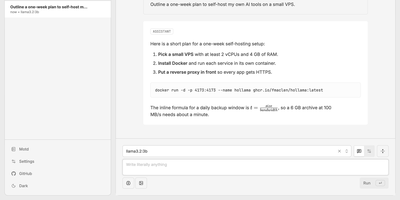
A tidy, account-free chat client for every language model server you run. Ollama, the OpenAI API, and OpenAI-compatible servers like llama.cpp plug in side by side, and each of their models appears in one picker. Prompts accept images for vision models, and answers render Markdown, highlighted code, and KaTeX formulas. Reasoning models keep their thinking in a separate panel from the final answer. Messages can be edited, retried, or copied, and the session panel holds a system prompt plus Ollama options for temperature, Top K, Top P, and seed. Knowledge notes, written in a built-in code editor, attach to a session as reusable context. The Settings page pulls new Ollama models by tag, labels each connection, and filters model names by prefix. Tabs stay in sync, themes switch between light and dark, and the interface is translated into many languages. Servers, preferences, sessions, and knowledge export and import as files. Nothing sits in a cloud database, because history lives in the browser of whoever opens it. A single Docker container on port 4173 serves a whole team. Running on a dedicated VPS on RepoCloud with guaranteed CPU, RAM, and SSD, full root SSH access, and a browser serial console. MIT licensed.
KoboldCpp
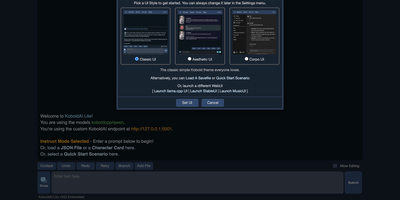
One file runs your own language model and serves it to any browser tab. KoboldCpp loads GGUF models on CPU or GPU. A web UI opens on port 5001. OpenAI, Ollama, Anthropic, and KoboldAI style endpoints answer every app that expects a cloud API. The bundled KoboldAI Lite interface covers chat, instruct, story, and adventure modes in Classic, Messenger, Aesthetic, and Corpo themes, with memory, world info, author's notes, character cards, scenarios, and saveable sessions. A llama.cpp style chat interface and interactive API documentation share the same port. Add a vision projector and the model reads images. Load Stable Diffusion, Flux, or video models for pictures and clips, Whisper for transcription, and Kokoro or Qwen3TTS for spoken replies. Tool calling, web search, retrieval over your own documents, an MCP bridge, and a built-in agent for editing code come included. Context size, GPU layers, batch size, and samplers including DRY and XTC are set from the launcher or the command line. A no-model option points it at a remote provider instead. An API key protects the endpoint before it faces a network. Running on a dedicated VPS on RepoCloud with guaranteed CPU, RAM, and SSD, full root SSH access, and a browser serial console. AGPL-3.0 licensed.
Nakama
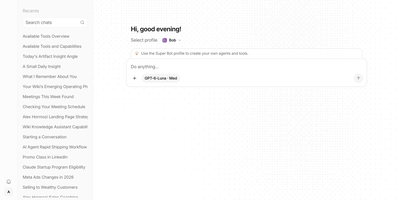
Nakama gives your whole team a shared home for AI agents, where each agent has its own identity, memory, tools, and permissions and meets people where they already talk. The dashboard feels like a familiar chat app: pick an agent from the rail, start a conversation, and watch it use tools, recall memory, and reply inside Telegram, WhatsApp, Discord, or Slack when the work lives there. Every agent is configured as a small personality you can read and edit, with prompt files for its soul, style, instructions, and memory, plus tabs for its channels, tools, MCP servers, and skills. One server hosts many organizations with invites and roles, and agents stay isolated from each other so the support agent never wanders into the finance agent's toolbox. The control center manages workspace settings, model providers, plugins, and integrations, and a connector layer opens the door to more than a thousand external apps. Daily encrypted backups and an in-app update button keep operations boring, and the entire platform idles in about two hundred megabytes inside a single container. Running on a dedicated VPS on RepoCloud with guaranteed CPU, RAM, and SSD, full root SSH access, and a browser serial console. MIT licensed.
Lobe Chat
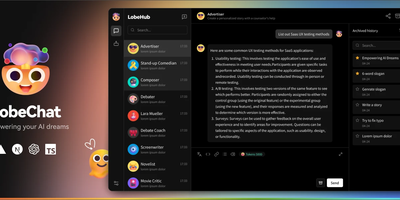
A private ChatGPT built with Next.js: Lobe Chat is the open-source AI chat interface teams self-host instead. Its main advantage is provider breadth: one interface connects to 40+ model providers, including OpenAI, Anthropic Claude, Google Gemini, Mistral, Groq, AWS Bedrock, Azure, and local models served through Ollama, so you can switch models per conversation and compare outputs. It handles multi-modal work: image recognition, image generation, text-to-speech, and speech-to-text. A plugin system based on function calling and the Model Context Protocol (MCP) adds external tools like web search and code execution. Run it in standalone mode as a single container with settings in browser storage, or in database mode with PostgreSQL and S3-compatible storage for persistent history, multi-user auth, and RAG knowledge bases built from uploaded documents with pgvector retrieval. Because tools arrive through function calling and MCP rather than a proprietary plugin format, custom internal tools can be exposed to the assistant with a standard server over STDIO or HTTP. Hundreds of pre-configured assistant roles import from the community marketplace. For teams the cost model matters: provider API keys billed per token typically undercut a ChatGPT Plus seat per person, and self-hosting keeps API keys, uploaded files, embeddings, and conversation history entirely on your own server.
AgentConnect
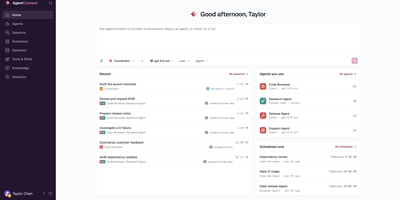
AgentConnect brings Claude Code, Codex, Grok Build, DeepSeek, and any other ACP-compatible coding agent into the chat channels and repositories where your team already works, each with a role of its own. Mention an agent in Slack, Microsoft Teams, Google Chat, Lark, Discord, or Telegram and it replies in the thread, calls on a colleague agent when needed, and keeps its session visible to teammates who can step in. Work can also start from a GitHub, GitLab, Gitea, or Azure DevOps pull request, a Linear issue, a webhook, or a schedule. The web console organizes the fleet into Agents, Sessions, Schedules, Tools and Skills, Knowledge, and Daemons views. Every agent gets its own memory, skills, MCP servers, workspace, and sandbox policy, and reviewed Knowledge pages can be published for all agents to search. Decisions route new conversations to specialist agents and pick the runtime and model for each session. Review bots can run several reviewers with separate instructions on one pull request. Set who may see each agent or session, which repositories it can touch, and which agents it may call. Running on a dedicated VPS on RepoCloud with guaranteed CPU, RAM, and SSD, full root SSH access, and a browser serial console. Apache-2.0 licensed.